
Quick Answer
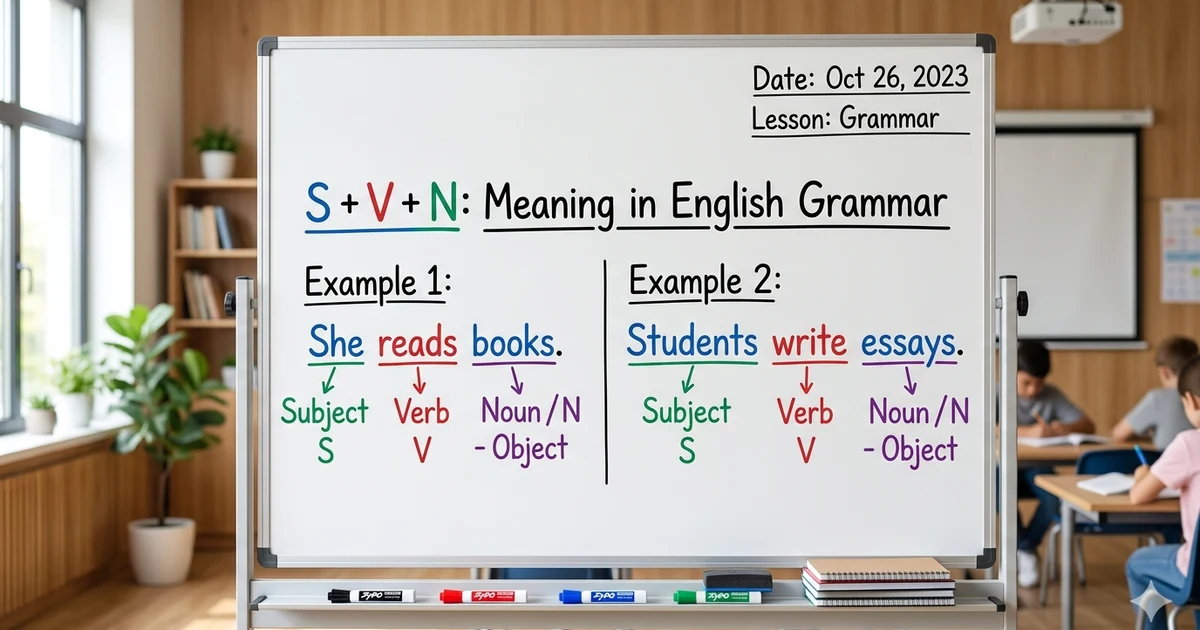
S+V+N is a basic English sentence pattern that stands for Subject + Verb + Noun. It describes how many simple English sentences are structured. In this pattern, the subject performs an action, the verb shows the action, and the noun receives or completes the meaning of the sentence.
For example:
- She reads books.
- Dogs chase balls.
- Students write essays.
People often search for s+v+n when studying English grammar, sentence structure, writing basics, or school level language lessons. The pattern is especially common in beginner grammar classes, ESL learning, and academic writing guides.
Introduction
Many people come across the term s+v+n while studying English grammar, preparing for exams, improving writing skills, or learning sentence construction. At first glance, the abbreviation can look confusing because it uses letters instead of full grammar terms. Once explained clearly, though, it becomes one of the easiest sentence patterns to understand.
The structure s+v+n represents a very common way English sentences are built. The letters stand for Subject, Verb, and Noun. This pattern helps learners understand who is doing the action, what action happens, and what thing or person is connected to that action.
Teachers often use this structure in schools, ESL programs, language apps, and grammar textbooks because it helps students create clear sentences quickly.
Understanding s+v+n also improves writing confidence. It helps students avoid sentence fragments, improve clarity, and recognize how English grammar works in real life. Whether someone is writing essays, sending emails, practicing conversation, or learning English as a second language, this sentence structure appears constantly in everyday communication.
In this guide, you will learn the meaning of s+v+n, how the structure works, common examples, differences from similar sentence patterns, typical mistakes, and practical ways to use it correctly.
What Does S+V+N Mean in Grammar?
In grammar, s+v+n means:
| Letter | Full Meaning | Role in the Sentence |
|---|---|---|
| S | Subject | The person, place, or thing doing the action |
| V | Verb | The action or state |
| N | Noun | The object, person, or thing connected to the action |
The structure follows this basic order:
Subject + Verb + Noun
Here are simple examples:
| Sentence | Subject | Verb | Noun |
| The boy kicked the ball. | The boy | kicked | ball |
| Sarah bought coffee. | Sarah | bought | coffee |
| Birds build nests. | Birds | build | nests |
This sentence pattern is one of the most common structures in English. It creates complete ideas in a direct and easy to understand way.
Why Teachers Use the S+V+N Pattern
Grammar teachers use s+v+n because it simplifies sentence construction for beginners. Instead of explaining advanced grammar immediately, teachers break sentences into clear parts.
This method helps learners:
- Identify the subject quickly
- Understand verb placement
- Recognize nouns and objects
- Build grammatically correct sentences
- Improve reading comprehension
- Write clearer English
The pattern is especially useful for:
- Elementary school students
- ESL learners
- Beginner writers
- Test preparation students
- People learning sentence basics
Many English learning systems introduce sentence patterns before moving into more advanced grammar concepts like clauses, passive voice, or complex sentence structures.
How the S+V+N Structure Works
The s+v+n structure follows a logical sequence.
Subject Comes First
The subject tells the reader who or what performs the action.
Examples:
- Maria
- The dog
- My teacher
- Cars
- Children
Verb Comes Second
The verb explains the action or state.
Examples:
- runs
- eats
- studies
- builds
- watches
Noun Comes Third
The noun often acts as the object receiving the action.
Examples:
- pizza
- homework
- movies
- houses
- music
When combined, the sentence becomes complete.
Examples:
- Maria studies science.
- The dog chased squirrels.
- Children play games.
Common S+V+N Examples in Daily English
The s+v+n pattern appears constantly in everyday speech and writing.
| Sentence | Real Life Situation |
| I drink coffee. | Morning routine |
| Kids play soccer. | School activities |
| She writes emails. | Workplace communication |
| We watch movies. | Entertainment |
| They buy groceries. | Shopping |
These examples show how natural and common the structure is in daily communication.
Difference Between S+V+N and Similar Grammar Patterns
Many students confuse s+v+n with other sentence structures. Understanding the difference makes grammar easier.
| Pattern | Meaning | Example |
| S+V | Subject + Verb | Birds fly. |
| S+V+N | Subject + Verb + Noun | Birds build nests. |
| S+V+Adj | Subject + Verb + Adjective | The soup smells delicious. |
| S+V+Adv | Subject + Verb + Adverb | She sings beautifully. |
The key difference is that s+v+n includes a noun after the verb.
For example:
- She reads.
This is S+V. - She reads books.
This is S+V+N.
The noun books completes the action.
S+V+N in ESL and Language Learning
English learners often study sentence formulas like s+v+n to improve speaking and writing speed. These formulas reduce confusion because learners can focus on structure first before expanding vocabulary.
A beginner might start with:
- I eat rice.
- We watch TV.
- They play games.
Later, the learner can expand sentences:
- I eat rice every evening after work.
- We watch TV together on weekends.
- They play games at the park after school.
The core structure remains the same.
How Students Use S+V+N in Writing
Students frequently use this sentence structure in:
- Essays
- Homework assignments
- Reading exercises
- Grammar worksheets
- Language exams
- Writing practice
Teachers also ask students to identify sentence components.
Example:
Sentence: The cat caught a mouse.
- Subject = The cat
- Verb = caught
- Noun = mouse
This exercise helps learners understand sentence organization more clearly.
Practical Examples of S+V+N Sentences
School Examples
- Students complete assignments.
- Teachers explain lessons.
- Children read stories.
Workplace Examples
- Employees answer emails.
- Managers hold meetings.
- Teams discuss projects.
Home and Family Examples
- Mom cooks dinner.
- Dad washes dishes.
- Kids clean rooms.
Social Media and Technology Examples
- Users share photos.
- Friends send messages.
- People watch videos.
These examples help learners see how sentence structures work in real situations.
Common Mistakes With S+V+N
Many learners make small mistakes when practicing this grammar pattern.
Missing the Verb
Incorrect:
- She homework.
Correct:
- She does homework.
Every sentence needs a verb.
Using the Wrong Word Order
Incorrect:
- Eats John pizza.
Correct:
- John eats pizza.
English usually follows subject first, then verb, then noun.
Confusing Adjectives With Nouns
Incorrect:
- She buys beautiful.
Correct:
- She buys flowers.
Beautiful is an adjective, not a noun.
Forgetting Singular and Plural Agreement
Incorrect:
- He eat apples.
Correct:
- He eats apples.
The verb must match the subject.
Is S+V+N Always a Complete Sentence?
Usually yes, but context matters.
For example:
- Birds build nests.
This is complete because it expresses a full idea.
However, some verbs do not need an object noun.
Example:
- Babies cry.
This sentence uses the s+v structure only.
Not every English sentence requires a noun after the verb.
Other Meanings of S+V+N
Although grammar is the most common meaning in education related searches, s+v+n can occasionally appear in other contexts.
| Context | Possible Meaning |
| English grammar | Subject + Verb + Noun |
| Linguistics notes | Sentence formula |
| Language teaching | Sentence structure shorthand |
| Study guides | Basic syntax pattern |
In most searches related to education or English learning, the grammar meaning is the intended one.
Tips to Learn S+V+N Faster
Start With Short Sentences
Simple examples make learning easier.
- Cats drink milk.
- Boys play basketball.
- We study English.
Practice Daily Writing
Write five short sentences every day using the structure.
Read Simple English Texts
Children’s books and beginner articles often use clear sentence patterns.
Identify Sentence Parts
When reading, underline:
- The subject
- The verb
- The noun
This builds grammar awareness naturally.
S+V+N Examples for Beginners
| Subject | Verb | Noun | Full Sentence |
| I | play | games | I play games. |
| She | drinks | tea | She drinks tea. |
| They | watch | movies | They watch movies. |
| We | study | math | We study math. |
| Dogs | chase | cats | Dogs chase cats. |
These examples are commonly used in beginner grammar lessons.
Why Sentence Patterns Matter in English
Sentence patterns help learners organize thoughts clearly. Instead of memorizing random grammar rules, students learn predictable structures that work in real communication.
The s+v+n structure improves:
- Writing clarity
- Speaking confidence
- Reading comprehension
- Grammar accuracy
- Sentence building skills
Even advanced writers still rely on simple sentence patterns for clear communication.
Conclusion
S+V+N is a simple but essential English grammar structure that stands for Subject + Verb + Noun. It helps learners understand how sentences are built and how ideas connect clearly in written and spoken English.
Whether someone is learning English for school, exams, work, or daily communication, understanding the s+v+n pattern makes sentence building easier and more natural. By practicing short examples, recognizing sentence parts, and avoiding common mistakes, learners can improve grammar skills quickly and communicate with greater confidence.
FAQs About S+V+N
What does s+v+n stand for?
S+V+N stands for Subject + Verb + Noun. It is a common English sentence structure.
Is s+v+n the same as subject verb object?
Often yes. In many sentences, the noun acts as the object. However, grammar teachers may use slightly different labels depending on the lesson.
Why is s+v+n important in grammar?
It helps learners understand how English sentences are formed and improves writing and speaking skills.
Can a sentence work without the noun in s+v+n?
Yes. Some sentences only need a subject and verb, such as Birds fly.
Is s+v+n used in academic writing?
Yes. Simple and clear sentence structures are common in essays, reports, and educational writing.
Do native English speakers use s+v+n naturally?
Yes. Native speakers use this pattern constantly in everyday conversation and writing.
Is s+v+n only for beginners?
No. Beginners learn it first, but all English speakers use this structure regularly.