
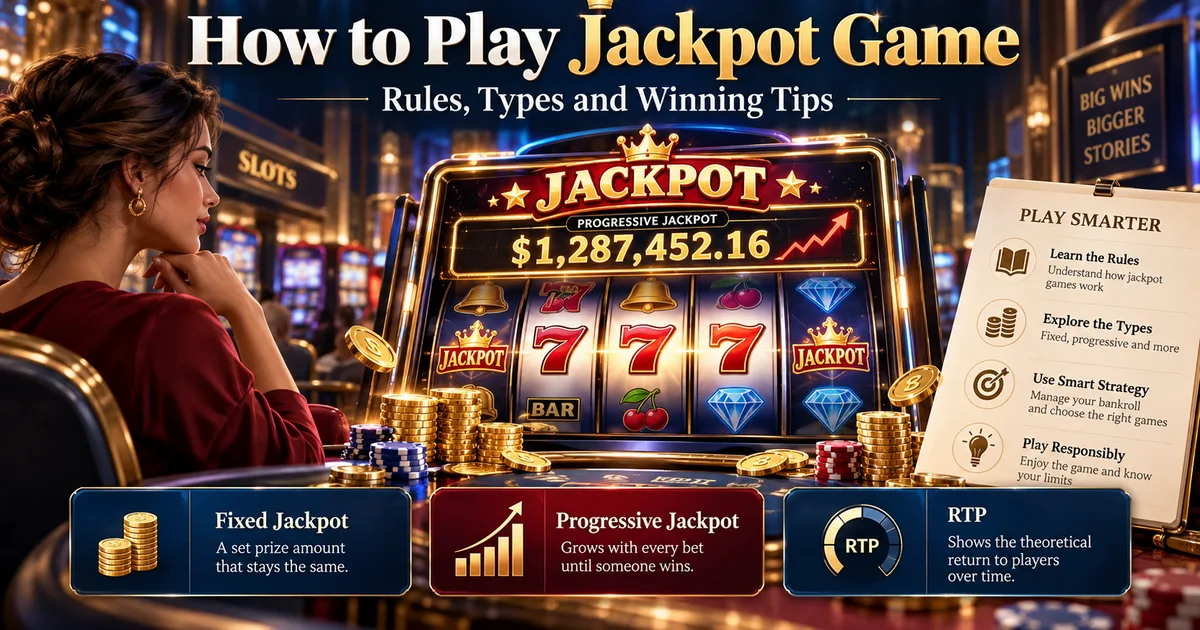
Jackpot games offer a chance to win a special prize that is separate from regular game payouts. Some jackpots have a fixed value, while others grow as players place bets. The rules depend on the game, but the basic idea is simple: a specific event or combination triggers the jackpot. If you have played a jackpot online game, you may have seen prize counters, special symbols, or bonus wheels. These features show how much a jackpot is worth and what players need to do to qualify. However, not every jackpot works the same way. Some require matching symbols, while others use random prize triggers. This guide explains how to play jackpot games, the different types available, how prizes are calculated, and what affects the chances of winning.
What Is a Jackpot Game?
A jackpot game offers a special prize when certain conditions are met. The prize can be a fixed amount or a growing pool of money. Jackpots are common in online slots, but they can also appear in other casino games. The main difference is how the prize is won. Regular payouts follow the normal game rules. A jackpot usually needs a special symbol combination, bonus event, or random trigger.
How Jackpot Games Work
Most jackpot games follow a basic structure. A player selects a stake and starts a round. The game determines the result, and certain outcomes may qualify for a jackpot. In a slot game, the jackpot might be triggered by landing special symbols on the reels. Other games use a bonus wheel or a separate prize feature. Progressive jackpots work differently. A small part of qualifying stakes contributes to a shared prize pool. The amount continues to grow until a player triggers the winning condition. When the jackpot is awarded, the prize pool usually resets to a starting value called the seed amount.
What Makes a Jackpot Different From Regular Prizes?
Regular slot payouts are usually based on symbol combinations and the selected stake. A jackpot is a separate prize feature that may offer a much larger amount. For example, a regular combination might pay 20 times the stake. A jackpot feature could award a fixed prize of ₹10,000 or a progressive amount that has grown to ₹500,000. The size of the prize does not indicate how easy it is to win. Large jackpots may have very low winning probabilities. A game can also have several jackpot levels, such as Mini, Minor, Major, and Grand. Each level has its own value and may have different triggering conditions.
Different Types of Jackpot Games
Jackpot games can be divided into several categories based on how their prize pools work. Knowing the difference helps explain why some jackpot values remain unchanged while others increase over time.
Fixed Jackpot Games
A fixed jackpot has a predetermined prize value. The amount remains the same regardless of how many people play the game. For example, a slot might offer a fixed jackpot of ₹25,000 for a particular combination. Every qualifying result awards the same amount unless the game provider changes its configuration. Some fixed jackpots are expressed as stake multipliers instead of currency amounts. A prize of 1,000 times the stake would pay ₹10,000 on a ₹10 stake. Fixed jackpots are easier to understand because their values do not depend on a growing prize pool.
Progressive Jackpot Games
A progressive jackpot increases as qualifying bets are placed. A portion of those bets contributes to the jackpot pool. Suppose a jackpot starts at ₹100,000. As players continue participating, the prize might grow to ₹150,000, ₹250,000, or more. The jackpot keeps increasing until a qualifying event awards the prize. It then resets to its seed value and begins growing again. Not every progressive jackpot uses the same contribution percentage or winning mechanism. These details depend on the individual game.
Local and Networked Jackpots
A local jackpot is connected to a limited group of games or machines. Its prize pool may grow through activity at one casino or a specific group of linked games. A networked jackpot connects games across multiple casinos or platforms. Contributions from more players can allow the prize to grow faster.
| Jackpot type | Prize structure | Main feature |
| Fixed | Set amount or multiplier | Prize does not grow |
| Progressive | Accumulating pool | Increases with qualifying play |
| Local | Limited shared pool | Connected to one location or operator |
| Networked | Wider shared pool | Connected across multiple operators |
Local and networked describe how a jackpot is connected, while fixed and progressive describe how its prize value is calculated. A networked jackpot is often progressive, but these classifications are not mutually exclusive.
How to Play Jackpot Game Step by Step
The steps below explain a typical jackpot slot game. Exact controls and winning conditions vary, so the game’s own paytable and rules remain the main reference.
Step 1: Identify the Type of Jackpot Game
First, check whether the game offers a fixed or progressive jackpot.
A fixed jackpot displays a set prize value or multiplier. A progressive jackpot usually shows a counter that increases as qualifying bets are made. Some games have several jackpot levels. For example, the interface may display Mini, Minor, Major, and Grand prizes. Identifying the type of jackpot helps explain how the prize works and what conditions apply.
Step 2: Read the Rules and Jackpot Conditions
Open the game’s information or paytable section. Look for details about the jackpot trigger, qualifying stakes, and any special bonus features. Some jackpots require a specific combination of symbols. Others can be awarded randomly during a qualifying spin. Also check whether all stake levels qualify for the jackpot. Some games allow every qualifying bet to participate, while others require particular stake settings. These rules can change between games, even when their jackpot features look similar.
Step 3: Understand the Available Stake Options
The stake is the amount committed to each round. It may affect regular payouts, jackpot eligibility, or the value of certain prizes. For example, a jackpot calculated as 500 times the stake would pay ₹5,000 on a ₹10 stake and ₹10,000 on a ₹20 stake. However, a larger stake does not automatically increase the probability of winning a jackpot. Whether the odds change with the stake depends on the game’s rules. It is important to distinguish between prize size and winning probability.
Step 4: Start a Round and Follow the Game Mechanics
After choosing the stake, the player starts the round. In a slot game, this usually means spinning the reels. The game system then decides the result. Regular symbol matches may give normal payouts. Special events can trigger a jackpot feature. For example, five matching symbols may give a standard win, while the jackpot may only be available through a separate bonus round. These outcomes should not be confused.
Step 5: Check for Jackpot Symbols or Bonus Triggers
During the round, watch for the special symbols or events listed in the paytable. For example, one jackpot slot may need three bonus symbols to open a prize wheel. The wheel may then give a fixed prize or one of several jackpot levels. Another game may award a jackpot at random during a qualifying round. It may not need any special symbol combination. The exact trigger depends on the game.
Step 6: Review the Result and Payout
After the round ends, check the result. A normal win follows the regular paytable, while a jackpot uses separate prize rules. For example, a ₹20 round may trigger a ₹10,000 jackpot. The jackpot is separate from the original ₹20 stake. The final result also depends on any other payouts from that round. In a progressive game, the jackpot counter may reset after the prize is won. This is the final step in the basic gameplay process.
How Do You Win a Jackpot?
Jackpot wins depend on specific conditions built into the game. These conditions are described in the paytable or game information screen. There is no universal combination that wins every jackpot. Different games use different symbols, features, and mathematical models.
Matching Jackpot Symbols
Some jackpot slots use dedicated jackpot symbols. A particular number of these symbols must appear in a qualifying position to award the prize. For example, a game might require five jackpot symbols on an active payline. Another might use a special arrangement across several reels. The number and placement of symbols matter. Simply seeing a jackpot symbol does not necessarily mean a prize has been won. Some games also use wild symbols, but their role in jackpot combinations depends on the rules.
Triggering a Jackpot Bonus Round
Other games award jackpots through bonus features. These may include prize wheels, pick-and-win rounds, or special reels. A player might trigger a bonus by landing three scatter symbols. The bonus then presents several hidden prizes, one of which may be a jackpot. In another format, players collect symbols until a jackpot level is reached. These bonus mechanics add extra steps between the initial game result and the final prize.
Random Jackpot Awards
Some jackpots can trigger at random during eligible gameplay. They may not need a special symbol combination. Instead, the game uses an internal system to decide when the jackpot is awarded. The chance may also change based on the bet size, jackpot value, or other game settings. This means not every round always has the same jackpot chance. To understand how a specific jackpot works, check the official game rules.
Understanding Jackpot Prizes and Payouts
Jackpot payouts can be calculated in several ways. Some use fixed amounts, others depend on the stake, and progressive jackpots use an accumulating prize pool. These differences affect the value of the prize but do not reveal when it will be awarded.
How Jackpot Prize Amounts Are Calculated
A fixed jackpot may award a specific amount, such as ₹20,000. The value does not change with each round. Another game may define its jackpot as a multiplier. If the prize is 1,000 times the stake, a ₹10 stake produces a ₹10,000 jackpot. Progressive jackpots follow a different model. Their displayed value grows through contributions from qualifying bets. Some games combine these structures by offering smaller fixed jackpots alongside a larger progressive prize.
How Progressive Jackpot Pools Grow
A progressive jackpot usually begins with a seed amount supplied by the operator or game provider. A small percentage of qualifying stakes then contributes to the prize pool. Consider a hypothetical jackpot starting at ₹50,000. If qualifying players collectively stake ₹100,000 and 1% contributes to the pool, the jackpot grows by ₹1,000. The displayed value becomes ₹51,000, assuming no jackpot is awarded during that period. When the jackpot is won, the prize is paid according to the game’s rules. The pool then normally resets to its starting amount. The actual contribution rate is game-specific. It should not be assumed from the size or speed of the displayed counter.
Jackpot Payout Calculation Examples
The following examples illustrate different prize structures.
| Jackpot structure | Calculation | Total prize |
| Fixed amount | Set prize | ₹5,000 |
| Stake multiplier | ₹10 × 500 | ₹5,000 |
| Larger multiplier | ₹20 × 1,000 | ₹20,000 |
| Progressive | Current prize pool | ₹125,000 |
| Tiered jackpot | Fixed Minor prize | ₹1,000 |
These are hypothetical amounts rather than prizes from a particular game. The total prize should also be distinguished from net profit. If a player stakes ₹100 and receives a ₹5,000 jackpot payout, the net gain for that round is ₹4,900, assuming there are no other costs or payouts.
Jackpot Game RTP, Volatility and Winning Chances
Jackpot games use mathematical systems to determine outcomes and payouts. Two useful concepts are Return to Player (RTP) and volatility. Understanding them helps explain why jackpot games can produce long periods without a major prize.
What Does RTP Mean in Jackpot Games?
RTP is the theoretical percentage of total stakes returned to players over a very large number of rounds. For example, a game with a 96% RTP has a theoretical long-term return of ₹96 for every ₹100 wagered. This does not mean every player receives ₹96 back after spending ₹100. Individual results can vary greatly. In some jackpot games, the advertised RTP includes the contribution from jackpot prizes. This means part of the theoretical return may depend on rare, large awards. A player who never triggers a jackpot may experience a return far below the game’s advertised RTP.
Why Jackpot Games Often Have High Volatility
Volatility shows how much game results can change from one round to another. Games with large jackpots often have high volatility because the biggest prizes are rare. One player may go through hundreds of rounds without a major win, while another may hit a jackpot much sooner. Both results can be normal. Rare prizes can appear at any time. However, not every jackpot game has the same volatility. The exact payout pattern depends on how each game is designed.
Can You Predict When a Jackpot Will Hit?
You cannot reliably predict the next jackpot from past results if each round is random and independent. If a jackpot has not been won for several days, that does not mean it is more likely to appear in the next round. Some jackpot games use special rules tied to prize size or set ranges, but this must be checked in the game rules. A rising jackpot amount alone does not show the real chance of winning.
Jackpot Game Demo Mode vs. Real Money Play

Many jackpot-style games offer a demo mode. This allows users to explore the interface and rules using virtual credits. However, jackpot features may behave differently in demo and real-money versions.
How Jackpot Demo Games Work
A demo game generally reproduces the main controls, symbols, and bonus features of the standard version. Players can select virtual stakes, start rounds, and observe how ordinary payouts and jackpot triggers appear. Demo mode is useful for learning which symbols matter and how bonus features work. It also allows beginners to explore the paytable without financial risk.
Differences Between Demo and Real Money Jackpots
The main difference is that demo prizes have no real cash value. Some demo games show simulated jackpot amounts instead of live jackpots. Others may not include jackpot features at all. Even if the demo uses the same game math, past demo results cannot predict future real-money results. Demo access and available features depend on the game developer and operator.
Practical Tips for Understanding Jackpot Games
Jackpot games do not offer a guaranteed winning strategy. However, understanding their structure can help players interpret the rules and avoid common assumptions.
Check the Jackpot Eligibility Requirements
Before looking at the jackpot prize, check how a round can qualify for it. Some games require a certain bet size. Others allow different stakes but change the jackpot odds or payout. A game may show the same progressive jackpot at several stake levels, even if the chance of winning it is different. Another game may require a specific bonus feature to be active. The key point is simple: being eligible for a jackpot does not always mean you have the same chance of winning it.
Understand the Difference Between Jackpot Size and Winning Probability
A bigger jackpot does not always mean better winning chances. For example, Game A may offer ₹50,000 with odds of 1 in 100,000 qualifying rounds. Game B may offer ₹500,000 but with odds of 1 in 5,000,000 rounds. Game B has the larger prize, but it is much harder to hit in this example. To compare the games properly, you also need to know the jackpot odds, other payouts, and overall return.
Avoid Common Betting Misconceptions
A common mistake is thinking a jackpot is due after a long losing period. This can lead players to raise their bets based on past results instead of the game rules. Another mistake is assuming that a bigger bet always improves the chance of hitting a jackpot. In some games, stake size can affect eligibility or odds, but this is not true for every game. Winning a small prize also does not mean a larger jackpot is more or less likely in the next round. These ideas should be checked against the actual game rules, not treated as reliable strategies.
Common Mistakes Beginners Make in Jackpot Games
One common mistake is confusing a regular win with a jackpot. A large payout is not always a jackpot. Some games also have special rules for jackpot prizes, such as certain bet sizes or bonus triggers. RTP is often misunderstood too. A 96% RTP does not mean that 96% of rounds will pay. Progressive jackpots can also work in different ways. Their contribution rates, reset values, and winning conditions may vary. Another mistake is raising bets after losses because a jackpot feels more likely. Unless the game rules say the odds change, past losses do not make a jackpot more likely in the next round.
Jackpot Games vs. Regular Slot Games

Jackpot games and regular slots share many mechanics, including reels, symbols, paylines, and bonus features. The difference is the presence of a special jackpot prize structure. A regular slot can still produce large wins, but these are generally calculated using the standard paytable or bonus rules.
Differences in Prize Structure
Regular slots usually award payouts based on symbol combinations and stake multipliers.
Jackpot slots add a separate prize feature. The jackpot may have a fixed value or a progressive amount that grows over time. Some jackpot games also offer several prize levels, giving players different possible awards within the same feature.
Differences in RTP and Volatility
Both regular slots and jackpot games have RTP and volatility characteristics.
A jackpot game may assign part of its theoretical return to rare jackpot awards. This can create a wide gap between ordinary session results and the overall long-term average.
However, it is incorrect to assume that every jackpot slot is more volatile than every regular slot. The actual distribution of prizes depends on the individual game.
How Jackpot Features Change Gameplay
Jackpot features may introduce additional symbols, bonus rounds, or special prize displays.
| Feature | Regular slot | Fixed-jackpot slot | Progressive-jackpot slot |
| Standard payouts | Yes | Yes | Yes |
| Special jackpot | Not necessarily | Fixed prize | Growing prize |
| Jackpot reset | Not applicable | Usually unchanged | Normally resets after a win |
| Jackpot contribution | None for a separate jackpot | Not usually a growing pool | Often funded by qualifying stakes |
| Winning conditions | Standard paytable | Special jackpot rules | Special jackpot rules |
The table describes common structures. Individual games may combine features or use different rules.
Frequently Asked Questions About Jackpot Games
- How Do You Play Jackpot Game Online?
The basic process is to understand the game’s rules, select a stake, start a round, and check whether the result meets the jackpot conditions. In slot-based games, jackpots may be triggered by special symbols, bonus features, or random events.
- How Does a Progressive Jackpot Work?
A progressive jackpot begins with a seed amount and grows as qualifying stakes contribute to its prize pool. When the jackpot is awarded, the pool normally resets to its starting value.
- Can You Win a Jackpot With a Small Stake?
Yes, in some games. However, eligibility requirements vary. Certain jackpots can be awarded at different stake levels, while others require a minimum qualifying stake. The game’s paytable should explain these conditions.
- What Is the Difference Between Fixed and Progressive Jackpots?
A fixed jackpot has a predetermined prize value. A progressive jackpot grows as qualifying bets contribute to the pool. The progressive amount usually resets after someone wins.
- Can You Play Jackpot Games for Free?
Some jackpot games offer demo versions using virtual credits. These versions allow users to explore the rules without risking money. However, demo jackpot prizes are not redeemable for cash, and some features may differ from real-money play.
- Are Jackpot Games Based on Luck or Skill?
Most slot-based jackpot games depend on random outcomes. Players can choose stakes or interact with certain bonus features, but these actions do not necessarily change the underlying probabilities. Skill-based jackpot games may use different rules.
- Does a Bigger Jackpot Mean Better Winning Chances?
No. Jackpot size and winning probability are separate factors. A larger prize does not automatically mean that the jackpot is easier or harder to win. The probability depends on the game’s mathematical design.
- Can You Predict When a Jackpot Will Be Won?
Not reliably in a game with independent random outcomes. Previous results and the length of time since the last jackpot do not reveal the next winning round. Any game-specific mechanics that change probabilities must be confirmed through its rules.
Conclusion
Jackpot games add special prizes to regular gameplay. Some jackpots have a fixed value, while progressive jackpots grow over time. The key details are the jackpot type, entry rules, trigger conditions, and payout structure. RTP and volatility can also help explain why large prizes are rare. There is no reliable way to predict or guarantee a jackpot win. Each game uses its own rules, and a large prize does not show how likely it is to be won. Beginners can learn more by checking the paytable and using demo mode when it is available.