
Quick Answer
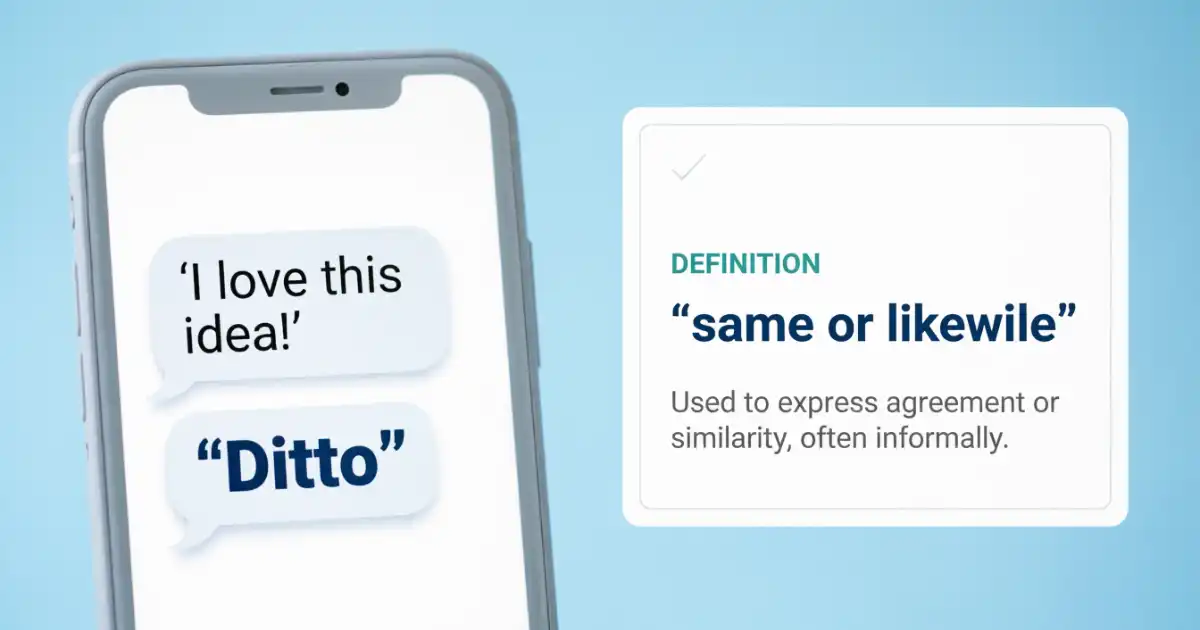
Ditto means the same, likewise, or I agree with what was just said. It is often used to avoid repeating something that another person has already said or written. For example, if someone says, “I loved that movie,” you can reply, “Ditto,” meaning “I loved it too.” The word can also refer to an exact copy or repetition in some contexts.
Introduction
You may have seen ditto in a text message, social media comment, conversation, book, or workplace note and wondered exactly what it means. Unlike many modern texting abbreviations, ditto is a regular English word with a long history. Its main idea is simple: the same thing applies to me, or the same thing as previously mentioned.
In everyday conversation, ditto is often a quick way to show agreement without repeating an entire sentence. If your friend says, “I am exhausted after that workout,” replying “Ditto” tells them that you feel the same way.
In writing, the word can also indicate that information above should be repeated, although this use is more formal or traditional.
This guide explains the ditto meaning, where the word comes from, how people use it in texting and conversation, and how it differs from expressions such as same, likewise, and me too. You will also see practical examples and common mistakes so you can use the word naturally.
What Does Ditto Mean?
The most common meaning of ditto is the same as what was just mentioned. It can describe agreement with another person’s statement or indicate that previously given information should be repeated.
For example:
“I need a vacation.”
“Ditto.”
The second speaker means, “I need a vacation too.”
Ditto can work as a short response because the context provides the missing information. Instead of repeating the entire sentence, the speaker simply uses ditto to say that the same statement applies to them.
The word can also mean an exact copy or duplicate. This meaning appears more often in writing, printing, or older usage. For instance, someone might say that a document was produced as a ditto, meaning it was copied from another document.
Today, the conversational meaning is especially easy to understand:
Ditto = Same here = Me too = Likewise
However, these expressions are not always interchangeable in every situation. Ditto usually refers directly to something that was just said or written.
Ditto Meaning in Texting and Social Media
In texting, ditto usually means same here or I feel the same way.
It can be a convenient one word reply when you agree with someone’s statement.
For example:
Friend: “I could sleep for ten hours tonight.”
You: “Ditto.”
Here, ditto means that you could also sleep for ten hours.
Another example:
Friend: “That was the best concert I have ever seen.”
You: “Ditto!”
The response shows that you share the same opinion.
On social media, someone may also comment ditto beneath another person’s statement to show agreement. The tone can be casual, friendly, humorous, or supportive depending on the conversation.
Because the word is short and easy to understand from context, it works particularly well when repeating the original statement would feel unnecessary.
How Is Ditto Used in a Sentence?
Ditto can be used as a standalone response or as part of a sentence. Its exact role depends on the context.
| Use | Meaning | Example |
|---|---|---|
| Agreement | I feel or think the same | “I am ready to go.” “Ditto.” |
| Repetition | Repeat the information above | “John Smith, ditto for the next entry.” |
| Same condition | The same situation applies | “She is tired, and ditto for me.” |
| Casual response | Me too or same here | “I love pizza.” “Ditto!” |
The standalone form is especially common in casual conversation.
For example:
Person 1: “I really enjoyed this book.”
Person 2: “Ditto.”
You can also use it after a longer statement:
“I have no idea what happened, and ditto for everyone else.”
This means everyone else also had no idea what happened.
Examples of Ditto in Everyday Conversation
Understanding the word becomes easier when you see how it works in realistic situations.
Example 1: Sharing an Opinion
Alex: “That restaurant has amazing burgers.”
Sam: “Ditto. I would go back tomorrow.”
Here, Sam agrees with Alex’s opinion.
Example 2: Agreeing With a Feeling
Alex: “I am so tired today.”
Sam: “Ditto.”
Sam means, “I am also very tired.”
Example 3: Agreeing With a Preference
Alex: “I prefer working in the morning.”
Sam: “Ditto.”
The response means Sam has the same preference.
Example 4: Agreeing Online
Comment: “This is one of my favorite shows.”
Reply: “Ditto!”
The person replying is saying they have the same opinion.
Example 5: Repeating Information
In a list or form, ditto can indicate that the information is the same as the entry above.
For example:
| Name | City |
|---|---|
| Sarah | Chicago |
| Mike | Ditto |
In this example, ditto means Mike is also associated with Chicago.
When Should You Use Ditto?
Ditto works best when the thing you are agreeing with is obvious from the conversation. It saves time and prevents unnecessary repetition.
You can use it when:
- You agree with someone’s opinion.
- You share the same feeling.
- You have the same preference.
- You want to say me too.
- You want to indicate that information should be repeated.
- You are responding casually to a friend or colleague.
For example, if someone says, “I am excited about the weekend,” a natural response is simply, “Ditto.”
The word is generally easygoing, but the exact tone depends on the situation. In a formal document, it may be better to clearly repeat the information instead of relying on ditto if there is any chance of confusion.
Ditto vs. Same, Me Too, and Likewise
Several English expressions have a similar meaning, but they have slightly different uses.
| Term | Meaning | Best Use | Example |
|---|---|---|---|
| Ditto | The same as what was said | Casual agreement or repetition | “I am tired.” “Ditto.” |
| Same | I feel the same way | Very casual conversation | “I need coffee.” “Same.” |
| Me too | I also feel or think this | Direct agreement | “I love this song.” “Me too.” |
| Likewise | The same applies to me or you | Polite or slightly formal agreement | “Nice to meet you.” “Likewise.” |
| Same here | I have the same feeling or situation | Casual conversation | “I am hungry.” “Same here.” |
Ditto and same are especially close in casual texting. However, ditto can also refer to repeating written information, while same is usually an informal expression of agreement.
Likewise has another common use. If someone says, “Have a great day,” replying “Likewise” means you hope they have a great day too.
Where Did the Word Ditto Come From?
The word ditto comes from Italian and originally relates to the idea of something that has already been said or mentioned. It entered English through written and record keeping contexts.
Historically, ditto was useful in lists and documents when the same information appeared repeatedly. Instead of writing the same word or phrase again and again, a person could use ditto to show that the information was unchanged from the entry above.
Over time, the word became common in everyday English as a way to express agreement or repetition.
That history helps explain why the modern conversational use makes sense. When someone says ditto, they are essentially saying that the previous statement applies again.
Is Ditto Formal or Informal?
Ditto can be either neutral or casual depending on how it is used.
As a standalone response, it usually feels conversational.
For example:
“I cannot believe how expensive groceries are.”
“Ditto.”
This sounds natural in everyday conversation.
In written records, ditto can have a more functional meaning because it indicates that information should be repeated from a previous entry.
For important professional, legal, financial, or administrative documents, clarity is usually more important than brevity. If repeating the actual information would prevent confusion, writing it out is often preferable.
Common Mistakes When Using Ditto
Although ditto is simple, a few misunderstandings can make its use awkward.
Using Ditto Without Clear Context
Ditto depends on the reader or listener knowing what you are referring to.
If several different statements were made immediately before your response, saying only “ditto” may leave people wondering which statement you mean.
Treating Ditto as a Universal Synonym for Yes
Ditto usually means the same applies to me. It does not simply mean yes.
For example:
“Did you finish your homework?”
A response of “ditto” would not normally mean yes. The word works when you are referring to a statement that can also apply to you.
Using Ditto When You Actually Mean Likewise
The words can overlap, but they are not identical in every situation.
If someone says, “It was nice meeting you,” the natural response is likewise, not necessarily ditto.
Assuming It Is Only Internet Slang
Ditto is not a modern abbreviation or newly invented texting term. It is an established English word that existed long before texting and social media.
Conclusion
The simplest ditto meaning is the same as what was just said or mentioned. In everyday conversation and texting, it commonly means me too, same here, or I agree. It can also be used in written lists and records to show that information is repeated from an earlier entry.
Remember that ditto works best when the context is clear. If someone shares an opinion, feeling, or preference that you also share, replying ditto is a quick and natural way to say that you feel the same. For situations where greater clarity matters, especially formal writing, it is often better to state the information directly.
Frequently Asked Questions About Ditto
What does ditto mean in texting?
In texting, ditto usually means same here, me too, or I agree. It tells the other person that their statement or feeling also applies to you.
Is ditto a slang word?
Ditto is not strictly slang. It is a standard English word, although using it as a one word reply often gives the conversation a casual tone.
What is another word for ditto?
Depending on the context, alternatives include same, me too, same here, likewise, and the same. The best choice depends on what you are responding to.
Can ditto mean the exact same thing?
Yes. Ditto can indicate that something is the same as something previously mentioned. It can refer to repeated information as well as agreement in conversation.
Can I say ditto by itself?
Yes. Ditto can work as a complete response when the context is clear.
For example:
“I am ready for the weekend.”
“Ditto.”
Is ditto rude?
Usually, no. However, tone and context matter. A one word reply can sometimes sound dismissive if the other person expects a more thoughtful response.
What does ditto mean in a document?
In a document or list, ditto can mean that the information is the same as the information in the preceding entry. This usage is more traditional and administrative than conversational.