
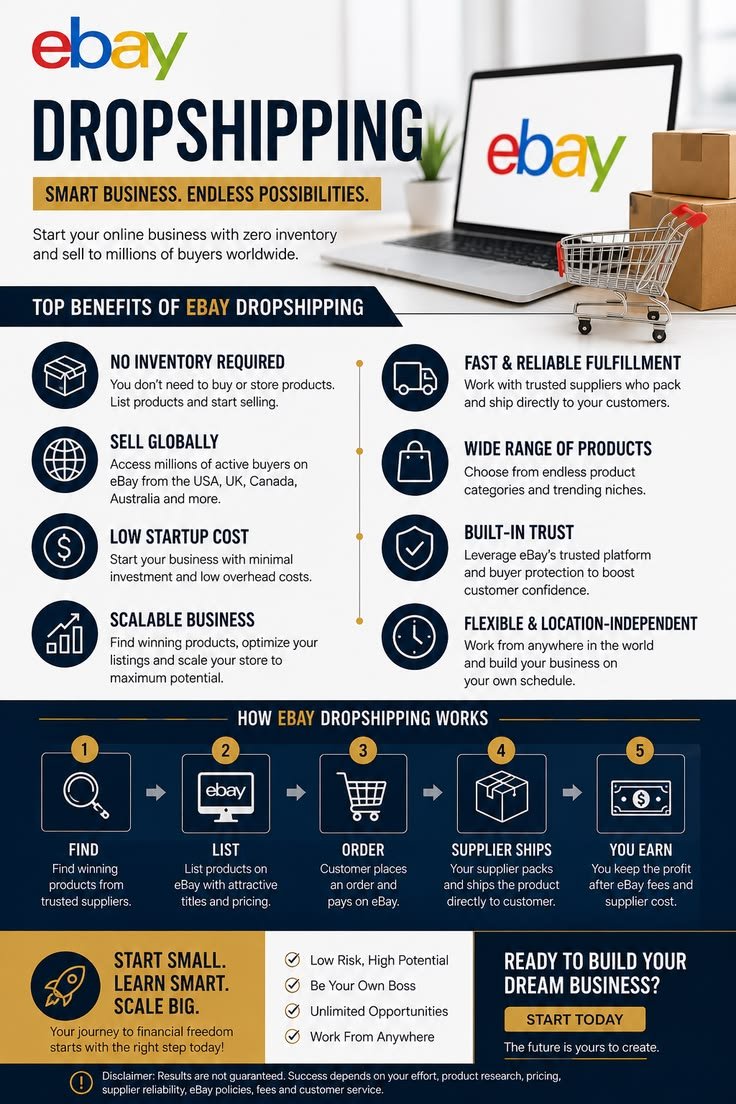
The e-commerce industry has created opportunities for entrepreneurs to launch online businesses without investing heavily in inventory, warehouses, or traditional retail infrastructure. One popular approach is the dropshipping business model, which allows sellers to offer products online while third-party suppliers handle inventory storage and order fulfillment.
Unlike traditional retail businesses, dropshipping stores generally do not purchase large quantities of products before receiving customer orders. Instead, the seller markets products, accepts payments, and forwards orders to suppliers who ship merchandise directly to customers.
This approach can reduce upfront inventory expenses and make starting an online store more accessible. However, dropshipping is not a guaranteed source of passive income. Successful businesses still require product research, reliable suppliers, effective marketing, customer service, and careful financial management.
Whether you are exploring e-commerce for the first time or considering adding dropshipping to an existing business, understanding how the model operates is essential.
This comprehensive guide explains what dropshipping is, how it works, its advantages and disadvantages, typical expenses, profit calculations, supplier selection, and practical strategies for building a sustainable online business in 2026.
What Is the Dropshipping Business Model?
The dropshipping business model is an e-commerce fulfillment method in which an online retailer sells products without maintaining its own physical inventory.
When a customer purchases an item from the retailer’s online store, the retailer sends the order information to a third-party supplier. The supplier then packages and ships the product directly to the customer.
The retailer earns revenue from the customer’s payment and pays the supplier for the product and fulfillment services.
For example, suppose an online store sells a backpack for $50.
The supplier charges $25 for the backpack, including shipping. The retailer receives the customer’s $50 payment and pays the supplier $25.
The difference of $25 is the gross spread before accounting for advertising, payment processing, refunds, software, and other business expenses.
Although the retailer never physically handles the backpack, it remains responsible for the customer experience, product information, order communication, and resolving service issues.
How Does the Dropshipping Business Model Work?
Dropshipping generally involves three primary participants: the customer, the online retailer, and the supplier.
The process follows a straightforward sequence.
1. The Retailer Creates an Online Store
The entrepreneur establishes an e-commerce website using a platform such as Shopify or WooCommerce.
The store displays product descriptions, photographs, prices, shipping information, and checkout options.
2. The Customer Places an Order
A customer visits the online store, selects a product, and completes the purchase.
The retailer receives the order details and payment through its e-commerce platform and payment processor.
3. The Retailer Forwards the Order to a Supplier
The retailer submits the order to its dropshipping supplier.
Depending on the system, this process may happen manually or through an automated integration.
4. The Supplier Prepares and Ships the Product
The supplier picks, packages, and ships the item directly to the customer’s delivery address.
The retailer generally does not need to store or handle the product.
5. The Customer Receives the Order
The customer receives the product from the supplier’s fulfillment operation.
The retailer remains the customer’s primary point of contact for order questions, complaints, refunds, and other support requests.
6. The Retailer Calculates Its Profit
The retailer calculates the remaining revenue after supplier charges, marketing costs, payment fees, refunds, and operating expenses.
This final amount determines whether the sale was profitable.
Dropshipping Business Model Example
Consider an entrepreneur operating an online store that sells fitness accessories.
The store offers resistance bands, yoga equipment, exercise mats, and related products.
A customer purchases a resistance band set for $40.
The retailer pays the supplier $17 for the product and shipping.
Additional costs include $8 in advertising expenses, $2 in payment processing fees, and $1 allocated to other operating expenses.
| Expense Category | Amount |
|---|---|
| Customer Selling Price | $40.00 |
| Supplier Product and Shipping Cost | $17.00 |
| Advertising Cost | $8.00 |
| Payment Processing | $2.00 |
| Other Allocated Expenses | $1.00 |
| Net Contribution Before Taxes | $12.00 |
The retailer earns $12 on the order before taxes and any unallocated overhead.
The contribution margin is:
\[ \text{Margin}=\frac{12}{40}\times100=30\% \]
This example demonstrates how a dropshipping store can generate a positive margin without purchasing inventory in advance.
However, actual margins depend on product pricing, supplier charges, advertising performance, customer acquisition costs, returns, and other expenses.
Key Participants in a Dropshipping Business
Understanding the responsibilities of each participant helps explain how dropshipping operations function.
The Online Retailer
The retailer manages the storefront and customer relationship.
Typical responsibilities include selecting products, writing descriptions, establishing prices, running advertisements, processing orders, and handling customer support.
The retailer also monitors supplier performance and ensures that customers receive accurate information.
The Dropshipping Supplier
The supplier provides products and fulfills orders.
Depending on the arrangement, the supplier may be a manufacturer, wholesaler, distributor, or specialized fulfillment company.
Supplier responsibilities generally include storing inventory, preparing orders, packaging merchandise, and arranging shipping.
The Customer
The customer purchases products from the online retailer.
Customers usually expect the same level of service they would receive from a traditional e-commerce business, regardless of the retailer’s fulfillment arrangement.
This means the retailer must provide accurate delivery estimates, reliable customer support, and clear return policies.
Advantages of the Dropshipping Business Model
Dropshipping offers several advantages, particularly for entrepreneurs who want to enter e-commerce without managing substantial inventory.
Low Initial Inventory Investment
Traditional retail businesses often require significant capital to purchase inventory before selling products.
Dropshipping eliminates the need to buy most products in advance.
This can reduce financial exposure to unsold merchandise.
However, entrepreneurs still need money for website development, marketing, business operations, and order fulfillment.
No Personal Warehouse Required
Because suppliers store merchandise, retailers generally do not need to rent warehouses or manage physical inventory facilities.
This reduces storage responsibilities and allows business owners to focus on marketing and customer relationships.
Flexible Product Selection
Dropshipping stores can offer products across multiple categories without physically stocking every item.
Retailers may test different products and adjust their catalogs based on customer demand.
However, frequent product changes can create branding challenges and operational complexity.
Location Independence
A dropshipping business can often be managed remotely with a computer and reliable internet connection.
Entrepreneurs can coordinate suppliers, process orders, and communicate with customers from different locations.
Nevertheless, payment availability, business registration, tax requirements, and supplier coverage depend on the countries involved.
Potential for Business Expansion
Retailers can expand their product catalogs without making proportional investments in warehouse space.
Suppliers handle much of the physical fulfillment process, although increasing order volume still creates additional customer service and operational responsibilities.
Opportunity to Test Products
Dropshipping allows entrepreneurs to evaluate customer interest before committing to large inventory purchases.
Products with consistent sales may eventually justify wholesale purchasing, private labeling, or other fulfillment arrangements.
Disadvantages and Risks of Dropshipping
Although dropshipping reduces certain startup barriers, it introduces challenges that entrepreneurs must understand.
Lower Profit Margins
Dropshipping markets can be highly competitive because multiple retailers may sell identical products.
Price competition, advertising expenses, and supplier charges can reduce profitability.
A product with a high selling price does not necessarily generate a strong profit margin.
Limited Inventory Control
Retailers depend on suppliers for stock availability.
A supplier may unexpectedly run out of a product after the retailer has already accepted customer orders.
This can lead to cancellations, refunds, and customer dissatisfaction.
Shipping Delays
Shipping times vary depending on supplier location, carrier performance, customs procedures, and destination.
Long or unpredictable delivery times can reduce customer satisfaction.
Retailers should avoid promising delivery dates they cannot reasonably support.
Product Quality Problems
Retailers may not inspect individual products before shipment.
If a supplier delivers defective, damaged, or inaccurate merchandise, the customer typically contacts the retailer.
This makes supplier verification and product testing especially important.
High Customer Acquisition Costs
Paid advertising can become expensive, particularly in competitive product categories.
If customer acquisition costs exceed the contribution margin from an order, the business may lose money despite generating sales.
Dependence on Third-Party Suppliers
A dropshipping retailer relies on suppliers for essential operational functions.
Supplier failures, pricing changes, fulfillment errors, or business closures can disrupt the retailer’s operations.
Dropshipping vs. Traditional E-Commerce
Dropshipping and traditional inventory-based e-commerce share many similarities, but they differ significantly in inventory management and fulfillment.
| Feature | Dropshipping | Traditional E-Commerce |
|---|---|---|
| Inventory Ownership | Usually no advance stock purchases | Business typically owns inventory |
| Startup Inventory Cost | Generally lower | Often higher |
| Warehouse Requirement | Usually unnecessary | May be required |
| Shipping Control | Primarily supplier-managed | More direct control |
| Product Quality Control | Limited before shipment | Greater direct control |
| Profit Margin Potential | Often lower | May be higher |
| Inventory Risk | Lower unsold-stock exposure | Higher unsold-stock exposure |
| Fulfillment Responsibility | Third-party supplier | Retailer or fulfillment provider |
| Branding Opportunities | Supplier-dependent | Often more flexible |
| Scalability | Depends on suppliers and operations | Depends on inventory and infrastructure |
Neither approach is automatically superior.
Dropshipping can be useful for testing markets with limited inventory investment, while traditional e-commerce may provide stronger control over product quality, fulfillment, and branding.
How Much Does It Cost to Start a Dropshipping Business?
Startup costs vary depending on the e-commerce platform, website requirements, product category, marketing strategy, and business location.
A simple store may require relatively little upfront investment, but sufficient working capital is important.
Estimated Dropshipping Startup Budget
| Expense | Illustrative Budget |
|---|---|
| Domain Name | $10–$25 per year |
| E-Commerce Platform or Hosting | $10–$50 per month |
| Store Design and Branding | $0–$200 |
| Product Samples | $50–$150 |
| Initial Advertising Tests | $100–$500 |
| Applications and Integrations | $0–$100 per month |
| Contingency Reserve | $100–$300 |
These figures are planning examples, not verified current provider prices. Registration, taxes, payment processing, and legal compliance costs may be additional.
A small experimental store might begin with a few hundred dollars, while a more substantial launch can require significantly more.
The amount needed also depends on whether the entrepreneur uses paid advertising or builds traffic through organic channels.
Why Working Capital Matters
Even though dropshipping businesses do not normally purchase large amounts of inventory upfront, suppliers may require payment before customer funds become available.
Payment processors can delay settlements or temporarily hold funds.
Retailers therefore need enough working capital to fulfill orders, manage refunds, and handle unexpected expenses.
How to Start a Dropshipping Business in 2026
Starting a dropshipping business requires careful planning, product selection, supplier research, and a realistic marketing strategy.
The following process explains how beginners can build an online store.
1. Choose a Profitable Dropshipping Niche
A niche is a specific market or customer segment that your business targets.
Instead of selling unrelated products, consider focusing on a category with identifiable customer needs.
Potential dropshipping niches include:
- Home organization products
- Pet accessories
- Fitness and exercise equipment
- Kitchen accessories
- Travel organizers
- Office and desk accessories
- Gardening equipment
- Car interior accessories
- Hobby and craft supplies
- Non-medical beauty accessories
A suitable niche should have enough customer demand to support sales while offering opportunities for differentiation.
Avoid selecting products solely because they appear popular on social media.
Evaluate competition, supplier reliability, product quality, customer needs, and potential profitability.
2. Research Products Before Selling
Product research is one of the most important activities in the dropshipping business model.
A product should solve a recognizable problem, provide practical value, or appeal to a clearly defined audience.
When evaluating products, consider customer demand, competition, supplier costs, shipping requirements, and potential returns.
Google Trends can help identify changes in search interest over time.
Keyword research platforms can provide insights into search demand, while online marketplaces may reveal competing products and customer feedback.
However, high search volume does not guarantee profitable sales.
A product must also have sufficient margin after advertising, shipping, payment fees, and other expenses.
3. Find Reliable Dropshipping Suppliers
Supplier selection can significantly influence the success or failure of an online store.
Popular supplier platforms and fulfillment services include:
| Supplier Platform | Main Focus | Suitable For |
|---|---|---|
| AliExpress | Broad international product marketplace | Product research and testing |
| CJdropshipping | Product sourcing and fulfillment | General dropshipping stores |
| Spocket | Supplier marketplace | Stores seeking regional supplier options |
| Zendrop | Dropshipping fulfillment services | Automated fulfillment workflows |
| Printful | Print-on-demand products | Custom apparel and merchandise |
| Printify | Print-on-demand supplier network | Personalized products |
| Syncee | Supplier and product marketplace | Multi-category stores |
Service availability, subscription requirements, shipping destinations, and integrations can change.
Before selecting a supplier, verify product quality, processing times, shipping estimates, refund procedures, and customer support responsiveness.
4. Build Your Online Store
A professional website helps customers understand your products and complete purchases confidently.
Two widely used e-commerce options are Shopify and WooCommerce.
Shopify provides a hosted e-commerce platform with store management tools, checkout features, and integrations.
WooCommerce is an e-commerce solution built for WordPress. It offers flexibility and control over website customization, although hosting, maintenance, and security require attention.
Your store should include clear navigation, detailed product pages, mobile-friendly layouts, and straightforward checkout.
Essential website pages generally include an About Us page, Contact page, Privacy Policy, Terms and Conditions, Shipping Policy, and Return and Refund Policy.
Policies must accurately describe how your business operates and comply with applicable consumer protection laws.
5. Create High-Quality Product Listings
Product pages directly influence customer purchasing decisions.
A useful product listing should explain what the product does, who it is designed for, and what customers can realistically expect.
Include accurate specifications, dimensions, materials, compatibility information, and delivery estimates.
Avoid copying misleading supplier descriptions or using unsupported claims.
Where possible, order product samples and create original photographs, demonstrations, and descriptions.
6. Set Competitive Product Prices
Pricing should cover all relevant costs while remaining attractive to customers.
A basic pricing formula is:
\[ \text{Selling Price}=\text{Total Variable Cost}+\text{Target Contribution} \]
However, successful pricing also considers customer expectations, competitor prices, product differentiation, and perceived value.
For example, if a product costs $20 from the supplier, advertising averages $10 per order, and payment and other variable expenses total $4, the variable cost is $34.
Selling the product for $49 produces a $15 contribution before fixed operating costs and taxes.
This does not mean every product should be priced using the same markup.
Different categories have different competitive conditions and customer expectations.
7. Set Up Payment Processing
Customers need secure and convenient ways to pay.
Depending on your country and platform, payment options may include card payments, digital wallets, local payment gateways, and other supported methods.
Before launching, verify whether your business is eligible to use the payment provider.
Also review transaction fees, settlement times, refund procedures, currency conversion charges, and account reserve policies.
Do not assume that a payment service available in one country will support merchants registered in another.
8. Develop a Marketing Strategy
A dropshipping store needs targeted visitors to generate sales.
Marketing options include search engine optimization, paid advertising, social media content, influencer partnerships, email marketing, and referral campaigns.
Each channel has different costs and requirements.
New businesses should test marketing activities carefully and measure results rather than spending their entire budget immediately.
9. Test the Ordering Process
Before accepting real customer orders, test your website’s shopping experience.
Confirm that product pages work correctly, checkout calculations are accurate, shipping fees are displayed, and confirmation emails are delivered.
Where possible, place a test order to verify that the supplier receives the information correctly.
10. Launch and Monitor Performance
After launching, track website traffic, conversion rates, advertising costs, order values, refunds, and profitability.
Use these results to identify which products and marketing channels are performing effectively.
Avoid expanding aggressively before understanding your actual costs and customer satisfaction levels.
Best Marketing Strategies for Dropshipping
Marketing plays a central role in attracting customers and building a sustainable dropshipping business.
Search Engine Optimization (SEO)
SEO helps online stores attract visitors from search engines without paying for every click.
A dropshipping SEO strategy may include keyword research, category optimization, product descriptions, informational content, and technical improvements.
For example, a store selling home organization products could publish articles about organizing small kitchens, choosing storage containers, and maximizing limited space.
These articles can attract visitors who are researching related problems.
However, informational traffic does not always convert into immediate sales.
SEO should support relevant product discovery rather than simply generating large visitor numbers.
Google Shopping and Search Advertising
Google advertising can help retailers reach users actively searching for products.
Shopping advertisements may display product information directly in search results.
Retailers must provide accurate product data and comply with advertising and merchant policies.
Paid search campaigns should be evaluated using conversion tracking and actual profit margins.
Social Media Marketing
Platforms such as Instagram, TikTok, Facebook, and Pinterest can help businesses demonstrate products and build brand awareness.
Short demonstrations, tutorials, and practical use cases may perform particularly well for visually interesting products.
Social media content should be informative and authentic rather than relying on exaggerated promises.
Influencer Marketing
Influencers can introduce products to relevant audiences.
Smaller creators may offer targeted communities, but audience size alone does not determine campaign success.
Evaluate audience relevance, engagement quality, costs, and measurable results.
Paid promotional relationships should also be disclosed according to applicable advertising rules.
Email Marketing
Email marketing can support repeat purchases and customer retention.
Useful campaigns include welcome messages, abandoned-cart reminders, product education, and relevant offers.
Businesses should obtain appropriate consent and provide unsubscribe options where required.
Dropshipping Profit Margins Explained
Profit margins vary significantly across product categories and businesses.
There is no guaranteed profit percentage for dropshipping.
Some stores operate with narrow margins because of strong competition and high advertising costs.
Others achieve better margins through differentiated products, repeat customers, effective branding, and organic traffic.
Gross Margin vs. Net Margin
Gross margin measures revenue remaining after the cost of goods sold.
\[ \text{Gross Margin}=\frac{\text{Revenue}-\text{COGS}}{\text{Revenue}}\times100 \]
Net profit margin measures the portion of revenue remaining after all relevant expenses.
\[ \text{Net Profit Margin}=\frac{\text{Net Profit}}{\text{Revenue}}\times100 \]
Consider the following hypothetical monthly performance.
| Financial Metric | Monthly Amount |
|---|---|
| Total Revenue | $10,000 |
| Supplier and Fulfillment Costs | $5,000 |
| Gross Profit | $5,000 |
| Advertising | $2,000 |
| Payment Processing | $350 |
| Software and Hosting | $150 |
| Refunds and Other Expenses | $500 |
| Profit Before Taxes | $2,000 |
In this example, the business has a 50% gross margin and a 20% profit margin before taxes.
These numbers illustrate a possible financial structure, not an industry average or expected outcome.
Dropshipping vs. Amazon FBA
Dropshipping and Amazon Fulfillment by Amazon (FBA) are different business approaches.
With dropshipping, suppliers typically fulfill orders after customers purchase products.
With Amazon FBA, sellers generally purchase or own inventory and send it to Amazon fulfillment centers, where Amazon handles storage, picking, packing, and shipping for eligible orders.
| Feature | Dropshipping | Amazon FBA |
|---|---|---|
| Inventory Purchase | Usually after customer orders | Usually before customer orders |
| Storage | Supplier-managed | Amazon fulfillment centers |
| Upfront Inventory Capital | Generally lower | Generally higher |
| Customer Acquisition | Seller-managed | Amazon marketplace traffic may help |
| Branding Control | Varies | Varies |
| Fulfillment | Supplier | Amazon |
| Inventory Risk | Lower unsold inventory exposure | Greater inventory exposure |
| Platform Dependence | Depends on store and providers | Strong dependence on Amazon |
Both approaches require careful financial planning.
Amazon also has specific dropshipping policies, including requirements concerning seller identification and responsibility for customer returns. Sellers should review applicable policies before choosing a fulfillment arrangement.
Is Dropshipping Legal?
Dropshipping is generally a lawful business model in many countries, including the United States, United Kingdom, and Pakistan.
However, operating legally requires compliance with relevant business, tax, consumer protection, advertising, and product safety rules.
Legal requirements depend on where the business is registered, where customers are located, and which products are sold.
Important considerations include business registration, tax obligations, truthful advertising, product safety, intellectual property rights, and privacy protection.
Retailers should avoid counterfeit products, unauthorized brand representations, misleading shipping promises, and prohibited merchandise.
Even when suppliers handle shipping, retailers may remain legally responsible for customer-facing transactions.
Is Dropshipping Still Profitable in 2026?
Dropshipping can still be profitable in 2026, but profitability depends on execution rather than the fulfillment model alone.
The availability of low-cost store-building tools has made e-commerce more accessible, which also means many product categories face intense competition.
Businesses that simply copy supplier listings and rely on expensive advertisements may struggle to maintain positive margins.
More sustainable opportunities often involve building a recognizable brand, selecting a specific customer segment, improving product presentation, and developing reliable fulfillment relationships.
Factors That Support Long-Term Profitability
Product differentiation: Offering products with a clear benefit or distinctive positioning can reduce direct price competition.
Reliable fulfillment: Consistent delivery and product quality can improve customer satisfaction.
Organic customer acquisition: SEO, useful content, and repeat visitors may reduce dependence on paid advertising over time.
Financial discipline: Monitoring contribution margins and cash flow helps identify unprofitable products early.
Customer retention: Satisfied customers may return, reducing the need to acquire a new buyer for every order.
Dropshipping should therefore be treated as a real retail business rather than a shortcut to effortless income.
Common Dropshipping Mistakes to Avoid
Many beginners experience difficulties because they underestimate the operational responsibilities involved.
Choosing Products Without Research
Selecting products based only on viral trends can lead to weak demand or intense competition.
Research customer needs and verify product quality before investing heavily in promotion.
Working With Unreliable Suppliers
Poor supplier performance can result in damaged products, delayed deliveries, and dissatisfied customers.
Order samples and monitor supplier reliability.
Ignoring Advertising Costs
Revenue alone does not indicate profitability.
A store can generate thousands of dollars in sales while losing money on customer acquisition.
Track actual costs per order.
Using Misleading Product Descriptions
Exaggerated claims can increase refund requests and damage customer trust.
Provide accurate specifications and realistic expectations.
Offering Poor Customer Support
Customers expect timely responses regardless of the fulfillment method.
Establish clear communication procedures for order delays, returns, and complaints.
Launching Too Many Products
Large catalogs can make inventory synchronization, product quality monitoring, and customer support more difficult.
Starting with a focused selection may be easier to manage.
Ignoring Taxes and Regulations
Business registration, tax collection, and consumer protection requirements vary by jurisdiction.
Research applicable obligations before selling.
How to Scale a Dropshipping Business
Scaling means increasing sales while maintaining sustainable profitability and service quality.
A business should ideally establish reliable fulfillment and consistent positive contribution margins before expanding.
Focus on Proven Products
Analyze which products generate profitable sales and satisfied customers.
Prioritize products with reliable demand rather than continually introducing untested merchandise.
Improve Conversion Rates
A better website experience can increase sales without requiring proportional increases in traffic.
Review mobile usability, product information, checkout performance, and delivery transparency.
Negotiate Supplier Terms
As order volume grows, suppliers may be willing to discuss improved pricing, faster processing, or customized packaging.
Any arrangement should be documented clearly.
Automate Repetitive Operations
Automation can help synchronize inventory, transmit orders, update tracking information, and manage routine communications.
However, automated systems still require monitoring for errors.
Develop a Recognizable Brand
Brand development can reduce dependence on selling interchangeable products.
Consistent messaging, useful content, reliable service, and distinctive positioning can help create customer loyalty.
Consider Alternative Fulfillment Models
Some successful dropshipping businesses eventually transition toward bulk purchasing, private labeling, or third-party logistics.
These approaches may provide greater control but generally require additional capital and inventory management.
Future of the Dropshipping Business Model
The future of dropshipping will likely be influenced by changing consumer expectations, e-commerce technology, fulfillment infrastructure, and advertising costs.
Greater Emphasis on Delivery Speed
Customers increasingly expect accurate tracking and predictable delivery times.
Retailers may prioritize suppliers with regional warehouses or faster fulfillment capabilities.
More Automation
E-commerce integrations can simplify order processing, inventory updates, and customer communication.
Artificial intelligence may also assist with product research, customer support, and marketing analysis.
However, automation does not eliminate the need for human oversight.
Increased Importance of Branding
Generic product stores may face growing competition.
Businesses that establish a recognizable identity and serve specific customer needs may be better positioned to retain customers.
Higher Expectations for Product Transparency
Customers expect accurate descriptions, authentic reviews, clear return policies, and reliable delivery information.
Retailers that provide transparent information can build stronger relationships with buyers.
Continued Competition in Digital Advertising
Paid advertising costs can fluctuate based on competition, platform changes, and consumer demand.
Developing multiple customer acquisition channels may help reduce business risk.
Frequently Asked Questions
What Is the Dropshipping Business Model?
The dropshipping business model is an online retail fulfillment method in which a store sells products without keeping inventory. When a customer orders, a third-party supplier ships the product directly to the buyer.
How Much Money Do I Need to Start Dropshipping?
Startup expenses vary. A small experimental store may begin with a few hundred dollars, while businesses investing in paid advertising, samples, software, and branding may require substantially more.
Is Dropshipping Profitable for Beginners?
Dropshipping can be profitable for beginners, but success is not guaranteed. Profitability depends on product demand, supplier costs, customer acquisition expenses, pricing, and operational management.
Can I Start Dropshipping Without Inventory?
Yes. One of the main features of dropshipping is that retailers generally do not purchase and store inventory before customer orders. However, working capital is still needed for fulfillment and other expenses.
Which Platform Is Best for Dropshipping?
Shopify and WooCommerce are popular choices. Shopify offers a hosted environment, while WooCommerce provides greater flexibility within WordPress. The better option depends on budget, technical experience, and business requirements.
Can I Start Dropshipping From Pakistan?
Yes, entrepreneurs in Pakistan can operate dropshipping businesses, subject to applicable laws and platform requirements. Before launching, verify payment gateway eligibility, supplier shipping coverage, business registration requirements, and tax obligations.
How Do Dropshippers Make Money?
Dropshippers earn revenue by selling products at prices higher than their total costs. Actual profit remains after paying suppliers, shipping charges, advertising expenses, payment processing fees, refunds, and operating expenses.
Is Dropshipping Better Than Traditional E-Commerce?
Neither model is universally better. Dropshipping typically requires less upfront inventory investment, while traditional e-commerce may provide greater control over fulfillment, product quality, and branding.
Can Dropshipping Become a Full-Time Business?
Yes, some entrepreneurs operate dropshipping businesses full-time. However, achieving reliable income requires consistent sales, positive margins, dependable suppliers, and effective business management.
What Is the Biggest Risk in Dropshipping?
Major risks include unreliable suppliers, low profit margins, expensive advertising, shipping delays, product quality problems, and customer dissatisfaction. Effective supplier research and financial management can help reduce these risks.
Conclusion
The dropshipping business model provides an accessible way to enter e-commerce without purchasing large quantities of inventory or managing a warehouse. By partnering with third-party suppliers, entrepreneurs can focus on product selection, marketing, customer relationships, and online store management.
However, dropshipping is not an effortless business opportunity. Competition, supplier reliability, shipping performance, advertising costs, and customer expectations can significantly influence profitability.
For beginners, the most practical approach is to select a focused niche, research products carefully, work with dependable suppliers, build a professional online store, and test marketing strategies within a controlled budget.
As the e-commerce industry continues to evolve in 2026, businesses that prioritize customer satisfaction, transparent operations, accurate product information, and sustainable profit margins are better positioned for long-term success.
Ultimately, dropshipping is best understood as a fulfillment strategy within a broader retail business. Its success depends not on avoiding inventory alone, but on delivering genuine value to customers while maintaining efficient and financially sustainable operations.