
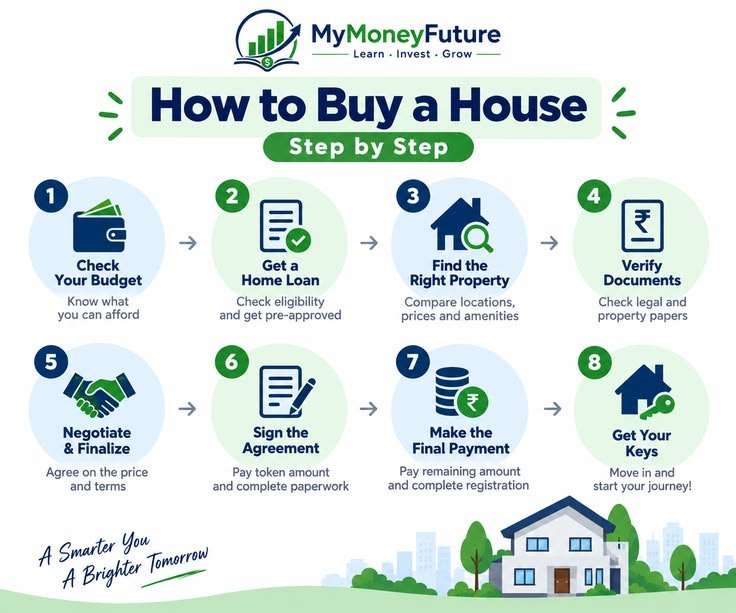
Buying a house is one of the most important financial decisions you will ever make. Whether you are purchasing your first home, moving to a larger property, or investing in real estate, understanding how to buy a house can help you avoid costly mistakes and make confident decisions.
The homebuying process involves more than finding a property you love. You need to evaluate your finances, understand mortgage options, compare neighborhoods, negotiate a fair price, inspect the property, and complete legal paperwork before receiving the keys.
For first-time buyers, these responsibilities can seem overwhelming. However, breaking the process into manageable stages makes it easier to understand what comes next.
This comprehensive guide explains how to buy a house step by step, including financial preparation, mortgage approval, property searches, inspections, closing costs, and practical strategies for becoming a homeowner.
Quick Answer: How to Buy a House
To buy a house, start by reviewing your financial situation and determining how much you can afford. Save for a down payment and closing costs, check your credit score, and explore mortgage options. Once you receive mortgage preapproval, search for suitable homes, make an offer, arrange inspections and an appraisal, finalize your mortgage, and complete the closing process.
Here is a quick overview of the typical homebuying journey in the United States.
| Step | What You Need to Do |
|---|---|
| 1 | Evaluate your financial situation |
| 2 | Determine your homebuying budget |
| 3 | Check your credit score |
| 4 | Save for a down payment |
| 5 | Compare mortgage options |
| 6 | Obtain mortgage preapproval |
| 7 | Find a real estate agent |
| 8 | Search for suitable properties |
| 9 | Make an offer |
| 10 | Schedule a home inspection |
| 11 | Complete the appraisal and mortgage process |
| 12 | Review documents and close the purchase |
The exact process varies depending on your location, financing method, and property type.
1. Evaluate Your Financial Situation Before Buying a House
Before searching for homes, understand your current financial position.
Buying property creates long-term financial responsibilities, including mortgage payments, insurance, taxes, maintenance, and potential repairs.
Review Your Monthly Income
Start by calculating your reliable monthly income.
Include your regular salary, consistent business income, and other documented earnings. If you are self-employed, lenders may examine tax returns and income history rather than relying on your current monthly earnings alone.
Knowing your income helps establish a realistic housing budget.
Calculate Your Existing Debts
Mortgage lenders evaluate your debt-to-income ratio, commonly called DTI.
This ratio compares your required monthly debt payments with your gross monthly income.
For example, suppose you earn $6,000 per month before taxes and have $600 in monthly debt payments.
If your proposed housing payment is $1,800, your total monthly debt obligations would be $2,400.
Your DTI would be:
60002400×100=40%
Different mortgage programs have different DTI requirements. A lower ratio generally gives you greater financial flexibility.
Review Your Savings
Consider how much money you have available for the down payment, closing expenses, moving costs, and emergencies.
Avoid using every dollar of savings to purchase a property. Maintaining an emergency fund can protect you against unexpected expenses after moving in.
2. Determine How Much House You Can Afford
One of the biggest mistakes homebuyers make is shopping based on the maximum mortgage amount a lender offers.
Mortgage approval does not automatically mean the monthly payment fits comfortably into your lifestyle.
Your housing budget should account for:
- Mortgage principal and interest
- Property taxes
- Homeowners insurance
- Mortgage insurance, when required
- Homeowners association fees, if applicable
- Utilities and regular maintenance
- Repairs and unexpected expenses
Example of a Homebuying Budget
Suppose you are considering a $300,000 house with a 10% down payment.
| Expense | Example Amount |
|---|---|
| Home purchase price | $300,000 |
| Down payment (10%) | $30,000 |
| Mortgage amount | $270,000 |
| Interest rate (illustrative) | 6.5% |
| Mortgage term | 30 years |
| Monthly principal and interest | Approximately $1,706 |
This payment excludes property taxes, homeowners insurance, mortgage insurance, and other ownership expenses.
The interest rate is an illustration, not a current lender quote.
Use a Mortgage Affordability Calculator
Online mortgage calculators help estimate monthly payments based on the property price, down payment, interest rate, and repayment term.
Compare several scenarios instead of relying on a single estimate.
For example, examine how your payment changes when you choose a less expensive house, make a larger down payment, or receive a different interest rate.
3. Check and Improve Your Credit Score
Your credit score can influence mortgage eligibility, interest rates, and loan costs.
Lenders also examine your payment history, outstanding debt, credit utilization, and other information in your credit report.
What Credit Score Do You Need to Buy a House?
There is no single credit score requirement for every mortgage.
Some conventional mortgage programs commonly use a minimum score around 620, although requirements vary by lender and loan product. Certain government-backed mortgage programs may allow lower scores when other eligibility conditions are satisfied.
A higher credit score can improve your chances of obtaining favorable financing, but it does not guarantee approval.
Ways to Improve Your Credit Before Buying
Pay bills on time, reduce outstanding credit card balances, check your credit reports for errors, and avoid unnecessary new borrowing before applying for a mortgage.
You should also avoid making major financed purchases, such as a new vehicle, while your mortgage application is being reviewed.
Even small changes in your debt obligations can affect your approval.
4. Save for a Down Payment and Closing Costs
A down payment is the portion of the purchase price you pay upfront.
Many buyers believe they must save 20% of the property’s price before buying a home. Although a 20% down payment can provide benefits, it is not universally required.
How Much Down Payment Do You Need?
| Mortgage Type | Potential Down Payment |
|---|---|
| Certain conventional loans | As low as 3% |
| FHA loans | As low as 3.5% for qualifying borrowers |
| VA loans | Potentially 0% for eligible borrowers |
| USDA loans | Potentially 0% for eligible properties and borrowers |
| Standard conventional loan | Varies by program and lender |
Eligibility requirements, credit standards, property restrictions, and other conditions apply.
A larger down payment generally reduces the amount borrowed and may lower monthly payments.
Understand Closing Costs
Closing costs are additional expenses associated with completing a real estate transaction.
They may include lender charges, title services, appraisal fees, government recording fees, prepaid insurance, and other settlement expenses.
For planning purposes, buyers sometimes estimate closing costs at approximately 2% to 5% of the purchase price, although actual costs can fall outside this range.
For a $300,000 home, that estimate would be $6,000 to $15,000.
Your lender’s official disclosures provide a more accurate estimate.
Keep an Emergency Fund
After paying the down payment and closing costs, try to retain savings for unexpected repairs and essential living expenses.
A home may need plumbing repairs, appliance replacements, electrical work, or other maintenance shortly after purchase.
5. Explore Different Mortgage Options
Choosing the right mortgage is an essential part of learning how to buy a house.
A mortgage is a loan secured by real estate, typically repaid through scheduled payments over an agreed period.
Conventional Mortgages
Conventional mortgages are not insured or guaranteed by the federal government.
They may offer competitive terms to qualified borrowers and are available with different down payment requirements.
Private mortgage insurance is often required on conventional loans when the down payment is below 20%.
FHA Loans
FHA loans are insured by the Federal Housing Administration.
They are often considered by buyers who have limited down payment savings or credit profiles that make certain conventional loans harder to obtain.
FHA loans include mortgage insurance requirements, which should be considered when comparing overall costs.
VA Loans
VA loans are available to eligible military service members, veterans, and certain surviving spouses.
Qualified borrowers may be able to purchase a home without making a down payment.
However, eligibility rules and potential funding fees must be reviewed.
USDA Loans
USDA mortgage programs support eligible buyers purchasing qualifying homes in designated rural areas.
Some USDA loans allow qualified borrowers to finance the full eligible purchase price without a down payment.
Income and geographic restrictions apply.
Fixed-Rate vs. Adjustable-Rate Mortgages
A fixed-rate mortgage maintains the same interest rate throughout the loan term.
An adjustable-rate mortgage, or ARM, generally begins with an initial rate period before the rate can change according to the loan agreement.
Fixed-rate loans offer predictable principal-and-interest payments, while adjustable-rate loans introduce future interest-rate uncertainty.
6. Get Preapproved for a Mortgage
Mortgage preapproval is an important milestone because it helps you understand what a lender may be willing to finance.
During preapproval, a lender reviews financial information and may verify your income, assets, debts, and credit history.
Documents Commonly Required
Lenders may request recent pay statements, tax returns, bank statements, employment information, identification, and records of other financial obligations.
Self-employed applicants may need additional business and income documentation.
Why Mortgage Preapproval Matters
Preapproval helps you establish a realistic property search range and demonstrates to sellers that you have started the financing process.
However, preapproval is not a final mortgage commitment.
Final approval generally depends on updated financial verification, property valuation, underwriting, and satisfaction of the lender’s requirements.
Compare Multiple Lenders
Do not automatically accept the first mortgage offer.
Compare interest rates, annual percentage rates (APRs), lender fees, discount points, repayment terms, and estimated monthly payments.
A lower advertised interest rate does not always mean the loan has the lowest overall cost.
7. Find a Reliable Real Estate Agent
A knowledgeable real estate agent can help you understand local property markets, identify suitable homes, evaluate asking prices, and negotiate purchase terms.
Although buyers can sometimes purchase homes without an agent, professional representation can be particularly helpful for first-time buyers.
What to Look for in an Agent
Choose someone familiar with your target neighborhoods and property type.
Ask about their recent transaction experience, communication style, availability, and approach to negotiations.
Also discuss how the agent is compensated.
In the United States, buyer-agent compensation is negotiable, and the payment arrangement should be clearly explained in your representation agreement.
8. Search for the Right House
Once you understand your budget and financing options, you can begin exploring available properties.
A house should satisfy both your immediate needs and reasonable long-term expectations.
Choose the Right Location
Location affects daily convenience, lifestyle, and future resale opportunities.
Consider commuting distances, schools, transportation, grocery stores, healthcare access, neighborhood conditions, and local property taxes.
Visit neighborhoods at different times of day when possible.
Identify Your Must-Have Features
Before touring properties, separate essential requirements from optional preferences.
For example, your essential requirements might include three bedrooms, two bathrooms, reliable parking, and a manageable commute.
A swimming pool, larger backyard, or recently renovated kitchen may be desirable without being necessary.
Compare Multiple Properties
Avoid purchasing the first attractive house without considering alternatives.
Review comparable homes to understand whether the asking price is reasonable.
Pay attention to property condition, layout, storage, construction quality, and potential maintenance needs.
Research Property Risks
Depending on the location, investigate flood exposure, wildfire risk, drainage problems, foundation concerns, and other environmental conditions.
Insurance availability and premiums can significantly affect the total cost of ownership.
9. Make an Offer on the House
When you find a suitable property, the next stage is submitting a purchase offer.
An offer typically specifies the proposed price and important transaction conditions.
What Does a House Offer Include?
A written offer may address the purchase price, earnest money deposit, financing terms, inspection contingency, appraisal contingency, closing date, and requested seller concessions.
The exact requirements depend on local laws and contract practices.
How Much Should You Offer?
Evaluate recent comparable sales, property condition, local inventory, and how long the home has been listed.
In a competitive market, a seller may receive multiple offers. In a slower market, buyers may have more room to negotiate.
Avoid making an offer based solely on emotion.
Understand Earnest Money
Earnest money is a deposit that demonstrates a buyer’s commitment to the transaction.
It is generally held according to the purchase agreement and applicable local rules.
Whether the money is refundable depends on the contract, contingencies, deadlines, and circumstances surrounding cancellation.
10. Schedule a Professional Home Inspection
A home inspection is one of the most valuable protections available to a buyer.
An inspector evaluates accessible components of the property and identifies visible concerns that may require attention.
What Does a Home Inspector Check?
A typical general inspection may cover the roof, foundation, structural components, plumbing, electrical systems, heating and cooling equipment, attic, insulation, windows, doors, and other accessible areas.
A general inspection does not guarantee that every hidden defect will be discovered.
Specialized inspections may be appropriate for pests, sewer lines, radon, mold concerns, or other location-specific risks.
What Happens If the Inspection Finds Problems?
Depending on your contract, you may be able to request repairs, negotiate a credit or price adjustment, accept the property as it is, or terminate the agreement under a valid inspection contingency.
Minor cosmetic issues are common, but major structural or safety problems deserve careful evaluation.
11. Complete the Home Appraisal
If you are financing the purchase, the lender will typically require an appraisal or another acceptable property valuation method.
An appraisal provides an independent opinion of the property’s value for lending purposes.
What If the Appraisal Is Lower Than the Offer?
Suppose you agree to buy a house for $350,000, but the appraisal comes back at $335,000.
The lender may base its loan calculation on the lower appraised value.
Depending on your contract and financing options, you may need to renegotiate the price, contribute additional cash, challenge the appraisal through an appropriate review process, or use an applicable contingency.
An appraisal and a home inspection serve different purposes. An appraisal focuses primarily on value, while an inspection evaluates the property’s condition.
12. Finalize Your Mortgage Approval
After the offer is accepted, your lender completes the underwriting process.
Underwriting involves reviewing the financial and property information necessary to determine whether the loan meets approval requirements.
The lender may ask for updated statements, clarification about deposits, proof of insurance, or additional employment verification.
Avoid Major Financial Changes
While your mortgage is pending, avoid taking on substantial new debt, making large unexplained bank transfers, or changing employment without discussing the implications with your lender.
Continue paying existing obligations on time.
Respond promptly to legitimate documentation requests to help prevent unnecessary delays.
13. Review the Closing Disclosure and Final Costs
Before closing, review your final loan terms and settlement expenses carefully.
For most covered U.S. mortgage transactions, lenders must provide a Closing Disclosure at least three business days before consummation.
This document summarizes important financial details, including the loan amount, interest rate, monthly payment, closing costs, and cash required to close.
Compare it with your earlier Loan Estimate and ask about unexpected differences.
Make sure you understand the financial obligations before signing.
14. Conduct a Final Walkthrough
A final walkthrough usually occurs shortly before closing.
Its purpose is to confirm that the property’s condition is consistent with the purchase agreement.
Check that agreed repairs have been completed, included appliances remain in place, and no significant new damage has occurred.
A final walkthrough is not a substitute for a professional home inspection.
If you discover a problem, notify your agent or appropriate transaction professional before completing the purchase.
15. Close on the House and Receive Your Keys
Closing is the final stage of the homebuying process.
During closing, the parties complete the required legal and financial steps to transfer ownership.
You may sign mortgage documents, settlement statements, title-related paperwork, and other required forms.
Funds are distributed according to the transaction arrangements, and the deed is recorded under applicable local procedures.
What Happens After Closing?
Once the transaction is completed and possession is authorized under the contract, you can receive the keys and prepare to move into your new home.
Keep copies of your important purchase and mortgage documents.
You should also arrange utilities, update your address, confirm insurance coverage, and establish a maintenance schedule.
How Much Money Do You Need to Buy a House?
The amount needed depends on the property price, mortgage program, location, and available financial assistance.
Consider this illustrative scenario for a $250,000 house.
| Expense | Estimated Amount |
|---|---|
| Home price | $250,000 |
| Down payment (5%) | $12,500 |
| Closing costs (3%) | $7,500 |
| Moving expenses | $2,000 |
| Initial maintenance reserve | $3,000 |
| Total upfront planning amount | $25,000 |
These figures are examples rather than universal requirements. They exclude any additional emergency savings you may wish to retain.
Some buyers qualify for down payment assistance, seller credits, or other programs that reduce the cash needed upfront.
How Long Does It Take to Buy a House?
The homebuying timeline depends on your financial readiness, local inventory, market competition, and financing arrangements.
| Stage | Illustrative Timeframe |
|---|---|
| Financial preparation | Several weeks to several months |
| Mortgage preapproval | A few days to a few weeks |
| House hunting | Several weeks to several months |
| Offer and negotiation | A few days to several weeks |
| Inspection and appraisal | Approximately 1–3 weeks |
| Mortgage underwriting and closing | Often 30–45 days after contract acceptance |
These stages may overlap, and individual transactions can move faster or take considerably longer.
Cash purchases may avoid mortgage underwriting, but buyers should still evaluate title, condition, and legal requirements.
How to Buy a House With Bad Credit
Buying a house with imperfect credit may be possible, although financing options can be more limited or expensive.
Start by reviewing your credit reports and identifying factors affecting your score.
Reducing high credit card balances, resolving reporting errors, and building a consistent payment history may improve your mortgage readiness.
You can also investigate government-backed mortgage programs and lenders that work with borrowers who have different credit profiles.
Be cautious about accepting a loan with high fees or an unaffordable payment simply because approval is available.
In some circumstances, delaying the purchase while improving your finances may be the better decision.
How to Buy a House With Little or No Down Payment
Saving a large down payment is a major obstacle for many first-time buyers.
Fortunately, several financing and assistance options may help.
Eligible borrowers may qualify for VA or USDA loans with no down payment. Certain conventional and FHA programs also allow relatively low down payments.
State and local housing agencies sometimes provide down payment assistance through grants, forgivable loans, or deferred-payment arrangements.
Each program has its own eligibility rules, and assistance may be restricted by income, location, purchase price, or first-time buyer status.
Remember that zero down payment does not necessarily mean zero upfront expenses or zero financial risk.
Should You Buy a New House or an Older House?
Both newly built and existing homes offer advantages.
| Factor | New Construction | Existing Home |
|---|---|---|
| Property condition | Generally newer systems | Varies by age and maintenance |
| Customization | May offer design selections | May require renovation |
| Maintenance | Often lower initially | Can be higher |
| Location | Frequently newer developments | Often established neighborhoods |
| Warranty | Builder coverage may be available | Depends on purchase terms |
| Pricing | May include builder premiums | Depends on local market |
New construction can offer modern layouts and energy-efficient features, but buyers should investigate builder quality, contracts, completion timelines, and warranty terms.
Older homes may provide established landscaping, mature neighborhoods, or distinctive architecture, but they can also require substantial repairs.
The best choice depends on your budget, preferences, and willingness to manage maintenance.
Common Mistakes to Avoid When Buying a House
Even experienced buyers can make costly decisions when they rush the process.
Buying More House Than You Can Afford
A lender’s maximum approval amount should not dictate your spending limit.
Choose a monthly payment that leaves room for savings, emergencies, and other financial goals.
Ignoring Hidden Ownership Costs
Mortgage payments represent only part of the expense.
Property taxes, insurance, maintenance, utilities, and association fees can make a seemingly affordable house expensive.
Skipping the Home Inspection
Waiving inspection protections may expose you to expensive problems that are difficult to identify during a casual viewing.
Understand the risks before agreeing to waive any contingency.
Failing to Compare Mortgage Offers
Different lenders may offer different rates, fees, and loan structures.
Comparing offers can reveal meaningful differences in the long-term cost of borrowing.
Overlooking the Neighborhood
A beautiful house may not be the right purchase if its location does not fit your daily needs.
Research the area before committing.
Making Emotional Decisions
Competition and excitement can encourage buyers to exceed their budgets or overlook warning signs.
Establish financial limits and property requirements before making offers.
Is It Better to Rent or Buy a House?
Homeownership is not automatically better than renting.
Buying may provide housing stability, opportunities to build equity, and greater freedom to modify your property.
However, it also creates transaction costs, maintenance responsibilities, and exposure to property-value changes.
Renting can provide flexibility and reduce responsibility for major property repairs, depending on the lease.
Buying may be more attractive when you expect to remain in one location for several years, have stable finances, and can comfortably afford ownership expenses.
Renting may be preferable when you anticipate moving soon, need financial flexibility, or are not prepared for maintenance costs.
A useful comparison considers total costs over your expected period of residence rather than comparing rent with the mortgage payment alone.
Practical Tips for First-Time Homebuyers
Successful homebuyers usually combine financial preparation with careful property research.
Build a realistic budget before visiting homes. Compare mortgage offers using the same loan assumptions, and review the total monthly housing cost rather than focusing only on the purchase price.
Investigate property taxes, insurance costs, local hazards, and potential maintenance expenses early.
Keep your financial records organized, read contracts carefully, and ask questions whenever a condition or fee is unclear.
Most importantly, remember that purchasing a home should support your long-term financial stability rather than create unnecessary pressure.
Frequently Asked Questions About Buying a House
Can I Buy a House Without a Real Estate Agent?
Yes. In many places, buyers can purchase a property without hiring a real estate agent. However, you may still benefit from a qualified real estate attorney or other professional who can help review contracts, title matters, and legal requirements.
Do I Need 20% Down to Buy a House?
No. Several mortgage programs allow eligible buyers to purchase homes with less than 20% down. Some qualifying borrowers may have access to zero-down-payment programs. Smaller down payments can increase borrowing costs or mortgage insurance requirements.
What Is the First Thing I Should Do When Buying a House?
Start by reviewing your income, savings, credit, and existing debts. This helps determine whether you are financially ready and what price range you can realistically afford.
Can I Buy a House With No Credit History?
It may be possible through certain mortgage programs or lenders that permit alternative credit documentation. However, requirements vary, and a lack of traditional credit history can make the process more challenging.
How Long Does Mortgage Preapproval Last?
Many preapproval letters are valid for approximately 60 to 90 days, but the duration depends on the lender. Updated documentation or another credit review may be required after expiration.
Who Pays Closing Costs When Buying a House?
Both buyers and sellers may have closing expenses. The allocation depends on local customs, the purchase agreement, loan requirements, and negotiated concessions.
What Happens If My Mortgage Is Denied After My Offer Is Accepted?
The consequences depend on your purchase contract and any financing contingency. You may be able to seek alternative financing, negotiate an extension, or terminate under an applicable contingency. Without appropriate protections, your earnest money could be at risk.
Can I Buy a House Without a Mortgage?
Yes. A cash purchase eliminates the need for mortgage financing, but buyers should still investigate property condition, ownership records, liens, title issues, and applicable closing requirements.
Is Buying a House a Good Investment?
A house can provide long-term value through housing stability and potential equity growth. However, property values can decline, and ownership involves taxes, insurance, interest, maintenance, and transaction costs. Investment outcomes are never guaranteed.
What Should I Check Before Buying an Older House?
Pay particular attention to the roof, foundation, electrical system, plumbing, heating and cooling equipment, water damage, and possible hazardous materials. Depending on the property’s age and location, specialized inspections may be advisable.
Final Thoughts: How to Buy a House Successfully
Learning how to buy a house is about much more than choosing a property and securing a mortgage. It requires thoughtful financial planning, careful market research, informed negotiations, and a clear understanding of the responsibilities that come with ownership.
Start by establishing a comfortable budget, strengthening your financial position, and comparing available mortgage options. Once you are ready, take time to research neighborhoods, evaluate properties, arrange professional inspections, and review all important documents before closing.
There is no universal perfect time to purchase a home. The right time depends on your financial stability, housing needs, local market conditions, and long-term plans.
With patience, preparation, and the right professional guidance, you can navigate the homebuying process more confidently and choose a property that supports your future goals.