Online learning has transformed how people develop skills, pursue career opportunities, and explore new interests. Whether you want to learn programming, digital marketing, graphic design, business management, or communication skills, online courses provide flexible opportunities to study from almost anywhere.
For someone with little or no previous experience, choosing the right course can be challenging. Thousands of programs are available across different platforms, offering everything from short introductory lessons to comprehensive professional certificates.
The best online courses for beginners focus on clear explanations, practical exercises, manageable learning schedules, and foundational knowledge. They help students understand essential concepts before moving toward more advanced subjects.
This comprehensive guide explores beginner-friendly online courses, popular learning platforms, free learning opportunities, career-focused skills, certificate programs, and practical strategies for choosing the right course in 2026.
What Are Online Courses for Beginners?
Online courses for beginners are educational programs designed for learners who have limited or no previous knowledge of a particular subject.
These courses typically introduce fundamental concepts, explain important terminology, and provide structured lessons that gradually increase in difficulty.
Unlike advanced training programs, beginner courses generally avoid assuming extensive technical knowledge or professional experience.
They may include video lessons, reading materials, interactive exercises, quizzes, downloadable resources, and practical assignments.
Online courses can be self-paced, allowing students to learn according to their availability, or instructor-led, requiring participation at scheduled times.
Who Should Take Beginner Online Courses?
Beginner courses are suitable for students, recent graduates, career changers, freelancers, entrepreneurs, working professionals, and individuals interested in personal development.
They are particularly useful for people who want to explore a subject before investing in more expensive or specialized training.
Quick Answer: What Are the Best Online Courses for Beginners?
Some of the most useful beginner online courses cover digital marketing, Python programming, Excel, graphic design, web development, data analytics, artificial intelligence, business communication, and personal finance.
The best choice depends on your interests, career goals, budget, and available study time.
| Course Subject | Skills You Can Learn | Potential Applications |
|---|---|---|
| Digital Marketing | SEO, content strategy, online advertising | Marketing, freelancing |
| Python Programming | Coding fundamentals, automation | Software, data analysis |
| Graphic Design | Layout, typography, visual communication | Design, branding |
| Microsoft Excel | Formulas, spreadsheets, data organization | Administration, finance |
| Web Development | HTML, CSS, JavaScript | Website creation |
| Data Analytics | Data cleaning, charts, interpretation | Business analysis |
| Artificial Intelligence | AI concepts, responsible tool use | Productivity, technology |
| Content Writing | Research, editing, storytelling | Blogging, communications |
| Project Management | Planning, scheduling, teamwork | Business operations |
| Business Communication | Writing, presentations, collaboration | Professional development |
No course guarantees employment or income. The value of training depends on what you learn, how well you apply it, and the opportunities available in your field.
Why Online Courses Are Worth Considering
Online education offers several advantages for people who want to develop new skills without attending traditional classroom programs.
Flexible Learning Schedules
Many online courses allow students to access lessons at convenient times.
This flexibility is particularly helpful for working professionals, university students, and people managing family responsibilities.
Access to Different Subjects
Online learning platforms offer courses covering technical, creative, academic, and professional subjects.
Students can explore unfamiliar fields without immediately committing to a full degree program.
Free and Affordable Options
Some providers offer free introductory lessons, open educational resources, or financial assistance.
Paid programs may provide additional assignments, instructor support, graded assessments, or certificates.
Opportunities for Practical Learning
Well-designed courses include projects and exercises that help learners apply theoretical knowledge.
For example, a web development student might build a simple website, while a digital marketing student could create a sample marketing campaign.
Career Development
Online training can help learners develop job-related skills and demonstrate initiative.
However, certificates alone rarely replace practical experience, a strong portfolio, or qualifications required for regulated professions.
1. Digital Marketing Courses for Beginners
Digital marketing is a popular starting point for people interested in online business, content creation, and advertising.
It involves promoting products, services, or brands through digital channels.
What You Will Learn
Introductory digital marketing courses often cover search engine optimization, social media marketing, content marketing, email marketing, paid advertising, website analytics, and customer engagement.
Students also learn how businesses identify target audiences and measure campaign performance.
Recommended Learning Platforms
Google Skillshop, HubSpot Academy, and Coursera offer learning resources related to digital marketing.
Course availability, enrollment conditions, and certificate policies vary.
Who Should Choose Digital Marketing?
This subject may appeal to aspiring marketers, bloggers, entrepreneurs, freelancers, and small business owners.
A useful beginner project is creating a basic marketing plan for a hypothetical business, including its target audience, content strategy, and performance goals.
2. Python Programming Courses for Beginners
Python is a widely used programming language known for its readable syntax and broad range of applications.
It is commonly used in software development, automation, data analysis, scientific computing, and machine learning.
What You Will Learn
A beginner Python course typically introduces variables, data types, conditional statements, loops, functions, lists, dictionaries, and basic error handling.
More comprehensive courses may introduce file handling, libraries, and simple programming projects.
Popular Beginner Course Options
Harvard’s CS50P, CS50’s Introduction to Programming with Python, is designed to teach Python programming fundamentals.
Python.org also provides official documentation and introductory learning resources.
Other platforms, including Codecademy and Coursera, offer structured Python courses.
Practical Projects
Beginners can practice by building a calculator, number-guessing game, simple expense tracker, or basic file organizer.
These projects help reinforce programming concepts through hands-on experience.
3. Graphic Design Courses for Beginners
Graphic design combines creativity with visual communication.
Designers use typography, colors, images, spacing, and layouts to communicate information effectively.
What You Will Learn
Beginner graphic design courses often cover color theory, typography, composition, visual hierarchy, branding, and basic design software.
Students may also learn how to create social media graphics, posters, presentations, and simple brand materials.
Where to Learn Graphic Design
Canva Design School provides educational resources related to visual design and Canva tools.
Adobe also offers tutorials for its creative applications.
Additional introductory courses are available through platforms such as Udemy, Skillshare, and Coursera.
Beginner Practice Ideas
Create a social media post, event flyer, business card, or presentation cover.
Focus on readability, alignment, spacing, and consistency rather than using excessive decorative effects.
4. Microsoft Excel Courses for Beginners
Microsoft Excel is a valuable skill for office administration, accounting, business operations, and data management.
Learning spreadsheets can improve your ability to organize information and perform calculations.
What You Will Learn
Beginner courses typically cover worksheets, cell formatting, basic formulas, sorting, filtering, charts, and common functions.
Important introductory functions include SUM, AVERAGE, COUNT, IF, and SUMIF.
More advanced training may introduce pivot tables, lookup functions, and data analysis tools.
Recommended Learning Resources
Microsoft provides Excel training and support documentation.
Platforms such as Coursera, LinkedIn Learning, and Udemy also offer structured Excel courses.
Practical Projects
Create a personal monthly budget, student grade sheet, inventory tracker, or basic sales report.
These exercises help develop skills that can be applied in everyday work.
5. Web Development Courses for Beginners
Web development involves creating and maintaining websites and web applications.
It is an accessible field for beginners because students can start building simple webpages with foundational technologies.
What You Will Learn
Most introductory web development courses begin with three core technologies:
- HTML for webpage structure
- CSS for visual styling and layout
- JavaScript for interactive behavior
Students may later explore responsive design, accessibility, version control, and development frameworks.
Best Places to Learn Web Development
freeCodeCamp offers interactive coding lessons and project-based learning.
The Odin Project provides a structured web development curriculum.
MDN Web Docs also contains extensive educational resources for web technologies.
Beginner Practice Projects
Start with a personal profile webpage, simple portfolio, restaurant menu, or basic landing page.
As your skills improve, add responsive layouts and interactive features.
6. Data Analytics Courses for Beginners
Data analytics involves examining information to identify patterns, answer questions, and support decision-making.
Organizations use data analysis in marketing, finance, healthcare, retail, and many other industries.
What You Will Learn
Beginner data analytics courses may introduce data collection, spreadsheet analysis, data cleaning, basic statistics, visualization, and introductory SQL.
Some programs also cover Python or business intelligence tools.
Popular Learning Options
The Google Data Analytics Professional Certificate on Coursera is a well-known introductory program.
Microsoft Learn offers educational material related to data tools and Power BI.
Kaggle Learn provides short, practical lessons covering selected data-related skills.
Practical Learning Activities
Analyze a small sales dataset, create charts showing monthly performance, or summarize customer survey responses.
A completed project can demonstrate your ability to organize information and explain findings.
7. Artificial Intelligence Courses for Beginners
Artificial intelligence is increasingly relevant across technology, business, education, and creative work.
Introductory AI courses help learners understand what these systems can do, how they work at a conceptual level, and where their limitations lie.
What You Will Learn
Topics may include machine learning fundamentals, generative AI, large language models, prompt writing, responsible AI use, privacy, and evaluating AI-generated information.
Some introductory courses require no programming knowledge.
Beginner-Friendly AI Courses
Elements of AI, developed by the University of Helsinki and MinnaLearn, is an introductory learning resource.
Google and Microsoft also offer AI learning materials through their educational platforms.
How to Practice
Try using AI tools to organize research questions, brainstorm ideas, summarize non-sensitive information, or create study plans.
Always verify important outputs rather than assuming generated information is accurate.
8. Content Writing Courses for Beginners
Content writing is useful for people interested in blogging, digital marketing, business communication, and freelance writing.
Strong writing skills can help communicate information clearly and persuasively.
What You Will Learn
Beginner courses often cover audience research, article structure, headlines, editing, grammar, readability, search intent, and content planning.
Some programs introduce SEO writing and content management systems.
Where to Learn
HubSpot Academy, Coursera, and Udemy offer writing and content marketing resources.
You can also improve through reputable writing guides and regular practice.
Practice Projects
Write an informational article, product comparison, newsletter, or short website page.
Revise your work for accuracy, organization, clarity, and usefulness.
9. Project Management Courses for Beginners
Project management focuses on planning, organizing, and coordinating activities to achieve defined objectives.
It is relevant to many industries, including technology, construction, marketing, education, and business operations.
What You Will Learn
Introductory courses cover project scope, scheduling, task management, stakeholder communication, risk identification, and team coordination.
Some programs introduce Agile and traditional project management methods.
Recommended Learning Options
The Google Project Management Professional Certificate is one structured introductory option.
Project Management Institute resources and other educational providers also offer foundational learning opportunities.
Practical Project
Plan a small event or website launch.
Define objectives, create a timeline, assign responsibilities, and identify potential risks.
10. Business Communication Courses for Beginners
Business communication skills help people express ideas professionally and collaborate effectively.
These abilities are valuable across nearly every industry.
What You Will Learn
Courses may cover professional email writing, presentations, active listening, workplace etiquette, negotiation, meeting participation, and written reports.
Where to Learn
Coursera, LinkedIn Learning, and edX offer business communication courses at different levels.
Practical Applications
Practice writing concise professional emails, preparing short presentations, and explaining complex ideas in simple language.
Effective communication requires both clarity and awareness of the intended audience.
Best Online Learning Platforms for Beginners in 2026
Choosing a reliable learning platform is almost as important as choosing the right subject.
Different platforms offer different teaching styles, pricing structures, certificates, and levels of instructor support.

1. Coursera
Offers university courses, professional certificates, and career-oriented programs. Suitable for learners seeking structured instruction and recognized educational providers.
Free and paid learning options; certificate access varies.

2. Udemy
Provides courses covering programming, design, marketing, business, and personal development. Useful for learning specific skills through instructor-led video lessons.
Free and paid courses; quality varies by instructor.

3. edX
Features academic courses and professional programs from universities and educational institutions. A good choice for structured academic learning.
Some courses offer free audit access; verified credentials may cost extra.

4. freeCodeCamp
Focuses on coding and web development through interactive lessons, exercises, and projects. Its updated Responsive Web Design certification includes hands-on assessments.

freeCodeCamp
Free learning resources and certifications.

5. Khan Academy
Provides educational lessons in mathematics, science, economics, and other foundational subjects. Particularly helpful for students building academic knowledge.
Free educational resources.

6. LinkedIn Learning
Offers professional development courses covering business software, communication, management, and technology.
Primarily subscription-based; access may also be available through institutions.
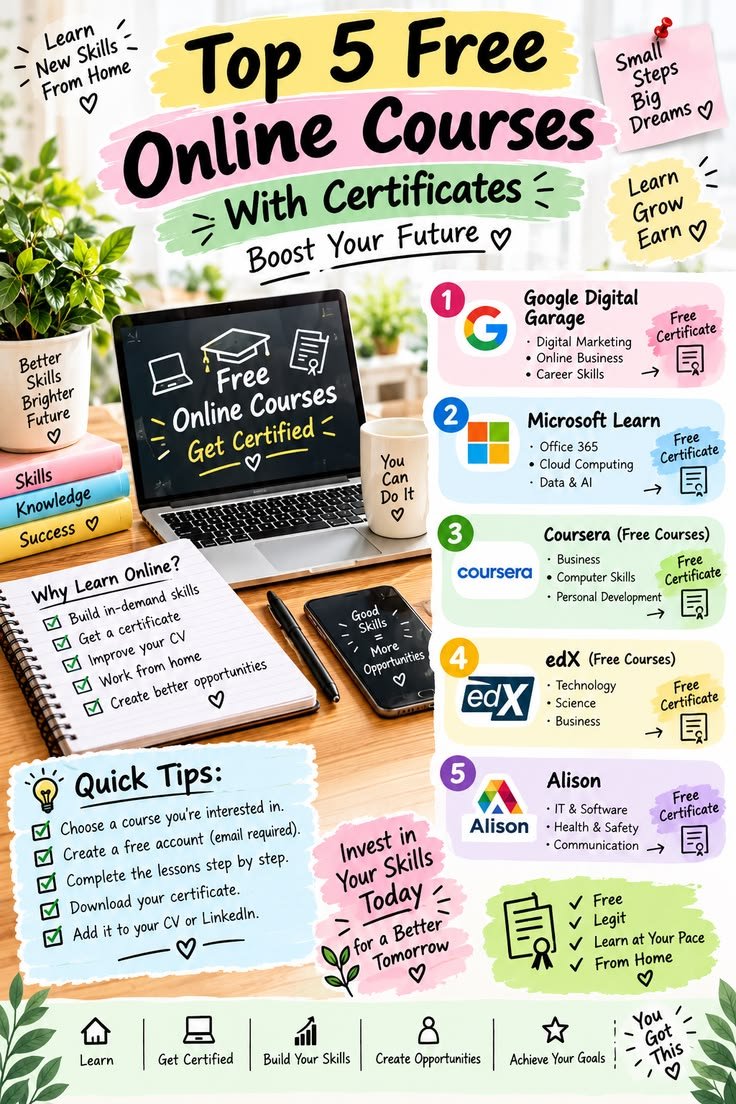
Free Online Courses for Beginners With Certificates
Free courses are useful when you want to explore a subject before committing financially.
However, there is an important difference between free course access and a free certificate.
Some platforms allow learners to view educational content without payment but charge for graded assignments or official certificates.
Other providers offer both free training and free credentials.
| Course or Provider | Subject | Free Learning | Certificate |
|---|---|---|---|
| Harvard CS50P | Python programming | Yes | Free CS50 certificate upon meeting requirements; paid verified option |
| freeCodeCamp | Web development | Yes | Free certification upon completion of requirements |
| HubSpot Academy | Digital marketing | Yes | Free certifications for qualifying courses |
| Khan Academy | Academic fundamentals | Yes | Primarily learning progress rather than professional certification |
| Microsoft Learn | Technology and software | Yes | Badges and credentials vary by program |
| Google Skillshop | Google products and advertising | Selected training | Depends on assessment and program |
Harvard’s CS50P, for example, is available through its free OpenCourseWare offering and is designed for people with or without previous programming experience.
edX
Always review the current certificate conditions before enrolling.
How to Choose the Right Online Course as a Beginner
A course that works well for one learner may not be suitable for another.
Your decision should depend on your goals, previous knowledge, learning preferences, and budget.
Identify Your Learning Goal
Determine whether you want to explore a hobby, improve an existing skill, prepare for employment, or develop a professional specialization.
A learner interested in office administration might benefit from Excel training, while someone interested in software development may prefer Python or web development.
Check the Course Prerequisites
Read the course description carefully.
A program labeled introductory may still assume basic computer skills, mathematics, or familiarity with particular software.
Review the Curriculum
Look for a logical progression from foundational concepts to practical applications.
A strong beginner course should explain what you will learn and how your understanding will be assessed.
Evaluate Instructor Credentials
Consider the instructor’s relevant professional experience, teaching background, and demonstrated expertise.
Student reviews can provide useful context, but they should not be your only basis for choosing a course.
Compare Costs and Certificate Conditions
Before paying, check whether the platform uses individual course purchases, monthly subscriptions, or recurring program fees.
Review cancellation policies, refund conditions, and certificate eligibility.
Look for Practical Assignments
Courses that include exercises and projects offer opportunities to apply new concepts.
For career-focused learning, practical experience can be particularly valuable.
Which Online Course Should You Start With?
What is your main learning goal?Improve my career opportunitiesLearn a freelance skillGrow my business knowledgeExplore something new
How many hours can you study per week?1–2 hours3–5 hours6+ hours
SUGGESTED STARTING SUBJECTS
Data Analytics
Project Management
These suggestions are based on your stated goals and available study time, not a guarantee of career outcomes.
How Much Do Online Courses Cost?
The cost of online education depends on the platform, instructor, program length, and credential.
Some educational resources are completely free, while others use subscription plans or charge separately for individual courses.
| Learning Format | Typical Pricing Structure |
|---|---|
| Open educational resources | Free |
| Individual video courses | Free or one-time purchase |
| Learning subscriptions | Recurring monthly or annual fee |
| Professional certificate programs | Subscription or program fee |
| University online courses | Free audit or paid enrollment |
| Online degree programs | Tuition-based |
Prices change frequently, and promotional discounts may affect the amount paid.
Before enrolling, calculate the total expected cost based on how long you realistically need to complete the program.
How Long Does It Take to Complete an Online Course?
Course duration varies considerably.
A short introductory course may require only a few hours, while a comprehensive professional certificate can involve several months of study.
For example, the Google Data Analytics Professional Certificate is presented as a beginner-level program with a suggested pace of approximately six months at ten hours per week. Actual completion times vary.
Coursera
A practical study schedule might look like this:
| Weekly Study Time | Suitable Learning Approach |
|---|---|
| 1–2 hours | Short introductory lessons |
| 3–5 hours | Regular coursework with small exercises |
| 6–10 hours | Structured courses with weekly projects |
| 10+ hours | Intensive learning and portfolio development |
The number of hours studied is less important than whether you understand and can apply the material.
Are Online Course Certificates Worth It?
Online certificates can demonstrate that you completed a particular learning program and, in some cases, passed assessments.
They may help you document professional development, but their value depends on the provider, curriculum, assessment quality, and employer expectations.
A certificate of completion is not necessarily equivalent to an accredited degree, professional license, or industry certification.
For technical and creative fields, employers may also want to see practical projects, portfolios, or demonstrations of your abilities.
Choose programs based on the knowledge and skills they teach rather than selecting courses solely because they offer certificates.
Can Online Courses Help You Get a Job?
Online courses can support career preparation by helping you acquire new knowledge and develop practical skills.
However, completing a course does not guarantee employment.
Employers may consider education, work experience, communication skills, technical abilities, portfolios, and interview performance.
For beginners, an effective approach is to combine structured learning with practical projects.
For example, someone learning web development can create a portfolio website, while a data analytics learner can prepare a report using a sample dataset.
These projects can provide tangible evidence of what you have learned.
Common Mistakes Beginners Make With Online Courses
One common mistake is enrolling in too many courses simultaneously.
This can divide attention and make it difficult to complete any single program.
Another mistake is watching lessons passively without practicing the material.
Taking notes is useful, but applying concepts through exercises and projects is essential for developing skills.
Some learners also choose courses based entirely on advertisements or promises of rapid income.
Be cautious of programs guaranteeing employment, unusually high earnings, or professional expertise after minimal training.
Finally, avoid spending heavily on advanced programs before confirming that you enjoy the subject and understand its fundamentals.
Tips for Successfully Completing Your First Online Course
Start with one subject that genuinely interests you.
Choose a beginner-level course with a clear curriculum and manageable assignments.
Set aside regular study time and create a distraction-free environment.
After each lesson, practice the concepts before moving forward.
Keep track of completed modules and identify topics requiring additional review.
If a concept is difficult, revisit earlier lessons or use supplementary educational resources.
Completing a small, practical project can be a meaningful milestone because it demonstrates your ability to apply what you have learned.
Frequently Asked Questions About Online Courses for Beginners
What Is the Best Online Course for a Complete Beginner?
The best course depends on your interests and goals. Excel, digital marketing, graphic design, Python, and web development are useful starting points for different career paths.
Can I Learn Online Without Previous Experience?
Yes. Many introductory programs are specifically designed for students with no previous experience in the subject.
Are There Free Online Courses With Certificates?
Yes. Providers such as freeCodeCamp and HubSpot Academy offer free certification opportunities for eligible courses. Other platforms may charge for verified certificates.
Which Online Courses Are Best for Getting a Job?
Courses in data analytics, programming, digital marketing, project management, and business software can help develop job-related skills. Employment outcomes depend on market demand, experience, and individual qualifications.
Can I Learn Programming Without a Computer Science Degree?
Yes. Many introductory programming courses require no computer science degree. Consistent practice and problem-solving are important for developing programming skills.
Are Online Courses Better Than Traditional Classes?
Neither format is universally better. Online courses offer flexibility, while traditional classes may provide more direct interaction and structured supervision. The right choice depends on your learning preferences and educational needs.
How Many Online Courses Should I Take at Once?
Beginners often benefit from focusing on one primary course at a time. Taking multiple courses may be manageable if the workload is realistic and the subjects complement one another.
Can I Take Online Courses Using a Smartphone?
Many platforms support mobile learning, but programming, graphic design, spreadsheets, and other practical subjects may require a laptop or desktop computer for certain assignments.
Do Employers Accept Online Course Certificates?
Some employers value relevant online certificates, especially when supported by demonstrated skills. Acceptance depends on the employer, position, credential, and industry.
How Can I Stay Motivated While Learning Online?
Set achievable weekly goals, establish a regular study schedule, track your progress, and practice through small projects. Focus on learning rather than simply finishing lessons.
Conclusion
Choosing the right online courses for beginners can be an important first step toward developing valuable skills, exploring career opportunities, or pursuing personal interests.
In 2026, learners can access introductory education in programming, digital marketing, graphic design, data analytics, artificial intelligence, business communication, and many other subjects.
Platforms such as Coursera, edX, freeCodeCamp, Khan Academy, and Udemy provide different learning formats for students with varying budgets and goals.
The most important factor is not how many courses you enroll in, but how effectively you apply what you learn.
Start with a subject that aligns with your interests, choose a reliable course, maintain a manageable study schedule, and complete practical exercises.
With consistent effort and realistic expectations, online learning can become a valuable part of your personal and professional development.