
Quick Answer
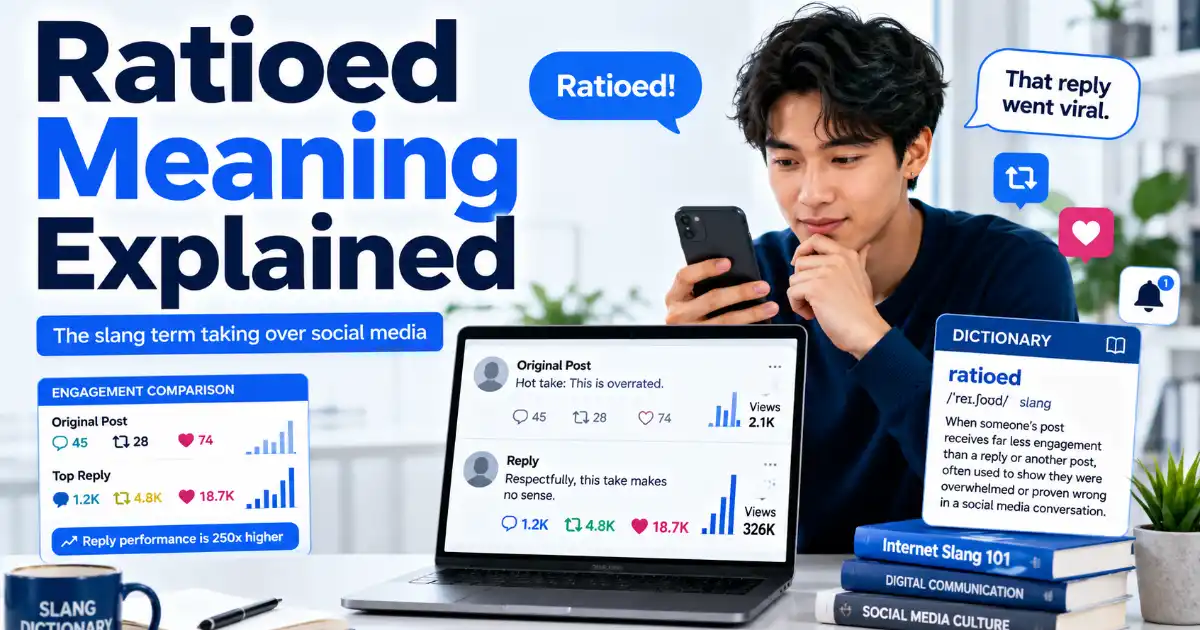
Ratioed is internet slang used when a social media post receives a much stronger negative or critical response than the original post itself. On platforms such as X, people may say someone got ratioed when a reply receives more likes, reposts, or attention than the original post. The term usually suggests that the audience disagreed with, mocked, or challenged the original message.
Introduction
Social media has created its own vocabulary, and ratioed is one of the terms that often appears during arguments, jokes, controversial opinions, and viral conversations. Someone might post an opinion and then receive a reply that gets thousands of likes while the original post gets very little engagement. Other users may respond by saying the original poster got ratioed.
The word can look confusing because ratioed does not describe a normal mathematical ratio in everyday social media conversations. Instead, it describes an engagement imbalance that users interpret as a sign that one side of a conversation received more public support.
Understanding the term helps make sense of comments on X, TikTok, Instagram, Reddit, YouTube, and other online communities. This guide explains what ratioed means, how the term developed, how people use it, what getting ratioed looks like, and how it differs from related expressions such as ratio, ratioing, and getting owned.
What Does Ratioed Mean?
Ratioed means that a social media post or comment received a weaker public reaction than another post or reply connected to it. The difference often appears through likes, reposts, replies, views, or other engagement signals.
The term comes from the idea of comparing two numbers. If a person’s original post receives 20 likes but a critical reply receives 2,000 likes, users may describe the original poster as being ratioed.
The meaning does not always depend on one exact mathematical formula. Social media users often use the word more casually. A person can be considered ratioed because a reply attracts substantially more attention, because most visible replies disagree with the original post, or because the audience clearly favors another side of the conversation.
For example:
Person A: This movie is completely overrated.
Person B: I think the three-hour runtime is the only problem.
Person B gets 15,000 likes while Person A gets 300.
Other users might say Person A got ratioed.
The term can also function as a verb:
That post got ratioed.
Or:
The reply ratioed the original post.
In casual online communication, ratioed usually carries a humorous, teasing, or critical tone.
Ratioed Meaning in Simple Terms
The easiest way to understand ratioed is to think of it as losing the social media engagement battle.
| Term | Meaning | Tone | Example |
|---|---|---|---|
| Ratio | Engagement comparison | Neutral or playful | That reply has a better ratio. |
| Ratioed | Received a much weaker reaction | Usually teasing | He got ratioed in the comments. |
| Ratioing | The act of overwhelming another post with engagement | Informal | People started ratioing the post. |
| Getting ratioed | Experiencing the engagement imbalance | Informal | She got ratioed after that opinion. |
The important point is that ratioed describes a social media reaction, not necessarily an objective judgment about who is correct.
A highly liked reply does not automatically prove that its argument is factually correct. It only shows that the reply attracted more visible engagement or approval from that particular audience.
How Does Ratioed Work on Social Media?
A ratio usually becomes noticeable when users compare the engagement of two connected posts.
Imagine an original post with:
- 100 likes
- 20 reposts
- 50 replies
A reply criticizing that post might receive:
- 8,000 likes
- 1,500 reposts
- 300 replies
People may call the original post ratioed because the response generated much stronger engagement.
The comparison can happen in several ways. Users may look at likes, reposts, comments, views, or the general reaction shown underneath a post.
On some platforms, the visual design makes these comparisons easier to notice. On others, people use the term more loosely when a comment section overwhelmingly criticizes an opinion.
What Does It Mean to Get Ratioed?
To get ratioed means that a social media post receives a comparatively poor reaction while another post or reply connected to it receives significantly more positive engagement.
The phrase often appears after someone makes a controversial statement.
For example:
User: Nobody watches baseball anymore.
Reply: That is definitely not true.
The reply receives far more likes than the original post.
Someone might comment:
You got ratioed.
The phrase can be playful rather than genuinely hostile. Friends sometimes use it jokingly when one person’s opinion receives less support than another person’s response.
However, the term can also be used as an insult during heated online arguments.
Where Did the Term Ratioed Come From?
The slang developed from the idea of comparing engagement numbers on social media. It became particularly associated with platforms where users could easily compare likes and reposts between an original post and its replies.
The term became widely recognized through online discussions involving controversial opinions, political arguments, celebrity posts, jokes, and viral replies.
Over time, users began using ratio more broadly. Instead of referring only to a strict numerical comparison, the word can describe any situation where the audience appears to overwhelmingly favor one side of an online exchange.
That broader use explains why someone might say a person got ratioed even when there is no precise mathematical ratio.
What Is an Example of Being Ratioed?
Consider this simple example:
Original post:
Pineapple absolutely does not belong on pizza.
Reply:
Let people enjoy the toppings they like.
If the original post receives 200 likes and the reply receives 25,000 likes, users could describe the original poster as getting ratioed.
Another example could happen with a sports discussion:
Original post:
This team has no chance of making the playoffs.
Reply:
They are currently leading their division.
If the reply receives dramatically more engagement, commenters might call the original post ratioed.
The phrase does not prove that the second statement is correct. It describes the reaction from the audience.
How People Use Ratioed on X
X is one of the platforms most strongly associated with the expression.
Users may compare the number of likes and reposts on an original post with the numbers on a reply. A reply that dramatically outperforms the original can become the focus of the conversation.
For example:
Original post: 500 likes
Reply: 30,000 likes
A user might respond:
Bro got ratioed.
The expression can also appear simply as:
Ratio.
In that context, the speaker may be predicting that a reply will receive more support than the original post.
How Ratioed Is Used on TikTok
TikTok users can also use ratio language when discussing comments, videos, and audience reactions.
A comment may receive thousands of likes while the video creator’s statement receives criticism from viewers. Users might describe the comment as having ratioed the creator.
TikTok usage can be more flexible than the traditional social media meaning. People sometimes use ratio as a general way to describe a comment that attracts an unusually strong reaction.
Can Someone Get Ratioed on Instagram?
Yes. Instagram users may use ratioed to describe situations where a comment receives substantially more engagement than the post or another comment.
For example, someone might make a controversial statement in a comment section. Another user responds with a clever correction, and that response receives far more likes.
People may jokingly say:
That comment ratioed the original.
The concept remains the same: one side receives significantly more visible audience support.
Is Ratioed Always Negative?
Not necessarily.
The word usually implies that the original post performed poorly compared with another response, but the tone depends on the conversation.
Someone might use ratioed as:
- A joke between friends
- A criticism of an unpopular opinion
- A celebration of a clever reply
- An insult during an argument
- A description of a viral interaction
The term often has a teasing quality. Context matters more than the word itself.
Ratio vs. Ratioed vs. Ratioing
These forms look similar but serve different grammatical purposes.
Ratio can work as a noun or verb. A user might say:
That reply got the ratio.
Or:
Ratio this post.
Ratioed describes something that already happened:
That comment got ratioed.
Ratioing describes the action or process:
Everyone started ratioing the original post.
The three forms relate to the same basic idea but appear in different sentence structures.
Ratioed vs. Getting Owned
These expressions can overlap, but they are not identical.
| Term | Main Idea | Example |
|---|---|---|
| Ratioed | Received weaker engagement than another response | That post got ratioed. |
| Owned | Was strongly defeated in an argument or exchange | He got owned in the comments. |
| Called out | Someone exposed or criticized a statement | She got called out for the comment. |
| Clowned | Someone became the subject of jokes or ridicule | The internet clowned the post. |
| Dragged | Received strong public criticism | The brand got dragged online. |
A person can get ratioed without losing an argument. The audience might simply prefer the other response.
Common Situations Where People Use Ratioed
The term appears most often in highly interactive online conversations.
Controversial Opinions
People frequently use ratioed when someone posts an unpopular opinion and receives strong disagreement.
Clever Replies
A witty response can attract far more engagement than the original post. Users may describe this as a successful ratio.
Celebrity Discussions
Public figures can receive heavily engaged replies when followers disagree with something they post.
Sports Arguments
Fans often use ratio language during debates about players, teams, trades, coaching decisions, and game results.
Memes and Jokes
A funny reply can outperform the original joke and become more popular than the post itself.
Brand Conversations
Companies sometimes receive highly visible criticism from customers. If a response receives much more engagement than the company’s original message, users may describe the exchange as a ratio.
Common Mistakes When Using Ratioed
Understanding the slang becomes easier when a few common misconceptions are avoided.
Mistake 1: Assuming Ratioed Means Factually Wrong
Getting ratioed does not prove that someone made a false statement. Engagement measures audience reaction, not factual accuracy.
Mistake 2: Treating Every Popular Reply as a Ratio
A reply receiving more likes does not automatically mean people consider the original poster defeated. The difference needs context.
Mistake 3: Thinking Ratio Always Refers to Mathematics
The word comes from comparison, but online slang uses it more casually than a formal mathematical ratio.
Mistake 4: Using It in Formal Writing
Ratioed belongs to informal internet language. It generally does not fit professional reports, academic essays, or formal business communication.
Mistake 5: Assuming It Has One Fixed Rule
Different communities use ratio differently. One group may compare likes, while another may focus on comments, reposts, or overall audience reaction.
Is Ratioed the Same as Ratio?
They are related, but they are not exactly the same.
Ratio often refers to the comparison itself or an attempt to outperform another post through engagement.
Ratioed describes the result.
For example:
Ratio.
This can mean someone is trying to outperform the original post.
You got ratioed.
This means the speaker believes the original post received a weaker response than another related post.
Can Ratioed Be Used in Real Life Conversation?
Yes, but it remains strongly associated with internet culture.
Friends may say:
You just got ratioed.
after one person makes an unpopular statement and everyone else disagrees.
The meaning remains understandable in casual conversation, especially among people familiar with social media slang. It would sound unusual in formal or professional communication.
Conclusion
Ratioed is internet slang for a situation where a social media post receives a much weaker reaction than another related post or reply. The term usually appears when users believe the audience strongly favored one side of an online exchange.
The easiest way to remember the meaning is to think of engagement comparison. If an original post receives little attention while a reply receives dramatically more likes, reposts, or other engagement, users may say the original post got ratioed.
The term often appears on X and other social platforms, especially during arguments, jokes, controversial opinions, sports debates, and viral conversations. However, getting ratioed does not automatically mean someone is factually wrong. It describes the audience’s reaction, not the objective truth of the argument.
FAQs About Ratioed
What does ratioed mean in texting?
In texting and online chat, ratioed usually means someone received much less positive engagement than another person responding to them. It often refers to likes, reposts, or comments.
What does ratio mean on social media?
Ratio refers to a comparison between the engagement received by connected posts or comments. It can also mean an attempt to receive more engagement than another user.
What does getting ratioed mean?
Getting ratioed means receiving a weaker public response than another post or reply, often because the audience appears to favor the other person’s position.
Is getting ratioed bad?
It depends on the situation. It can be embarrassing when a post receives heavy criticism, but people also use the term jokingly. A ratio does not establish whether someone is actually right or wrong.
What does ratio mean on X?
On X, ratio commonly describes an engagement imbalance between an original post and a reply. A reply that receives substantially more likes or reposts may be described as ratioing the original post.
Can a comment be ratioed?
Yes. A comment can be ratioed when another comment or response receives substantially more engagement or audience support.
Is ratioed formal English?
No. Ratioed is informal internet slang. It works well in casual online conversations but generally does not belong in academic, legal, or professional writing.
What is another word for ratioed?
Depending on the context, related expressions include outperformed, called out, clowned, dragged, or owned. However, none has exactly the same meaning because ratioed specifically focuses on comparative social media engagement.