
Quick Answer
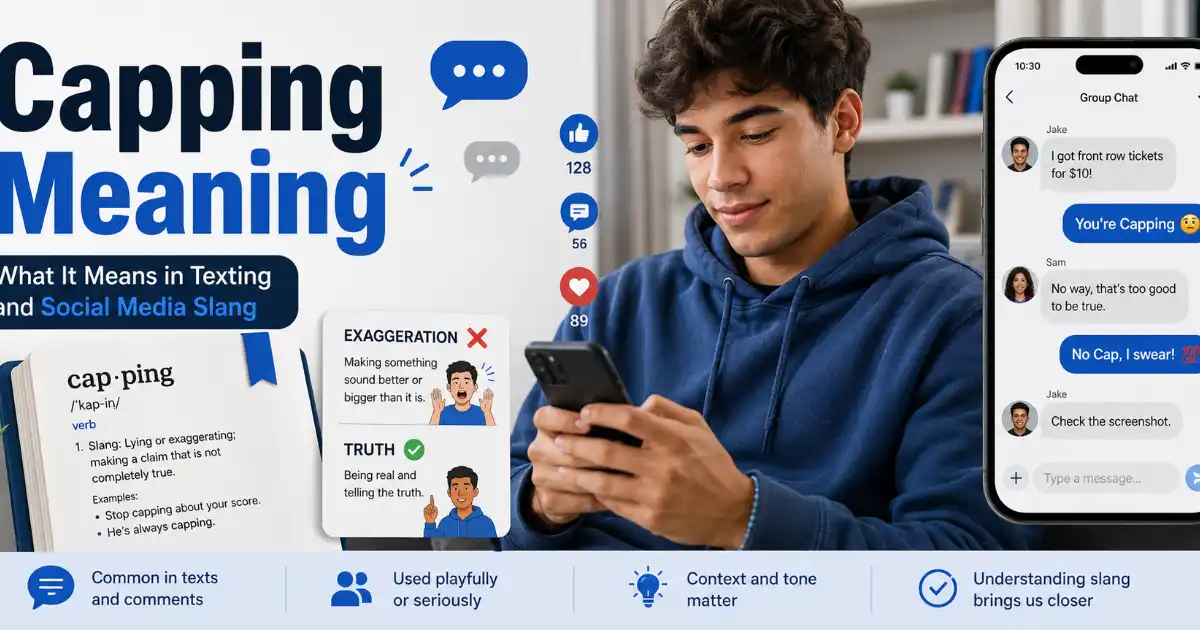
Capping is slang for lying, exaggerating, or making a claim that is not completely true. If someone says, “You’re capping,” they usually mean, “You’re lying” or “You’re exaggerating.” The word appears frequently in texting, social media comments, memes, gaming chats, and casual conversation. It connects directly to cap, while no cap means someone is being honest or serious.
Introduction
A single word can have several meanings depending on where someone sees it. Capping is a good example. In everyday English, capping can describe putting a cap or cover on something. In slang, however, it usually has nothing to do with hats, bottles, or physical objects. Instead, it describes someone who is lying, exaggerating, or making a claim that others do not believe.
People often search for the meaning of capping after seeing phrases such as “Stop capping,” “You’re capping,” or “He stays capping” in a text, TikTok comment, group chat, or social media post. The meaning becomes especially easy to understand when it appears alongside related expressions such as cap, that’s cap, and no cap.
The slang sense has roots in older forms of informal speech and became widely recognizable through hip hop culture and later through social media. Modern users often employ it playfully rather than as a serious accusation.
This guide explains what capping means, how people use it, how it differs from related expressions, and how to understand its tone in different situations.
| Expression | Meaning | Typical Tone | Example |
|---|---|---|---|
| Capping | Lying or exaggerating | Casual | “You’re capping.” |
| Cap | A lie or false claim | Casual | “That’s cap.” |
| No cap | No lie or seriously | Casual | “No cap, that was amazing.” |
| Stop capping | Stop lying or exaggerating | Playful or confrontational | “Stop capping about your score.” |
| Capper | Someone who lies or exaggerates | Informal | “He’s a capper sometimes.” |
What Does Capping Mean?
In modern slang, capping means lying, exaggerating, or presenting something as true when it is not. It can describe a completely false statement, but it can also describe a person who stretches the truth to make a story sound more impressive.
For example, if someone says they ran a mile in three minutes and their friends know that claim is unrealistic, someone might respond, “You’re capping.” The speaker does not necessarily mean that every part of the story is deliberately fabricated. They may simply believe the person is exaggerating.
The expression can also appear as cappin’, especially when people write slang the way it sounds in casual speech. “Stop cappin’” carries essentially the same meaning as “Stop capping.”
Context determines how strongly the word comes across. Among friends, “You’re capping” may sound humorous and teasing. In an argument, the same phrase can directly accuse someone of lying.
Capping Does Not Always Mean a Serious Lie
Capping can refer to something much smaller than deliberate deception. Someone may use it when a friend exaggerates a story, makes an unbelievable claim, or boasts about an achievement.
For example:
“You said you finished that whole project in twenty minutes. You’re capping.”
Here, the speaker may simply doubt the claim rather than accuse the other person of serious dishonesty.
That flexibility explains why capping appears so often in casual online communication.
Where Is Capping Used?
Capping appears mainly in informal communication. People may use it in text messages, social media comments, group chats, memes, gaming conversations, and casual face to face conversations.
It is especially common when someone wants to challenge a statement quickly. Instead of writing “I think you are exaggerating,” a person can simply write “You’re capping.”
The word also works well as a humorous reaction. Someone might post a dramatic story, and a friend could reply “Cap” to show disbelief.
The expression has become recognizable beyond a single social platform. Contemporary slang references describe capping as a way to accuse someone of lying or exaggerating, while current discussions also show people using it casually in everyday online conversation.
How Capping Relates to Cap and No Cap
Understanding cap and no cap makes capping much easier to understand.
Cap can function as a noun meaning a lie or false claim. Someone might say, “That story is cap,” meaning the story is not believable or truthful.
As a verb, cap describes the act of lying or exaggerating. That gives us capping, which describes someone currently doing it.
No cap works in the opposite direction. It signals that the speaker is being honest, serious, or not exaggerating.
| Phrase | Meaning | Example |
| Cap | Lie or false claim | “That is cap.” |
| Capping | Lying or exaggerating | “You’re capping.” |
| No cap | Honestly or seriously | “No cap, this is the best pizza I’ve had.” |
| Stop capping | Stop lying or exaggerating | “Stop capping about your grades.” |
How to Use Capping in a Sentence
Capping usually works as an informal verb. It often appears after a subject such as “you,” “he,” “she,” or “they.”
Natural examples include:
- “You’re capping right now.”
- “Stop capping about how much you paid.”
- “He was capping about getting invited.”
- “She said she never saw the message, but I think she’s capping.”
- “Are you serious, or are you capping?”
- “They keep capping about their gaming skills.”
The expression generally fits casual communication rather than formal writing.
A person would normally avoid writing “My colleague is capping” in a formal report. A more appropriate phrase would be “My colleague is exaggerating the situation” or “The claim appears inaccurate.”
What Does Stop Capping Mean?
Stop capping means stop lying, stop exaggerating, or stop making unbelievable claims.
The tone depends heavily on the relationship between the speakers.
A friend might say:
“Stop capping. You definitely ate the last slice.”
That can sound playful.
During an argument, however, someone might say:
“Stop capping and tell me what actually happened.”
That version sounds more serious because the speaker directly challenges the other person’s honesty.
The phrase therefore does not automatically indicate hostility. The surrounding conversation, relationship, and tone matter.
What Does You’re Capping Mean?
You’re capping directly tells someone that the speaker thinks they are lying or exaggerating.
It can mean:
- You are not telling the truth.
- You are exaggerating.
- Your story sounds unbelievable.
- I do not believe that claim.
- You are making yourself sound more impressive than you really are.
For example, if someone says, “I got a perfect score without studying at all,” a friend might respond, “You’re capping.”
The response does not necessarily prove that the person lied. It only communicates the speaker’s disbelief.
Examples of Capping in Texting
Text messages often make slang shorter and more direct. Capping fits naturally into this style.
Example 1: An unbelievable achievement
Alex: “I beat everyone in the tournament without losing once.”
Jordan: “Bro, you’re capping.”
Here, Jordan thinks Alex is exaggerating.
Example 2: A playful accusation
Alex: “I only had one cookie.”
Jordan: “Stop capping. There were six in the box.”
The word creates a humorous accusation.
Example 3: An exaggerated purchase
Alex: “I got these shoes for five dollars.”
Jordan: “That’s cap.”
Jordan does not believe the price.
Example 4: A serious disagreement
Alex: “I never said that.”
Jordan: “You’re capping. I have the messages.”
Here, capping has a more confrontational tone.
How Capping Appears on Social Media
On social media, capping often appears as a short reaction to a post or comment.
Someone may post an unbelievable story and receive comments such as:
- “Cap.”
- “You’re capping.”
- “Bro is capping.”
- “Stop capping.”
- “No cap?”
The shorter versions work because the surrounding post provides the context.
For example, someone might claim that they bought an expensive item for an unusually low price. A commenter could simply write “Cap,” meaning they do not believe the claim.
The expression can also appear jokingly when people know the original poster is exaggerating for entertainment.
Is Capping the Same as Lying?
Capping and lying overlap, but they do not always have exactly the same force.
Lying usually suggests that someone intentionally gives false information. Capping can include lying, but it can also describe exaggeration, boasting, or an unbelievable claim.
Consider these examples:
| Situation | Better Description |
| Someone knowingly gives false information | Lying |
| Someone makes a story sound bigger than it was | Capping |
| Someone boasts about an unrealistic achievement | Capping |
| Someone invents an entire story | Lying or capping |
| Someone jokes about an obvious exaggeration | Capping |
This distinction matters because slang often communicates attitude as well as literal meaning.
Capping vs Exaggerating
Exaggerating means making something seem larger, better, worse, or more important than it really is. Capping can include that behavior, but it usually carries a stronger suggestion that the speaker does not believe the claim.
For example, someone saying, “That concert felt like it lasted forever,” may simply exaggerate for effect.
If someone says, “I personally know every famous musician in town,” and their friends clearly doubt it, they might call the statement cap.
In everyday slang, capping can therefore cover a range from playful exaggeration to outright dishonesty.
Is Capping Rude?
Capping is not automatically rude, but it can sound disrespectful depending on how someone uses it.
Among close friends, “You’re capping” may be nothing more than playful teasing. In a workplace, classroom, or serious conversation, however, accusing someone of lying can create tension.
The safest approach is to consider the setting.
Use it casually when the conversation already has an informal tone. Avoid it when clarity and professionalism matter.
Instead of saying “You’re capping” during a formal discussion, someone could say:
- “I am not sure that is accurate.”
- “Can you clarify that?”
- “That claim seems exaggerated.”
- “Do you have a source for that?”
Does Capping Mean Anything Besides Lying?
Yes. The ordinary English word capping can have meanings unrelated to slang.
In a literal context, capping can mean putting a cap or covering on something. For example, someone might talk about capping a bottle or capping a pipe.
The word can also appear in technical, business, construction, sports, and other contexts where cap means a limit, covering, or maximum amount.
That means context matters. If someone says, “We are capping the number of tickets at 500,” they are not using the slang meaning. They mean they are setting a maximum limit.
| Context | Meaning of Capping | Example |
| Texting | Lying or exaggerating | “You’re capping.” |
| Social media | Calling out an unbelievable claim | “That’s cap.” |
| Physical object | Adding a cover | “They are capping the pipe.” |
| Limits | Setting a maximum | “The event is capping attendance.” |
| Casual conversation | Exaggerating or boasting | “He’s capping about his score.” |
Where Did the Slang Capping Come From?
The modern slang meaning did not suddenly appear because of TikTok. The expression has deeper roots in American slang and Black speech traditions.
Historical discussions of cap connect the word with older slang senses involving surpassing, boasting, exaggerating, and competitive verbal exchanges. Sources discussing the term also connect capping with ritualized insult traditions and later hip hop usage.
The expression later spread much more broadly through music, online communities, memes, and social media. By the late 2010s, cap, no cap, and capping had become highly recognizable expressions in mainstream internet slang.
It is worth avoiding overly simple claims that one social media platform invented the term. Internet culture helped popularize the modern expression, but its linguistic history reaches further back.
Why Do People Say No Cap?
People say no cap to emphasize that they are telling the truth or speaking seriously.
For example:
“No cap, that was the funniest movie I’ve seen all year.”
The speaker is emphasizing sincerity. In another conversation, someone might say:
“I finished the entire assignment in one night, no cap.”
Here, the speaker wants the listener to believe the claim.
No cap became widely recognizable alongside cap and capping, creating a simple contrast between dishonesty and honesty.
How to Respond When Someone Says You Are Capping
Your response depends on whether the claim is actually true.
If you are joking, you can play along:
- “Okay, maybe a little.”
- “I swear I’m serious.”
- “No cap.”
- “Check the receipts.”
If the other person misunderstood you, explain the situation instead of arguing.
For example:
“I’m not capping. I was talking about the other game.”
If you genuinely exaggerated, you can simply admit it:
“Okay, you got me. I exaggerated.”
This keeps the conversation relaxed and avoids turning casual slang into a serious conflict.
Common Mistakes When Understanding Capping
People often misunderstand capping because cap has several unrelated meanings.
Mistake 1: Thinking it always means a hat
In ordinary English, cap can mean a hat or covering. In slang, cap can mean a lie. The surrounding sentence tells you which meaning applies.
Mistake 2: Treating capping as a formal word
Capping is informal slang when it means lying or exaggerating. It works naturally in texts and casual conversations but may sound inappropriate in professional writing.
Mistake 3: Assuming capping always means deliberate deception
The slang can describe exaggeration or boasting as well as outright lying. Someone may say “you’re capping” simply because a story sounds unbelievable.
Mistake 4: Assuming no cap means the opposite of every use of cap
No cap generally means the speaker is being honest or serious. It does not necessarily prove that the statement itself is factually correct.
Mistake 5: Ignoring tone
A friend saying “You’re capping” may be joking. The same words during an argument may accuse someone of dishonesty.
Capping vs Similar Slang Terms
Several expressions can communicate disbelief, dishonesty, or exaggeration, but they do not always carry the same tone.
| Term | Meaning | Typical Tone | Example |
| Capping | Lying or exaggerating | Casual | “You’re capping.” |
| Cap | A lie or false claim | Casual | “That’s cap.” |
| No cap | Honestly or seriously | Casual | “No cap, I loved it.” |
| Fronting | Pretending or acting more impressive | Informal | “He’s fronting for the crowd.” |
| BS | Calling something untrue or foolish | More blunt | “That sounds like BS.” |
| Exaggerating | Making something seem bigger than it is | Neutral | “You’re exaggerating.” |
The best choice depends on the setting and relationship.
When Should You Avoid Using Capping?
Capping is easy to understand in casual conversations, but slang does not belong in every setting.
Avoid it when writing:
- Formal emails
- Academic assignments
- Business reports
- Professional complaints
- Legal documents
- Official applications
- Serious workplace communication
In those situations, words such as lying, exaggerating, misleading, inaccurate, or unsubstantiated communicate the idea more clearly.
Conclusion
Capping usually means lying, exaggerating, or making an unbelievable claim in modern slang. Someone who says “you’re capping” is usually telling another person that they do not believe what they are saying.
The easiest way to remember the slang is to connect three expressions: cap means a lie, capping means lying or exaggerating, and no cap means being honest or serious. These expressions commonly appear in texting, social media, memes, gaming chats, and casual conversations.
Context still matters. Capping can describe playful exaggeration between friends or a serious accusation during an argument. It can also be confused with the ordinary meanings of the word cap, so always look at the csentence before deciding what someone means.
FAQs About Capping
What does capping mean in texting?
Capping usually means lying, exaggerating, or making an unbelievable claim. If someone texts “you’re capping,” they are saying they do not believe what you said.
What does stop capping mean?
Stop capping means stop lying, exaggerating, or making claims that the speaker considers untrue. Friends may use it jokingly, while an argument can make it sound more serious.
What does cap mean in slang?
In slang, cap means a lie, false claim, or exaggerated statement. “That’s cap” means “That is not true” or “I do not believe that.”
What does no cap mean?
No cap means the speaker is being honest, serious, or not exaggerating. It is commonly used to emphasize sincerity.
Is capping the same as lying?
Not always. Capping can mean lying, but people also use it for exaggeration, boasting, or an unbelievable claim. The exact meaning depends on context.
Is capping a bad word?
Capping is not generally considered a profanity. It is informal slang, though, so it may sound inappropriate in professional or formal communication.
Can capping be used jokingly?
Yes. Friends often use capping as playful teasing when someone tells an exaggerated story or makes an unbelievable claim.
Why does cap mean lie?
The modern slang sense developed through older forms of American slang involving ideas such as surpassing, boasting, and exaggerating. Later music and internet culture helped spread the expression widely.