
Quick Answer
Fronting usually means pretending, exaggerating, or putting on a false image to make yourself seem tougher, richer, more confident, more knowledgeable, or more successful than you really are.
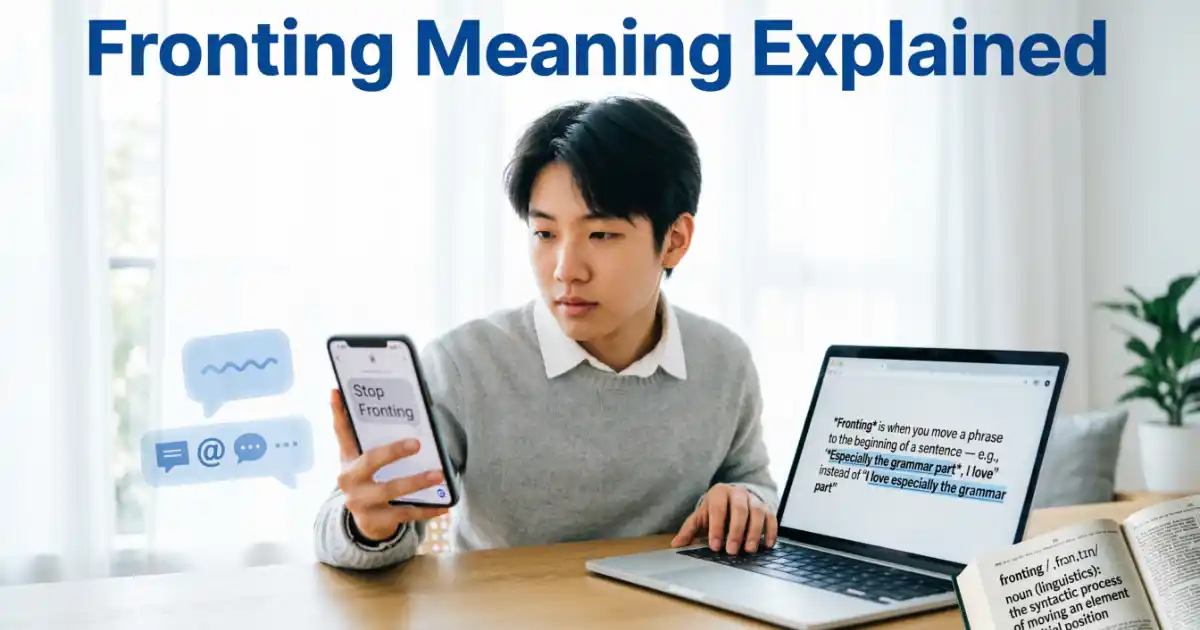
In casual slang, fronting is often used to call out someone for being fake or putting on an act. For example, “Stop fronting” can mean “Stop pretending” or “Be real.”
The word also has other meanings. In grammar, fronting means moving a word or phrase to the beginning of a sentence for emphasis. In insurance, fronting can describe falsely listing someone else as the main driver to obtain a lower premium.
Introduction
People often encounter fronting in texts, social media posts, music, movies, and casual conversations. The confusing part is that the word does not always have one meaning. When someone says, “He is fronting,” they may be accusing another person of pretending or exaggerating. In a grammar lesson, however, fronting describes a completely different change in sentence structure.
The slang meaning is the one most people are looking for when they search phrases such as “what does fronting mean,” “fronting meaning slang,” or “what does stop fronting mean.” In that context, the word describes behavior that creates a false impression. Someone might front about money, confidence, relationships, experience, or social status.
This guide explains the slang meaning first, then covers other important uses. It also provides natural examples, related terms, common mistakes, and practical ways to understand fronting based on context.
Fronting Meaning in Slang
In slang, fronting means pretending to be something you are not or presenting an exaggerated version of yourself. The behavior can involve acting tougher, wealthier, more confident, more knowledgeable, or more important than reality supports.
For example, imagine someone constantly tells friends that they own expensive things, but those claims are not true. Someone might respond, “You are fronting.” The speaker is saying that the person is putting on a false image.
Fronting can also describe emotional behavior. A person might act like they do not care about something when they actually care a lot. In that situation, the person is creating a public appearance that does not match their genuine feelings.
The expression frontin’ is simply a common informal spelling or pronunciation of fronting. You may see it in casual speech, lyrics, dialogue, and online conversations.
The word often carries a negative or teasing tone, but the exact feeling depends on the situation. Friends may use it jokingly, while someone may use it seriously when accusing another person of being dishonest.
Different Meanings of Fronting
The context determines what fronting means. The slang sense is only one use of the word.
| Meaning | Where It Is Used | Simple Explanation | Example |
|---|---|---|---|
| Pretending | Slang and casual speech | Acting like something is true when it is not | “Stop fronting about your new car.” |
| Sentence emphasis | Grammar | Moving a word or phrase to the beginning | “That book, I really enjoyed.” |
| Sound change | Phonetics | Pronouncing a sound farther forward in the mouth | A vowel shifts toward the front of the mouth |
| Leading a group | Music | Being the main performer or vocalist | “She is fronting the band.” |
| False insurance information | Insurance | Misrepresenting the main driver to reduce insurance costs | A parent falsely claims to be the primary driver |
The slang meaning should not automatically be applied whenever you see the word. Grammar, music, phonetics, and insurance use the same term differently.
What Does Stop Fronting Mean?
Stop fronting usually means stop pretending, stop acting fake, or be honest about what is really happening.
The expression can be playful or confrontational.
For example:
“You keep saying you hate that show, but you watched every episode. Stop fronting.”
Here, the speaker believes the person is pretending not to like the show.
Another example:
“You do not have to act like you know everything. Stop fronting.”
In this case, the accusation focuses on pretending to have knowledge or confidence.
The phrase does not necessarily mean that someone is committing a serious lie. Sometimes it simply means that the person is exaggerating or putting on a particular image.
How Fronting Is Used in Everyday Conversation
Fronting often appears when someone notices a difference between what another person says and what seems to be true.
Common situations include pretending to have money, exaggerating accomplishments, acting tougher than necessary, pretending not to care, or claiming knowledge that someone does not actually have.
For example:
- “He keeps fronting about how much money he makes.”
- “She was fronting like she was not nervous.”
- “You are fronting if you say you never liked that song.”
- “Do not front like you knew the answer already.”
- “He was just fronting to impress everyone.”
These examples show why the word can cover several kinds of behavior. The central idea remains the same: the outward image does not completely match reality.
Examples of Fronting in Texting and Social Media
Online conversations make it easy to exaggerate an image. Someone might post about expensive purchases, an exciting lifestyle, perfect relationships, or impressive achievements. Another person might describe that behavior as fronting if they believe the presentation is misleading.
Here are some natural examples:
Example 1
“Bro keeps posting luxury restaurants. He is probably fronting.”
This suggests that the speaker believes the person is exaggerating their lifestyle.
Example 2
“You were scared too. Stop fronting.”
Here, fronting means pretending to be brave.
Example 3
“She acts like she does not care, but she keeps checking his profile. She is fronting.”
This use focuses on hiding genuine feelings.
Example 4
“Do not front like you finished the project yourself.”
This suggests that someone is claiming more credit than they deserve.
Fronting About Money and Status
One common form of fronting involves wealth or social status. A person may want others to believe they have more money, influence, or possessions than they actually have.
For instance, someone might borrow an expensive item and present it as their own. Another person could describe that behavior as fronting.
However, context matters. Having nice clothes, driving an expensive car, or enjoying expensive restaurants does not automatically mean someone is fronting. The term concerns misrepresentation or exaggerated presentation, not simply having money or enjoying luxury.
That distinction matters because calling someone a fronter without evidence can turn an observation into an unfair accusation.
Fronting About Confidence or Toughness
Fronting can also describe someone who acts tougher or more confident than they actually feel.
Imagine someone who is nervous before giving a presentation but tells everyone, “I am completely relaxed.” A friend might jokingly say they are fronting.
The same idea can appear in more serious situations. Someone may deliberately create an intimidating image because they want others to respect or fear them.
In this sense, fronting is closely related to posturing. The person is trying to control how others perceive them.
Fronting and Pretending Are Not Exactly the Same
The two words overlap, but fronting often suggests a social performance.
| Term | Meaning | Best Use | Example |
|---|---|---|---|
| Fronting | Creating a false or exaggerated image | Casual slang | “He is fronting about his success.” |
| Pretending | Acting as though something is true when it is not | General English | “She was pretending to be asleep.” |
| Posturing | Deliberately displaying an attitude or position | Social or formal contexts | “He was posturing to look powerful.” |
| Faking | Making something appear genuine when it is not | Broad everyday use | “He was faking confidence.” |
| Bluffing | Trying to convince someone of something without necessarily having it | Games and negotiations | “She was bluffing about her hand.” |
| Exaggerating | Making something seem greater than it really is | General English | “He exaggerated his experience.” |
Fronting has a particularly informal, conversational feel when people use it as slang.
Fronting vs Capping
Capping and fronting can overlap, especially when someone is accusing another person of not being truthful.
Capping generally focuses more directly on lying or making false claims. Fronting can involve lying, but it often emphasizes the broader image someone is trying to create.
For example:
“He said he owns three businesses. He is capping.”
This focuses on the truth of the statement.
“He is always fronting like he is a huge businessman.”
This focuses more on the image or persona he presents.
The distinction is not absolute because slang changes between communities and situations.
Where Did the Slang Meaning Come From?
The slang history of fronting connects to the broader idea of putting up a front, meaning an outward appearance that may hide what is really happening. Historical slang uses of front included deceptive or cover roles, and later uses developed around bluffing, posturing, and presenting a false image.
The slang became particularly visible through hip hop and other forms of popular culture, where frontin’ could describe acting fake, showing off, or pretending to have qualities or status that someone did not actually possess.
That history helps explain the modern expression stop fronting. The underlying idea remains consistent: someone is putting a surface image ahead of reality.
Because slang develops within communities, its history should not be reduced to one exact moment or one single source. Different uses can emerge and spread over time.
What Does Fronting Mean in Grammar?
In grammar, fronting has nothing to do with pretending.
It refers to moving a word, phrase, or clause to the beginning of a sentence, usually to give it emphasis or make it the focus.
For example:
“I bought a very expensive camera.”
A writer might emphasize the object by restructuring the sentence:
“A very expensive camera it was.”
Another example is:
“He removed the lid carefully.”
A speaker can place the adverb at the beginning:
“Carefully, he removed the lid.”
This grammatical use appears in language study and writing analysis. It is completely separate from the slang meaning.
What Does Fronting Mean in Music?
In music, fronting a band means serving as its main or prominent performer, often as the lead vocalist.
For example:
“She has been fronting the band for five years.”
Here, the person is the visible lead performer rather than someone pretending or exaggerating.
This meaning comes from the idea of being at the front or leading a group.
What Does Fronting Mean in Insurance?
Insurance has another specific meaning for fronting.
In car insurance, fronting can refer to falsely stating that one person is the main driver when another person actually drives the vehicle most of the time. A commonly discussed example involves a parent claiming to be the primary driver when the car is primarily used by their child.
This is not harmless slang. Providing false information to obtain cheaper insurance can create serious consequences, including problems with coverage or legal and financial consequences depending on the circumstances and jurisdiction.
Anyone completing an insurance application should provide accurate information about who actually uses and drives the vehicle.
Common Mistakes When Using Fronting
Understanding the context prevents most confusion.
Mistaking slang for grammar
If a textbook says fronting, it probably refers to sentence structure rather than someone acting fake.
Assuming every exaggeration is fronting
People sometimes exaggerate stories without deliberately creating a false persona. Calling something fronting usually implies a stronger element of posturing or misrepresentation.
Treating fronting as exactly the same as lying
The words overlap, but fronting can involve behavior, appearance, attitude, or social presentation rather than one specific false statement.
Using slang in formal writing
In a school essay, business report, or professional email, words such as pretending, posturing, misrepresenting, or exaggerating will usually communicate the idea more clearly.
Assuming context does not matter
The sentence “She is fronting the band” means something completely different from “She is fronting about her money.”
Is Fronting a Negative Word?
Usually, fronting has a negative or critical tone when used as slang because it suggests that someone is being fake or misleading.
However, friends can use it jokingly.
For example:
“Stop fronting. You know you want another slice of pizza.”
That statement probably does not accuse the person of serious dishonesty. It playfully suggests that the person is pretending not to want something.
Tone, relationship, and context determine how strongly the word comes across.
Is Fronting Still Used Today?
Yes. Fronting and frontin’ remain recognizable informal expressions, particularly in conversations influenced by hip hop, pop culture, and slang. Contemporary usage can also appear in social media discussions and casual online communication.
That does not mean every English speaker uses the term regularly. Slang varies by age, region, community, and social setting.
For someone learning English, understanding the expression can help with comprehension, but copying slang into every conversation may sound unnatural. It is better to pay attention to how people around you actually use the term.
Conclusion
Fronting usually means pretending, posturing, or presenting a false or exaggerated image in casual slang. Someone might be fronting about money, confidence, knowledge, relationships, or social status. The phrase stop fronting generally means stop pretending and be honest about what is really going on.
The word also has legitimate technical meanings in grammar, phonetics, music, and insurance. Context therefore matters. If you see fronting in a text message or casual conversation, the slang meaning is often the right starting point. If it appears in a textbook, insurance document, or professional setting, check the surrounding language before interpreting it.
Understanding that difference makes it much easier to recognize what fronting means without confusing slang with its other uses.
Frequently Asked Questions About Fronting
What does fronting mean in slang?
In slang, fronting usually means pretending, exaggerating, or creating a false image. Someone who fronts may act richer, tougher, smarter, more confident, or more successful than they really are.
What does stop fronting mean?
Stop fronting usually means stop pretending, stop acting fake, or be honest about what you really think or feel. Depending on the context, it can sound playful or confrontational.
What does frontin’ mean?
Frontin’ is an informal spelling of fronting. It commonly means acting fake, pretending, posturing, or exaggerating an image.
Is fronting the same as lying?
Not exactly. Lying usually involves making a false statement. Fronting can include lying, but it can also involve acting, appearance, attitude, or exaggerated social presentation.
What is an example of fronting?
If someone pretends to be extremely wealthy to impress friends despite not having the money they claim to have, that could be described as fronting.
What does fronting mean in grammar?
In grammar, fronting means moving a word or phrase to the beginning of a sentence to emphasize it or make it the focus. This is different from the slang meaning.
What does fronting mean in music?
In music, fronting a band means serving as its main or lead performer, often as the lead singer.
Can fronting have a serious meaning?
Yes. In insurance, fronting can refer to falsely identifying the main driver on an insurance policy to obtain a lower premium. That use involves potential legal and financial consequences and should not be confused with casual slang.