
Quick Answer
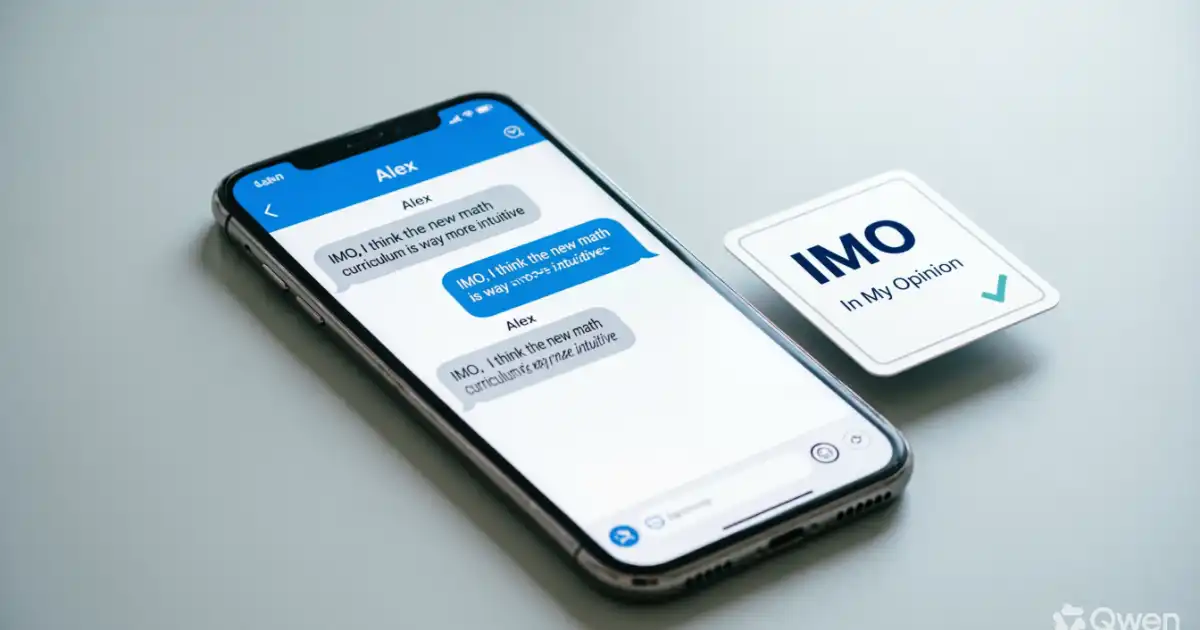
IMO means in my opinion. It is a common internet and texting abbreviation people use when they want to share a personal view, preference, judgment, or recommendation. For example, IMO, this is the best pizza in town means in my opinion, this is the best pizza in town.
IMO is usually casual and neutral, and you may see it in texts, group chats, comments, forums, social media posts, and informal emails.
Introduction
If you have seen someone type IMO in a text, comment, or social media discussion, you may wonder whether it means something specific to that platform. In most casual online conversations, the answer is simple. IMO stands for in my opinion.
People use it to show that they are sharing a personal viewpoint rather than presenting their statement as an established fact.
The abbreviation is useful because online conversations often move quickly. Instead of writing “in my opinion,” someone can type three letters and immediately signal that the next statement reflects their personal judgment.
You might see it while people discuss movies, music, food, sports, relationships, shopping, school, work, or everyday decisions.
This guide explains the IMO meaning, how people use it in texting and social media, how it compares with IMHO and other abbreviations, and when you should avoid using it. It also covers examples and common questions so you can understand IMO naturally when you see it online.
What Does IMO Mean?
IMO stands for in my opinion. It is an abbreviation used to introduce or identify a personal opinion. Oxford and Cambridge both define IMO as “in my opinion” and note its use in emails, text messages, and other digital communication.
When someone writes IMO, they are usually telling you that the statement reflects their own perspective. They are not necessarily claiming that everyone should agree with them.
For example:
IMO, the second movie was better.
This means:
In my opinion, the second movie was better.
The meaning stays the same whether IMO appears at the beginning or end of a sentence.
IMO, that restaurant is overrated.
That restaurant is overrated, IMO.
Both sentences communicate a personal judgment.
IMO can also make an opinion sound less absolute. Compare these two statements:
That phone is the best.
IMO, that phone is the best.
The second version makes it clearer that the speaker is expressing a personal preference.
IMO Meaning at a Glance
| Term | Meaning | Tone | Example |
|---|---|---|---|
| IMO | In my opinion | Casual and neutral | IMO, this one is better. |
| IMHO | In my humble opinion | Casual, sometimes playful | IMHO, that was the best episode. |
| TBH | To be honest | Casual and direct | TBH, I did not like it. |
| I think | Personal view | Natural and conversational | I think this is better. |
| AFAIK | As far as I know | Cautious | AFAIK, the store closes at 9. |
How Is IMO Used in Texting?
The IMO meaning in text is almost always in my opinion. People use it when giving advice, making a recommendation, sharing a preference, or responding to a discussion.
For example, a friend might text:
IMO, you should get the black jacket.
They are not saying that you must buy it. They are simply giving their personal recommendation.
You may also see IMO during disagreements:
IMO, we should have left earlier.
This wording presents the statement as the person’s perspective rather than an unquestionable fact.
IMO can appear in lowercase as imo. The lowercase version has the same meaning and is common in casual texting.
imo, that was a great game.
There is no important difference between IMO and imo. The choice usually comes down to typing style.
How Is IMO Used on Social Media?
People use IMO on social media when expressing reactions, preferences, or opinions. You may encounter it in comments, captions, discussions, and replies.
For example:
IMO, this is the best album they have released.
Or:
IMO, the original version was better.
The abbreviation can be especially useful when a person wants to make clear that they are giving their own take on a topic that may have several reasonable opinions.
It does not automatically make a statement polite, however. The rest of the sentence still determines the tone.
For example:
IMO, that design needs some work.
may sound fairly constructive.
But:
IMO, you have no idea what you are talking about.
can still sound rude.
The abbreviation identifies the statement as an opinion, but it does not automatically make the message friendly.
Examples of IMO in Everyday Conversation
IMO can appear in many types of casual online conversations. Here are some natural examples.
Sharing a Preference
IMO, chocolate ice cream is better than vanilla.
The writer is simply stating a personal preference.
Recommending Something
IMO, you should watch the first season before the new one.
The person is giving a recommendation based on their own judgment.
Discussing Food
IMO, that burger place has the best fries.
This expresses a personal opinion about food.
Talking About Movies
IMO, the ending was better than the beginning.
The writer is sharing their personal reaction to the movie.
Giving Advice
IMO, you should wait before buying a new laptop.
This signals that the recommendation is the person’s own view.
Discussing Work or School
IMO, the presentation would be stronger with fewer slides.
This presents a suggestion without claiming that it is the only correct approach.
Sharing an Online Opinion
IMO, people are overthinking this trend.
The person is identifying the statement as their own interpretation.
Where You Might See IMO
Because IMO is a general internet abbreviation, it can appear in many forms of digital communication.
Common examples include:
- Text messages
- Group chats
- Social media comments
- Online forums
- Reddit discussions
- Informal emails
- Gaming chats
- Reviews and discussions
- Messaging apps
The exact platform does not usually change the meaning. If someone uses IMO before giving a personal view, you can normally understand it as in my opinion.
IMO vs. IMHO
One of the most common comparisons is IMO vs. IMHO.
IMO means in my opinion, while IMHO means in my humble opinion. Both introduce a personal viewpoint.
| Term | Meaning | Main Difference | Example |
|---|---|---|---|
| IMO | In my opinion | Simple and neutral | IMO, this is better. |
| IMHO | In my humble opinion | Adds humble or playful wording | IMHO, this is better. |
In everyday texting, the two can often be used in the same situations. IMHO can sometimes sound more playful or self aware, depending on the context.
For example:
IMO, that was the best option.
and
IMHO, that was the best option.
communicate essentially the same opinion.
IMO vs. TBH, AFAIK, and IIRC
Several internet abbreviations can appear alongside IMO, but they do not mean exactly the same thing.
TBH means to be honest. It emphasizes honesty rather than simply identifying something as an opinion.
AFAIK means as far as I know. It signals that the speaker is limiting a statement to the information they currently know.
IIRC means if I recall correctly. It is used when someone is uncertain about their memory.
For example:
IMO, that restaurant is expensive.
This expresses an opinion.
TBH, I do not want to go there.
This emphasizes honesty.
AFAIK, they are closed on Mondays.
This limits the statement to the speaker’s knowledge.
IIRC, we went there last summer.
This signals uncertainty about memory.
Understanding these differences can help you interpret online conversations more accurately.
When Should You Use IMO?
IMO works best in casual communication when you want to make your personal viewpoint clear.
You can use it when:
- Sharing a personal preference
- Giving casual advice
- Making a recommendation
- Joining an online discussion
- Responding to a debate
- Giving your reaction to a movie, song, game, or product
- Offering feedback in an informal conversation
For example:
IMO, the cheaper option is good enough for what you need.
This clearly presents the statement as a personal recommendation.
You do not need to use IMO every time you express an opinion. In many conversations, simply saying I think sounds more natural.
When Should You Avoid IMO?
IMO is mainly an informal abbreviation, so it may not fit every situation.
For formal documents, academic writing, official reports, or highly professional communication, writing in my opinion or using a more direct sentence is usually better.
For example, instead of:
IMO, this approach is more effective.
a formal report might say:
This approach appears to be more effective based on the available evidence.
The best choice depends on the audience and setting.
You should also avoid using IMO to make factual information sound like a personal opinion.
For example, adding IMO to a verifiable fact does not change whether the statement is factually correct.
IMO, water freezes at 32°F under standard conditions.
The use of IMO does not turn a factual claim into a personal preference. Facts should still be supported by accurate information.
Is IMO Rude?
No. IMO is not inherently rude. It is generally a neutral way to indicate that you are sharing your personal viewpoint.
However, the words around IMO determine how the message feels.
Consider:
IMO, you could improve this by adding more detail.
This can sound constructive.
Now consider:
IMO, this is completely ridiculous.
The second message may sound harsh even though it contains IMO.
So, when interpreting a message, do not judge the tone based only on the abbreviation. Look at the complete sentence and the surrounding conversation.
Common Mistakes With IMO
Confusing an Opinion With a Fact
IMO signals a personal viewpoint. It does not prove that the statement is correct.
If someone writes “IMO, this is the best phone,” they are expressing a preference, not establishing an objective ranking.
Thinking IMO Has a Different Meaning on Every Platform
Whether you see IMO in a text, comment, group chat, or forum, it normally means in my opinion when the surrounding message expresses a viewpoint.
Assuming IMO Always Makes a Message Polite
IMO can soften a statement, but it cannot remove rude or insulting language.
Using IMO in Every Sentence
Repeating IMO too often can make a message feel unnatural. Use it when identifying your opinion actually adds clarity.
Assuming IMO and IMHO Are Completely Different
They are very similar. The main difference is the addition of humble in IMHO.
Other Meanings of IMO
Although in my opinion is the meaning most relevant to texting and casual online communication, IMO can refer to other things in different contexts.
For example, IMO can also refer to the International Maritime Organization, especially in shipping and maritime discussions.
This is why context matters.
| Meaning | Where It Is Used | Simple Explanation | Example |
|---|---|---|---|
| In my opinion | Texting and social media | A personal viewpoint | IMO, this is better. |
| International Maritime Organization | Maritime and shipping | A United Nations specialized agency | The IMO publishes maritime standards. |
If you see IMO in a text message followed by someone’s personal judgment, in my opinion is almost certainly the intended meaning.
Conclusion
The IMO meaning is usually in my opinion. It is a common abbreviation used in texts, chats, social media, forums, and other informal online conversations to show that someone is sharing a personal viewpoint.
IMO can make it clear that a statement represents a preference or judgment rather than an absolute fact. It is similar to IMHO, but IMO is simpler and more direct. Remember that the abbreviation itself does not determine the tone. The rest of the message matters too.
In other contexts, IMO can have a completely different meaning, such as the International Maritime Organization. When you see IMO in a casual text or social media comment, though, in my opinion is usually the meaning to choose.
Frequently Asked Questions
What does IMO mean in text?
IMO means in my opinion. People use it in texts and online conversations to show that they are sharing a personal viewpoint, preference, recommendation, or judgment.
What does IMO mean on social media?
On social media, IMO usually means in my opinion. It can appear in comments, captions, replies, and discussions when someone wants to identify a statement as their personal view.
Is IMO the same as IMHO?
They are very similar. IMO means in my opinion, while IMHO means in my humble opinion. IMHO can sound slightly more playful or self conscious, depending on the context.
Is IMO slang?
IMO is better described as an internet or texting abbreviation rather than traditional slang. It is widely understood in casual digital communication.
Is IMO rude?
No. IMO is not rude by itself. The tone depends on the statement surrounding it. A friendly opinion can sound polite, while an insulting opinion can still sound rude even when it starts with IMO.
Can I use IMO in a professional email?
You can, but it may be too casual for some professional situations. When the setting is formal, writing in my opinion or stating your assessment directly is usually a better choice.
What does IMO mean in shipping?
In shipping and maritime contexts, IMO can mean the International Maritime Organization. This meaning is different from the texting abbreviation.
How do you reply when someone says IMO?
You can agree, disagree respectfully, ask for more information, or simply acknowledge their view. For example, you might say, “I see your point,” or “I have a different take on that.”