
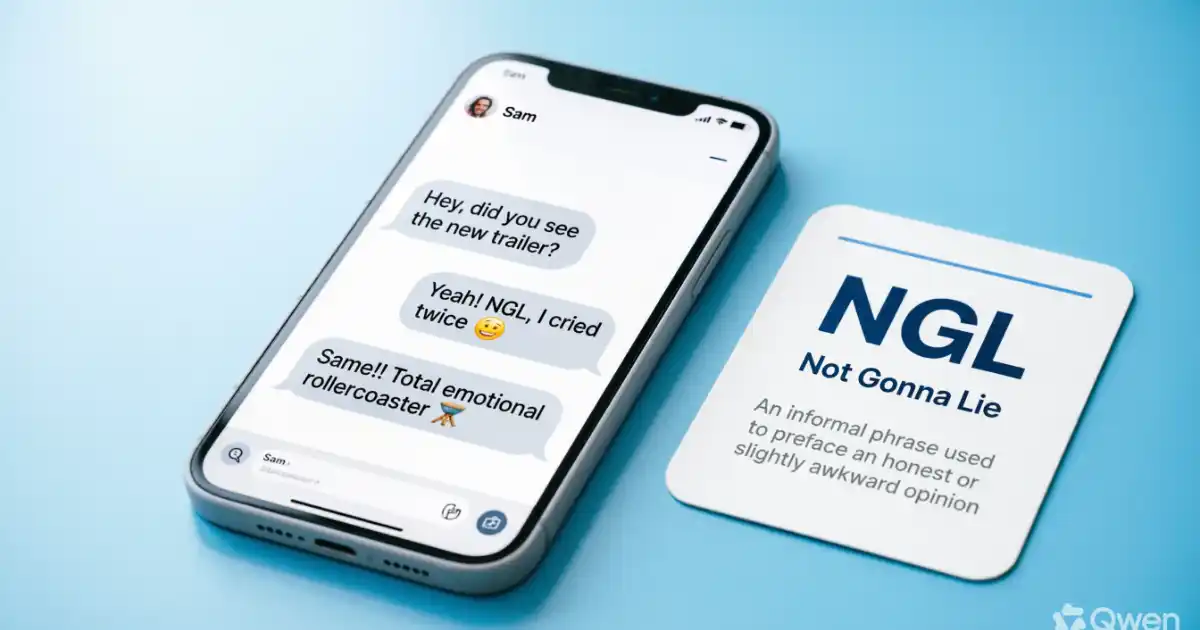
Quick Answer
NGL stands for not gonna lie. It is a casual internet abbreviation people use in texts, social media posts, comments, and online chats before sharing an honest opinion, feeling, confession, or reaction.
It is similar to saying honestly, to be honest, or if I am being real. For example, “NGL, that movie was really good” means “Honestly, that movie was really good.”
NGL can also refer to the name of an anonymous messaging app, so the exact meaning depends on context. In ordinary texting, however, not gonna lie is by far the most relevant meaning.
Introduction
If you have seen NGL in a text, comment, caption, or group chat, you may have wondered whether it has a special meaning beyond the three letters. Internet slang often changes the tone of a message without changing the basic meaning of the sentence.
NGL is a good example because it tells the reader that the person is about to share a genuine thought, personal reaction, or honest opinion.
You may see NGL before a compliment, criticism, confession, joke, or surprising observation. Someone might write, “NGL, I actually liked the movie,” or “NGL, I forgot about the meeting.” In both cases, the abbreviation signals that the following statement is meant to sound candid and personal.
Understanding NGL is useful because the abbreviation appears in many types of casual digital communication. This guide explains what NGL means, how people use it, what tone it creates, how it compares with similar expressions, and when you should avoid using it.
What Does NGL Mean?
NGL means not gonna lie.
It is a shortened form of the phrase “not going to lie.” In casual online communication, people use it to introduce something they consider honest, direct, unexpected, or personal. It can appear at the beginning of a sentence or sometimes at the end.
For example:
NGL, that was one of the best burgers I have had.
The person is basically saying:
Honestly, that was one of the best burgers I have had.
NGL does not automatically mean that the statement is extremely serious. It can be used for ordinary opinions, small confessions, compliments, criticism, or even humorous comments.
The abbreviation is normally written as NGL or ngl. Capitalization does not change the meaning. Lowercase often feels more casual, while uppercase can give the abbreviation slightly more emphasis.
NGL Meaning at a Glance
| Term | Meaning | Tone | Example |
|---|---|---|---|
| NGL | Not gonna lie | Casual and honest | NGL, I loved that movie. |
| TBH | To be honest | Casual and direct | TBH, I expected more. |
| FR | For real | Casual and emphatic | FR, that was hilarious. |
| No cap | No lie or no exaggeration | Casual and emphatic | No cap, this is amazing. |
How Is NGL Used in Texting?
NGL is mainly used to introduce an honest thought. It gives the reader a small signal that the writer is about to say what they genuinely think or feel.
It can be used in several different situations.
Sharing an Honest Opinion
This is one of the most common uses.
NGL, the new season is better than I expected.
Here, NGL tells the reader that the person is giving their genuine opinion.
Giving a Compliment
NGL does not have to introduce something negative. People frequently use it before compliments.
NGL, your presentation was really good.
The phrase makes the compliment feel more personal and spontaneous.
Making a Small Confession
Someone may use NGL before admitting something they were hesitant to say.
NGL, I watched the whole series in one weekend.
The statement is not necessarily serious. It simply presents the information as a candid admission.
Expressing a Feeling
NGL can also introduce emotions.
NGL, I was pretty nervous before the interview.
This use makes the message sound conversational rather than formal.
Softening a Criticism
People sometimes use NGL before criticism because it frames the statement as a personal opinion.
NGL, I did not really like the ending.
However, NGL does not automatically make criticism polite. The words that follow still determine whether the message sounds respectful or harsh.
What Does NGL Mean on Social Media?
On social media, NGL usually has the same meaning: not gonna lie.
You may see it in comments, captions, direct messages, group conversations, and reactions. The abbreviation works well in these spaces because social media communication tends to favor short and conversational wording.
For example:
NGL, this outfit looks great.
NGL, that video made me laugh.
NGL, I was expecting something completely different.
The meaning remains the same even when the context changes. The writer is signaling that the following statement represents their genuine reaction.
NGL can also appear at the end of a sentence:
That was actually pretty funny, ngl.
This placement can make the statement feel more casual or like an afterthought.
Examples of NGL in Everyday Conversations
The easiest way to understand NGL is to see how it works in natural sentences.
With Friends
NGL, we should have ordered pizza instead.
This means the person is honestly admitting what they think.
At School or College
NGL, that exam was harder than I expected.
The writer is sharing a genuine reaction to the exam.
At Work
NGL, that presentation went better than I thought.
This can work in an informal conversation with coworkers who already communicate casually.
About Food
NGL, this might be the best burger I have tried.
The abbreviation emphasizes that the opinion is sincere.
About Entertainment
NGL, I liked the second movie more.
It introduces a personal opinion without making the statement sound formal.
About Daily Life
NGL, I could use another hour of sleep.
The speaker is casually expressing how they feel.
About a Crush or Relationship
NGL, I have been thinking about you.
Here, NGL introduces a more personal statement and can make the message feel vulnerable or sincere.
What Tone Does NGL Have?
The tone of NGL depends heavily on the words around it.
It can sound friendly, honest, blunt, playful, emotional, or even sarcastic. The abbreviation itself does not determine the entire tone.
Compare these examples:
NGL, you did an amazing job.
This sounds positive and supportive.
NGL, I expected you to do better.
This sounds more critical.
NGL, I ate the entire pizza myself.
This sounds casual and humorous.
NGL, I was really worried about you.
This sounds more emotional and sincere.
Because of this, it is important to read the complete message instead of assuming that NGL always means something positive.
When Should You Use NGL?
NGL works best in casual communication.
Good places to use it include:
- Text messages with friends
- Group chats
- Casual social media comments
- Direct messages
- Informal online communities
- Gaming chats
- Casual conversations with people you know well
It is generally not appropriate for formal writing. Avoid using NGL in academic assignments, formal business emails, professional reports, applications, or other situations where standard English is expected.
Instead of writing:
NGL, I think the proposal needs more work.
A professional version would be:
Honestly, I think the proposal needs more work.
The second version communicates the same basic idea while fitting a more formal setting.
NGL vs TBH: What Is the Difference?
NGL and TBH are very similar because both can introduce an honest opinion.
TBH means to be honest, while NGL means not gonna lie. In many casual messages, they can be used almost interchangeably.
There is a slight difference in feel.
NGL often sounds more conversational and can introduce a confession, reaction, compliment, or opinion. TBH can sound slightly more direct when someone is giving an assessment or personal judgment.
For example:
NGL, I really enjoyed the concert.
TBH, I thought the concert was too long.
Both are natural, but the exact tone comes from the sentence that follows.
NGL vs FR and No Cap
Other slang terms can also communicate sincerity, but they are not identical.
FR usually means for real and is often used to show agreement or emphasize that something is genuinely true.
That was the funniest video ever, FR.
No cap means that someone is not lying or exaggerating.
No cap, that was the best meal I have had all year.
NGL is more often used to introduce a personal thought or admission.
| Term | Main Meaning | Typical Purpose |
|---|---|---|
| NGL | Not gonna lie | Introduces an honest thought |
| TBH | To be honest | Introduces a direct opinion |
| FR | For real | Shows agreement or emphasis |
| No cap | No lie or no exaggeration | Emphasizes truthfulness |
Does NGL Have Other Meanings?
Yes. Context matters.
In texting and social media, NGL almost always means not gonna lie. However, NGL can also refer to other things in specialized contexts. For example, NGL can mean natural gas liquids in the energy industry.
There is also an NGL anonymous messaging app. If someone is talking about receiving anonymous questions or messages through an app, they may be referring to that service rather than the slang abbreviation.
| Meaning | Where It Is Used | Simple Explanation | Example |
|---|---|---|---|
| Not gonna lie | Texting and social media | An honest or candid statement | NGL, I liked it. |
| Natural gas liquids | Energy industry | Hydrocarbons separated during natural gas processing | The report discusses NGL production. |
| NGL app | Social messaging | An anonymous messaging service | She received a message through NGL. |
For ordinary texting, not gonna lie should be your first interpretation unless the surrounding conversation clearly points to another meaning.
Common Mistakes When Using NGL
One common mistake is assuming that NGL always makes a statement sound friendly. It does not. If the sentence is insulting or overly blunt, adding NGL will not automatically make it polite.
Another mistake is using NGL in formal writing. The abbreviation belongs mainly to casual digital communication, so spelling out the idea with standard language is usually better in professional or academic settings.
People also sometimes assume NGL means that the following statement is completely objective. It usually introduces a personal opinion or reaction, not an independently proven fact.
For example:
NGL, this is the best restaurant in town.
The speaker is expressing an opinion. NGL does not turn that opinion into an objective fact.
Finally, do not confuse the slang meaning with the NGL app or technical uses of the abbreviation. Context usually makes the intended meaning clear.
Conclusion
NGL means not gonna lie, and it is one of the common abbreviations used in casual texting and online communication. People use it to introduce an honest opinion, personal feeling, confession, compliment, criticism, or genuine reaction.
The simplest way to understand NGL is to read it as honestly or to be honest. Just remember that it is informal, so it works best in texts, social media, group chats, and other casual conversations. If you see NGL in a technical or specialized context, check the surrounding information because the abbreviation can have other meanings.
Frequently Asked Questions About NGL
What does NGL mean in texting?
NGL means not gonna lie. People use it before sharing an honest opinion, feeling, confession, compliment, or reaction.
What does NGL mean on Instagram?
On Instagram, NGL usually means not gonna lie when it appears in a caption, comment, or message. It signals that the person is about to share a candid thought.
Is NGL positive or negative?
NGL can introduce either a positive or negative statement. For example, it can introduce a compliment such as “NGL, you look great” or criticism such as “NGL, I did not like the movie.”
Is NGL the same as TBH?
They are very similar. NGL means not gonna lie, while TBH means to be honest. Both can introduce a sincere opinion, although NGL often feels especially conversational.
Can I use NGL in a professional email?
It is better to avoid NGL in professional emails and formal documents. Use phrases such as honestly, to be honest, or in my opinion when appropriate.
Does NGL mean not gonna lie?
Yes. In texting, online chat, and social media, NGL most commonly means not gonna lie.
What does NGL mean in a relationship text?
It usually introduces a sincere or personal statement. For example, “NGL, I miss you” means the person is honestly expressing that they miss you.
Can NGL be used at the end of a sentence?
Yes. While it often appears at the beginning, people can also place it at the end.
That movie was actually pretty good, ngl.
The meaning remains essentially the same.