
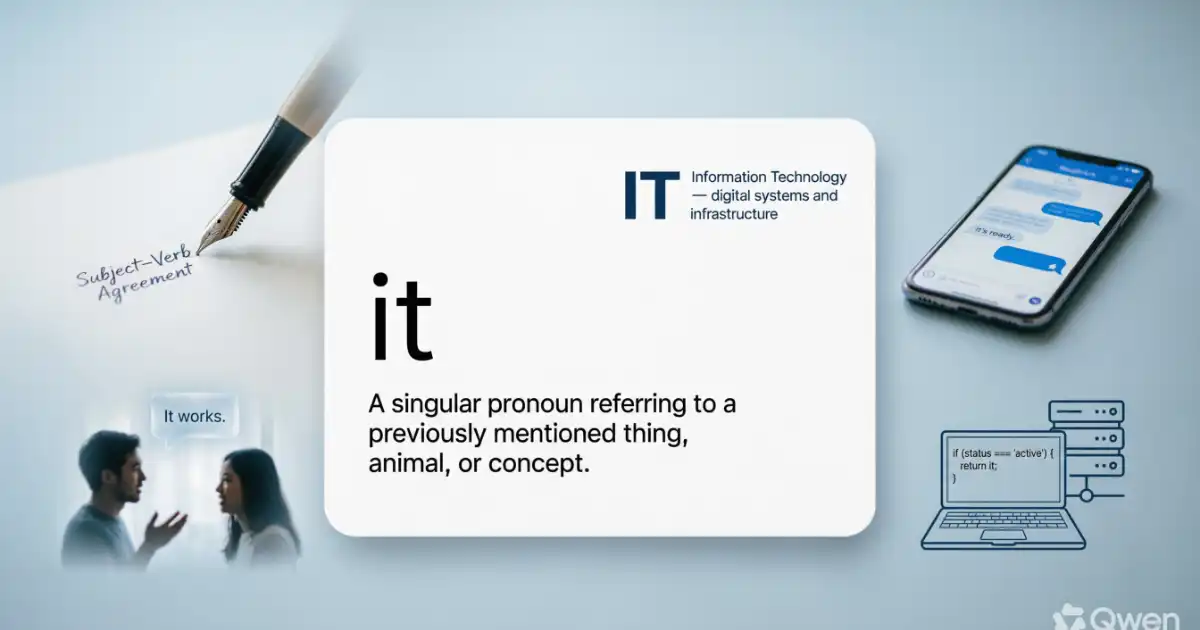
Quick Answer
It is a third person singular pronoun used to refer to a thing, animal, situation, idea, or fact that has already been mentioned or is understood from context.
It can also act as a subject in sentences about weather, time, distance, or general situations. In uppercase, IT commonly means information technology, so the intended meaning depends on the context.
Introduction
The word it looks simple, but it has several important uses in everyday English. You may see it in a text message, school assignment, workplace email, conversation, social media post, or technical discussion.
In most ordinary sentences, it works as a pronoun that replaces a thing, animal, situation, idea, or fact. For example, someone might say, “I bought a new laptop. It works great.” Here, it refers to the laptop.
The meaning can change slightly depending on how the word appears in a sentence. English speakers use it to talk about something already mentioned, identify a person, describe the weather, tell the time, discuss distance, or introduce a longer idea. English also uses it in expressions where it does not refer to one specific thing at all.
There is another important distinction. When written as IT, the term commonly stands for information technology, especially in workplaces, schools, business, and technology discussions. This article explains the common meanings of it, how to use it correctly, and how to tell which meaning someone intends.
What Does It Mean?
The most common meaning of it is a pronoun that refers to a thing, animal, situation, idea, or fact. Usually, the reader or listener already knows what it refers to from the surrounding sentence or conversation.
For example:
I found my phone, and it was under the couch.
In this sentence, it refers to the phone.
You can also use it as the object of a verb or preposition:
I cleaned the kitchen, and now I want to use it.
Here, it refers to the kitchen.
The word can also refer to an entire situation:
We missed the train, and it was frustrating.
In this example, it refers to the situation of missing the train.
English also uses it when there is no specific thing being referred to. This happens with expressions about weather, time, distance, and general conditions. For example, “It is raining,” “It is five o’clock,” and “It is two miles away.”
Common Meanings of It
| Meaning | Where It Is Used | Simple Explanation | Example |
|---|---|---|---|
| Thing or object | Everyday English | Refers to something already mentioned | I found the book. It was on my desk. |
| Animal | Everyday English | Refers to an animal when gender is unknown or unimportant | The dog is outside. It is waiting. |
| Situation or idea | Conversation and writing | Refers to something already understood | It was a difficult decision. |
| Time | Everyday conversation | Used to state the time | It is 8 PM. |
| Weather | Everyday conversation | Used with weather expressions | It is raining. |
| Distance | Everyday conversation | Used to describe distance | It is five miles away. |
| Information technology | Business and technology | IT means technology used to handle information | She works in IT. |
How Is It Used in English?
The most common use of it is to avoid repeating a noun. Instead of repeating the same word several times, English speakers use it to make the sentence smoother.
For example:
I bought a new computer. The computer is fast. The computer has a large screen.
This sounds repetitive. A more natural version is:
I bought a new computer. It is fast and has a large screen.
Here, it replaces “the computer.”
You can use it as either the subject or object of a sentence. Cambridge Dictionary identifies both subject and object uses as major functions of the word.
It as a Subject
It looks expensive.
It needs more time.
It works perfectly.
In these examples, it appears before the verb.
It as an Object
I fixed it.
She bought it yesterday.
We discussed it at lunch.
Here, it receives the action of the verb.
It After a Preposition
The word can also follow a preposition:
I put the documents in it.
We talked about it.
There is a problem with it.
The exact thing it represents comes from the context.
It for Time, Weather, and Distance
One of the most important grammar uses of it occurs when talking about time, dates, weather, and distance. In these sentences, it does not necessarily point to a particular object.
For example:
What time is it?
It is noon.
It is raining outside.
It is very cold today.
It is three miles from here.
English commonly uses it in these structures because the sentence needs a grammatical subject.
This is sometimes called a dummy subject or empty subject because it does not represent one specific object. Cambridge explains that English can use it as an empty subject when it does not refer to anything particular.
It Can Refer to a Situation or Idea
Sometimes it represents an entire situation rather than a physical object.
Consider this example:
I lost my job, and it was stressful.
Here, it does not mean the job itself. It refers to the situation of losing the job.
Another example is:
We have to leave early. It is important that we arrive on time.
In this sentence, it helps introduce the idea that arriving on time is important.
This structure is common in both everyday conversation and formal writing. Oxford notes that it can appear as the subject or object when the actual subject or object comes later in the sentence.
It in Everyday Conversation
In casual conversation, it appears constantly because speakers use it to refer back to things that both people understand.
For example:
“Did you see the new movie?”
“Yes, I watched it last night.”
The listener understands that it means the movie.
You may also hear expressions such as:
“That’s it.”
“This is it.”
“I’ve had it.”
“What’s it like?”
These expressions can have meanings that depend heavily on context. For example, that’s it can mean that something is finished or that someone has identified the important point. Oxford lists several idiomatic uses involving it, including this is it and that is it.
It vs. Its vs. It’s
One of the most common mistakes involving it is confusing it, its, and it’s.
| Term | Meaning | Example |
|---|---|---|
| it | Pronoun | I found it. |
| its | Possessive form | The dog wagged its tail. |
| it’s | Contraction of it is or it has | It’s raining. |
It refers to something.
Its shows possession.
It’s is a shortened form of it is or it has.
A simple test can help. If you can replace it’s with it is or it has, the contraction is probably correct.
It’s cold today.
This means:
It is cold today.
But:
The company changed its policy.
You cannot replace its with “it is,” so its is correct.
What Does IT Mean in Technology?
When written as IT, the abbreviation usually means information technology. It refers broadly to technology, systems, equipment, software, services, and related resources used to handle information and data.
You might hear someone say:
“I work in IT.”
This usually means the person works in information technology.
Common IT areas include computer systems, software, networks, technical support, cybersecurity, databases, and other technology related work.
For example:
Our IT department fixed the network problem.
Here, IT refers to the organization’s information technology function.
This meaning is especially common in workplaces, schools, job listings, business discussions, and technology articles.
Examples of It in Sentences
Seeing it in different contexts makes its meaning easier to understand.
Referring to an Object
I bought a new chair. It is very comfortable.
It refers to the chair.
Referring to an Animal
The cat is hiding because it is scared.
It refers to the cat.
Referring to a Situation
We missed the deadline, and it caused a problem.
It refers to the situation of missing the deadline.
Talking About Weather
It is snowing outside.
Here, it does not refer to a specific object.
Talking About Time
It is almost midnight.
Here, it is used as the grammatical subject in a time expression.
Talking About Distance
It is about ten minutes from my house.
Here, it helps describe distance or travel time.
Talking About Technology
The IT team upgraded the company’s computers.
Here, IT means information technology.
Common Use Cases for It
You will encounter it in almost every type of English communication.
In texting, it helps people refer to something already discussed:
“Did you get the package?”
“Yeah, I opened it.”
In school writing, it can prevent unnecessary repetition:
The experiment produced an unexpected result. It required further investigation.
In the workplace, it can refer to projects, documents, situations, or objects:
I reviewed the report and sent it to the manager.
In everyday speech, it appears in basic expressions:
It looks good.
It feels strange.
It sounds great.
It was fun.
Common Mistakes With It
Confusing It With Its
This is probably the most common written mistake.
Incorrect:
The company changed it’s website.
Correct:
The company changed its website.
The first sentence says “it is website,” which does not make grammatical sense.
Using It Without Clear Context
A reader should usually be able to understand what it refers to.
Unclear:
Sarah talked to Emily about the project, and she said it was confusing.
There are multiple possible references for she and it, so the sentence may need more context.
Confusing It With IT
Lowercase it normally refers to the pronoun.
Uppercase IT commonly means information technology.
Compare:
I fixed it.
I work in IT.
The first sentence uses a pronoun. The second uses an abbreviation.
Assuming It Always Refers to a Thing
Sometimes it does not represent a physical object.
It is raining.
It is late.
It is five miles away.
These sentences use it in grammatical structures involving weather, time, and distance.
Conclusion
The meaning of it depends on context, but its most common role is simple: it is a pronoun used to refer to a thing, animal, situation, idea, or fact. It can also serve as a grammatical subject when talking about weather, time, distance, or general situations.
When written as IT, it commonly means information technology in workplace and technology contexts. Remember the difference between it, its, and it’s, and always look at the surrounding words to understand what it refers to.
Frequently Asked Questions About It
What does it mean in a sentence?
It usually refers to a thing, animal, situation, idea, or fact that has already been mentioned or is clear from context.
Is it a pronoun?
Yes. It is a third person singular pronoun commonly used as a subject or object.
What does IT stand for?
In technology and business contexts, IT commonly stands for information technology.
What is the difference between it and its?
It is a pronoun, while its is the possessive form. For example, “I found it” and “The dog wagged its tail.”
What is the difference between it and it’s?
It’s is a contraction of it is or it has. It by itself is a pronoun.
Can it refer to a person?
Yes, it can sometimes be used when identifying someone in a sentence, such as “It’s me” or “It’s your brother on the phone.”
Why do we say it is raining?
English commonly uses it as a grammatical subject when talking about weather. In “It is raining,” it does not refer to a particular object.
Does it have slang meanings?
The basic word it is not normally considered slang. However, some expressions containing it can have informal or idiomatic meanings, such as “I’ve had it” or “you’ve got it.” The meaning depends on the complete expression and context.