
Quick Answer
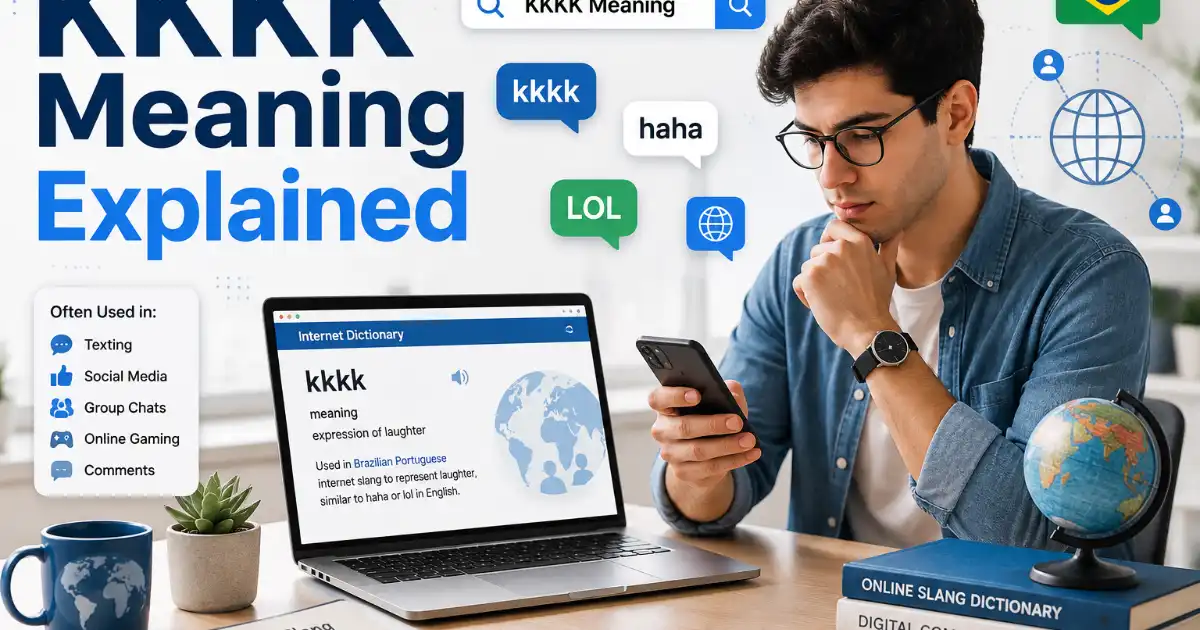
KKKK usually means laughter in online conversations, especially in Brazilian Portuguese. It works much like haha, hahaha, LOL, or lmao in English. The repeated k represents a written laughing sound, and adding more k’s can make the reaction feel stronger or more exaggerated.
The meaning depends on context. In Brazilian Portuguese, kkkk is a normal casual way to laugh in texts, comments, chats, and social media posts. Korean internet users also use repeated k characters to represent laughter when Romanized.
Introduction
Seeing kkkk in a text can be confusing if the reader expects every group of letters to represent an English abbreviation. Someone might send a message such as kkkk that was hilarious, and an English speaker unfamiliar with Brazilian internet slang may wonder whether the letters stand for something.
In many online conversations, however, kkkk simply expresses laughter. Brazilian Portuguese speakers commonly use repeated k’s as a casual written representation of laughing. The expression can appear in private messages, group chats, comments, memes, gaming conversations, and social media.
This guide explains the kkkk meaning, where it comes from, how people use it, what different numbers of k’s can communicate, and why context matters. It also covers an important point for English speaking readers: a string of k’s can have very different cultural associations depending on where the conversation takes place.
What Does KKKK Mean?
KKKK means laughter, particularly in Brazilian Portuguese internet communication. It functions similarly to haha, hahaha, LOL, or lolol in English.
The expression does not represent a standard Portuguese word. Instead, it works as a written representation of laughter. Brazilian internet users have used variations such as kk, kkk, kkkk, and much longer strings of k’s. The number of letters can help communicate the intensity of the reaction.
For example:
That video was ridiculous kkkk
This roughly communicates:
That video was ridiculous haha.
A longer version can suggest stronger amusement:
KKKKKKK that was so funny!
The exact emotional strength depends on the person and conversation. There is no strict rule saying that four k’s always means one specific level of laughter.
KKKK Meaning by Context
Because repeated k’s appear in more than one online culture, context helps determine the intended meaning.
| Context | Meaning | Tone | Example |
|---|---|---|---|
| Brazilian Portuguese | Laughter | Casual | kkkk that was funny |
| Brazilian social media | Laughter or amusement | Playful | KKKKK this meme |
| Korean internet culture | Laughter | Casual | kkkkk |
| English conversation | Potentially ambiguous | Context dependent | kkkk |
| Formal communication | Usually inappropriate | Informal | Avoid it in formal writing |
Brazilian Portuguese is the most important context for understanding kkkk as internet laughter. Korean users can also represent laughter with repeated ㅋ, which may appear as kkk or kkkk when written with the Latin alphabet.
Why Do Brazilians Type KKKK Instead of Haha?
The repeated k developed as a recognizable written form of laughter in Brazilian online communication. Portuguese speakers can use the letter k repeatedly to create a sound associated with laughing, often represented approximately as ka ka ka.
The expression became especially useful in fast digital conversations because it requires only one letter repeated several times. Instead of typing a complete expression such as hahaha, a person can simply press the k key repeatedly.
Historical evidence also shows the expression in Brazilian internet communication going back at least to the early 2000s.
Over time, kkkk became recognizable as part of Brazilian online culture rather than simply a random collection of letters.
What Does KKK Mean Compared With KKKK?
The number of k’s can influence the tone, although users do not follow a universal formula.
| Expression | Typical interpretation | Example reaction |
|---|---|---|
| kk | Small laugh or brief reaction | kk that was funny |
| kkk | Casual laugh | kkk I can’t believe that |
| kkkk | Clear amusement | kkkk that’s hilarious |
| kkkkkk | Stronger laughter | kkkkkk no way |
| KKKKKKK | Very strong or exaggerated laughter | KKKKKKK I’m dying |
These differences are flexible. One person might use kkk for a huge laugh while another might use ten k’s for the same reaction.
Capital letters can also add emphasis. KKKK often looks louder or more energetic than lowercase kkkk, particularly in an excited social media conversation.
How Is KKKK Used in Texting?
People generally use kkkk in casual digital conversations when they want to show that something amused them.
Common situations include:
Reacting to a Funny Message
A person might send:
I just walked into the wrong classroom and sat there for five minutes kkkk
A friend could respond:
KKKK I would have done the same thing.
Here, the expression works much like haha.
Responding to a Meme
Someone may comment:
KKKKK this is too accurate.
The repeated letters communicate amusement without requiring a full sentence.
Reacting to an Embarrassing Moment
A friend might write:
I waved back at someone who wasn’t waving at me kkkk.
The laughter can soften the embarrassment and make the story feel playful.
Laughing at a Joke
A simple response such as:
kkkk that’s actually funny
can show that the person enjoyed the joke.
KKKK Examples in Real Conversations
Understanding examples makes the slang easier to recognize.
Example 1
A: I forgot my own password again.
B: kkkk you need a password manager.
Here, kkkk means something like haha.
Example 2
A: The dog stole my sandwich and ran away.
B: KKKKK that’s hilarious.
The longer string shows a stronger reaction.
Example 3
A: I studied for three hours and the professor canceled the test.
B: kkkk that’s rough.
The laughter may communicate irony rather than genuine amusement.
Example 4
A: Look at this meme.
B: KKKKKKK 😂
Here, the repeated k’s and laughing emoji reinforce the humorous reaction.
Does KKKK Mean LOL?
Yes, kkkk can function much like LOL or hahaha, particularly in Brazilian Portuguese online conversations.
The expressions are not linguistically identical, but they perform a similar job in digital communication. They tell the other person that the message, joke, image, or situation caused amusement.
A rough comparison looks like this:
| Expression | General Meaning | Common Context |
|---|---|---|
| haha | Light laughter | English texting |
| hahaha | Stronger laughter | English texting |
| LOL | Laughter or amusement | English internet slang |
| kkkk | Laughter | Brazilian Portuguese internet slang |
| ㅋㅋㅋ | Laughter | Korean internet slang |
| rsrs | Laughs | Brazilian Portuguese |
The surrounding message remains important because online laughter can sometimes express awkwardness, irony, embarrassment, or friendliness rather than uncontrollable laughter.
KKKK and Korean Internet Slang
Another possible context comes from Korean internet communication.
Korean speakers commonly use the Hangul character ㅋ to represent a laughing sound. Repeated characters such as ㅋㅋㅋ communicate laughter, somewhat like lol or hahaha in English. When represented with Latin letters, this can appear as kkk or kkkk.
The Korean form has its own cultural background, so it should not automatically be treated as exactly the same expression as Brazilian kkkk.
For someone reading a message without knowing the sender’s language, the surrounding conversation usually provides the best clue.
Is KKKK the Same as the KKK?
No. Context matters greatly.
In Brazilian Portuguese internet slang, kkkk represents laughter. It has no connection to the American organization commonly abbreviated as KKK.
This distinction becomes particularly important for English speaking readers because the uppercase abbreviation KKK can carry a very different and highly offensive association in US English.
A person using kkkk in a Brazilian conversation may simply be laughing. An English speaker encountering KKK outside that context may interpret it differently.
The safest approach is to examine the language, surrounding words, platform, and conversation before assuming what the letters mean.
When Should Someone Use KKKK?
Someone can use kkkk when participating in an informal conversation where the expression makes cultural and linguistic sense.
It works well in:
- Casual text messages
- Social media comments
- Friendly group chats
- Online gaming conversations
- Informal conversations with Brazilian Portuguese speakers
- Meme discussions
It generally does not belong in formal writing such as a professional report, academic paper, job application, or business document.
If someone is communicating with a Brazilian Portuguese speaker, using kkkk naturally can show familiarity with local online communication. However, a learner should not feel pressured to use it. haha and lol may still be understood depending on the conversation.
What Is the Difference Between KKKK and RSRS?
Both can represent laughter in Brazilian online communication, but they have different origins and stylistic associations.
Kkkk is a direct written laughter expression built around repeated k’s. Rsrs comes from risos, meaning laughs in Portuguese.
| Term | Meaning | General Feel | Typical Use |
|---|---|---|---|
| kkkk | Laughter | Casual and expressive | Texts and social media |
| rsrs | Laughs | Often softer | Casual conversations |
| hahaha | Laughter | International | General online communication |
| lol | Laughing out loud | Internet slang | English based chats |
The choice depends on personal style, age, community, and context. No single expression works identically for every Portuguese speaker.
Common Use Cases for KKKK
The expression appears in many informal situations.
Friendly Conversation
Friends may add kkkk after a joke or funny observation.
Social Media Comments
People can use it when reacting to memes, videos, posts, or funny replies.
Gaming Chats
Players may use repeated k’s to react quickly to something funny that happens during a game.
Playful Teasing
A person may add kkkk after teasing a friend to signal that the comment was playful.
Embarrassing Stories
Someone telling an awkward story may add kkkk to show that they can laugh at themselves.
Common Mistakes With KKKK
Several misunderstandings can happen when someone sees this expression for the first time.
Mistaking It for an English Acronym
Not every sequence of capital k’s represents an English abbreviation. In Brazilian Portuguese, repeated k’s commonly represent laughter.
Assuming Every KKKK Has the Same Intensity
Four k’s do not always represent exactly the same level of laughter. People use different lengths depending on their personal style.
Ignoring the Language Context
The same letters can have different meanings across cultures. Check whether the conversation involves Brazilian Portuguese, Korean, English, or another language.
Using It in Formal Writing
Even when the meaning is harmless, kkkk is informal internet slang. A professional email or academic assignment should use appropriate formal language instead.
Confusing KKKK With KKK
The visual similarity can cause confusion for English speaking readers. In Brazilian Portuguese, kkkk can simply mean laughter, while the separate uppercase abbreviation KKK has a very different historical meaning in US English.
Is KKKK Rude?
Usually, no. In Brazilian Portuguese online conversations, kkkk normally expresses laughter or amusement.
Its tone can still change depending on the situation. For example, adding laughter after someone’s mistake could sound friendly if the relationship supports teasing, but it could also seem dismissive if the subject is serious.
As with haha or LOL, the surrounding message determines the emotional tone.
Is KKKK Used on Social Media?
Yes. Kkkk appears in informal online communication, including comments, direct messages, group conversations, and meme discussions.
The expression works particularly well when a user wants to react quickly without writing a complete sentence.
For example:
KKKKK this comment 😂
The meaning is essentially that the commenter found the post or comment very funny.
How Should English Speakers Interpret KKKK?
When an English speaker sees kkkk, the first step should be to consider the context.
If the sender speaks Brazilian Portuguese or the conversation takes place in a Brazilian online community, kkkk almost certainly points toward laughter.
If the conversation involves Korean internet culture, repeated k characters may also represent laughter.
If the message appears in an English speaking environment, do not automatically assign one meaning without looking at the surrounding text. Context can prevent an unnecessary misunderstanding.
Conclusion
The kkkk meaning becomes simple once the cultural context is clear. In Brazilian Portuguese internet communication, kkkk is a written form of laughter, similar to haha or LOL in English. More k’s can make the reaction appear stronger, although people use the expression flexibly.
The main point to remember is that context matters. Brazilian Portuguese speakers can use kkkk casually in texts, comments, memes, and social media, while Korean internet users have a related use of repeated k characters for laughter.
For English readers, recognizing the language and conversation context prevents confusion, especially because the visually similar uppercase KKK can have an entirely different meaning in US English.
Frequently Asked Questions About KKKK
What does KKKK mean in texting?
KKKK usually means laughter, especially in Brazilian Portuguese online communication. It works similarly to haha, hahaha, or LOL in English.
What does kkkk mean in Portuguese?
In Portuguese internet slang, particularly Brazilian Portuguese, kkkk represents laughter. People use different numbers of k’s to express varying levels of amusement.
Why do Brazilians type kkkk?
Repeated k’s became a recognizable written representation of laughter in Brazilian digital communication. The letters create a sound associated with laughing and provide a quick way to react in online conversations.
Does kkkk mean LOL?
Yes. In the appropriate context, kkkk performs a similar conversational function to LOL or hahaha. The expressions come from different linguistic traditions, but each can communicate amusement.
Does KKKK mean something offensive?
In Brazilian Portuguese internet slang, kkkk normally means laughter and is not connected to the separate English abbreviation KKK. Context and capitalization matter, particularly in English speaking environments.
What does more k’s mean?
More k’s often make the laughter appear stronger or more exaggerated. For example, kkkkkk can look more enthusiastic than kk. This remains a flexible convention rather than a strict rule.
Is KKKK used in Korean texting?
Repeated ㅋ, written in Latin characters as k’s, can represent laughter in Korean online communication. Korean ㅋㅋㅋ is a common informal expression of amusement.
Is KKKK appropriate in professional messages?
Usually not. It is informal internet slang, so professional emails, formal workplace documents, academic writing, and official communication should use clearer language.