
Quick Answer
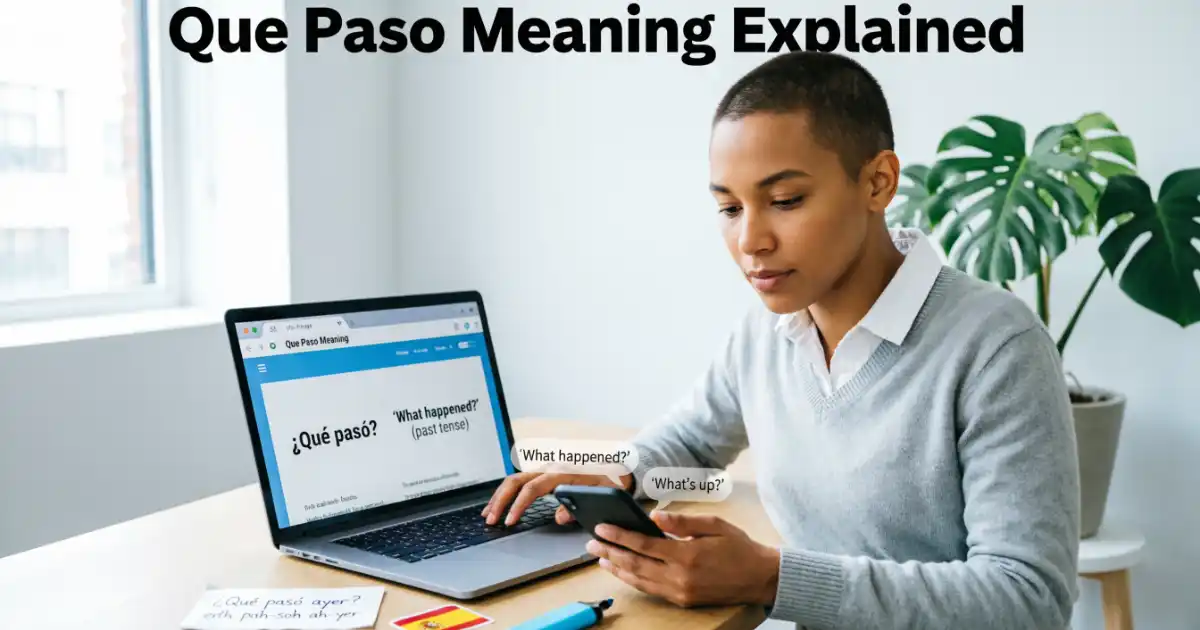
¿Qué pasó? is a Spanish phrase that most directly means What happened? in English. It uses the past tense of the verb pasar, meaning to happen, occur, pass, or go by depending on context. In casual conversation, especially in Mexican Spanish, ¿Qué pasó? can also work as an informal greeting similar to What’s up?, What’s going on?, or How’s it going?
The phrase is usually pronounced keh pah SOH. The accent mark in pasó matters because pasó and paso have different meanings.
Introduction
People often search for que paso after seeing the phrase in a text message, social media comment, movie, song, or conversation. Spanish phrases can change meaning depending on grammar and context, and this short expression provides a good example. ¿Qué pasó? normally asks about something that already happened, but in some informal conversations it can sound more like a friendly greeting.
For an English speaker, the easiest translation is What happened? That translation works when someone wants an explanation about an event, problem, surprise, or recent situation. For example, if a friend walks into a room and sees everyone looking worried, they might ask, ¿Qué pasó?
The phrase can also have a conversational meaning closer to What’s up? or What’s going on?, particularly in informal Mexican Spanish. This guide explains the meaning, pronunciation, grammar, everyday uses, examples, related phrases, and common mistakes so readers can understand exactly what someone means when they say ¿Qué pasó?
| Phrase | Basic English meaning | Common context | Tone |
|---|---|---|---|
| ¿Qué pasó? | What happened? | Asking about an event | Neutral to casual |
| ¿Qué pasó? | What’s up? | Informal greeting | Friendly |
| ¿Qué pasa? | What’s happening? | Current situation | Casual |
| ¿Qué ocurrió? | What happened? | Formal or careful speech | More formal |
| ¿Qué ha pasado? | What has happened? | Recent event | Neutral |
What Does Que Paso Mean?
The properly written Spanish phrase is ¿Qué pasó? and its primary meaning is What happened? The phrase contains qué, meaning what, and pasó, a past tense form of pasar. In this construction, pasar refers to something that happened or took place.
The accent mark on pasó is important. Spanish uses accent marks to distinguish certain words and indicate pronunciation. Pasó has the stress on the final syllable and means something like happened in this phrase. Without the accent, paso can have a different grammatical function and meaning.
The question can refer to a major event or something extremely ordinary:
- ¿Qué pasó? = What happened?
- ¿Qué pasó aquí? = What happened here?
- ¿Qué pasó ayer? = What happened yesterday?
- ¿Qué pasó con mi pedido? = What happened to my order?
- ¿Qué te pasó? = What happened to you?
The exact English translation can change slightly depending on the surrounding words and situation.
Que Paso Can Also Mean What’s Up
One reason qué pasó sometimes confuses English speakers involves its use as an informal greeting.
In some Spanish speaking communities, particularly Mexico, someone may say ¡Qué pasó! when greeting a friend. In that situation, the speaker may not literally ask about a past event. Instead, the phrase can function similarly to Hey, What’s up?, or How’s it going?
For example:
Carlos: ¡Qué pasó, Miguel!
Miguel: Todo bien. ¿Y tú?
A natural English version would be:
Carlos: What’s up, Miguel?
Miguel: Everything’s good. How about you?
Context makes the difference. If someone looks worried and asks ¿Qué pasó?, they probably want to know what happened. If two friends meet casually and one says ¡Qué pasó!, it may simply serve as a greeting.
How to Pronounce ¿Qué Pasó?
English speakers can approximate ¿Qué pasó? as:
keh pah SOH
The second word receives the strongest stress because of the accent on ó.
The pronunciation is roughly:
- qué sounds like keh
- pasó sounds like pah SOH
Avoid pronouncing pasó like the English word pass. Spanish vowels generally have more consistent pronunciation than English vowels.
Listening to native speakers can help because the rhythm becomes easier to recognize with practice.
What Is the Difference Between Qué Pasó and Qué Pasa?
¿Qué pasó? and ¿Qué pasa? look almost identical, but their verb forms point to different time frames.
¿Qué pasó? normally asks about something that happened.
¿Qué pasa? normally asks about something happening now or can mean What’s wrong?, What’s going on?, or What’s up? depending on context.
| Term | Meaning | Time or context | Example |
|---|---|---|---|
| ¿Qué pasó? | What happened? | Past event | ¿Qué pasó ayer? |
| ¿Qué pasa? | What’s happening? | Current situation | ¿Qué pasa aquí? |
| ¿Qué ocurrió? | What happened? | Past event | ¿Qué ocurrió durante la meeting? |
| ¿Qué ha pasado? | What has happened? | Recent event | ¿Qué ha pasado aquí? |
The distinction becomes especially useful for beginners because changing pasó to pasa changes the tense and therefore the basic meaning.
How Is Que Paso Used in Everyday Conversation?
The phrase appears in many ordinary situations. Someone might use it when they notice an unexpected event, want an explanation, or simply greet someone.
For example, imagine a student arriving at school and seeing several classmates gathered around a broken computer.
¿Qué pasó?
The natural English translation would be:
What happened?
If someone receives a message saying that a friend suddenly left a party, they might ask:
¿Qué pasó?
Again, the meaning is What happened?
But two friends meeting at a coffee shop might say:
¡Qué pasó!
Here, the phrase may function more like What’s up?
The surrounding situation and tone provide important clues.
Examples of Qué Pasó in Spanish
These examples show how the phrase works in different contexts.
Asking About an Event
¿Qué pasó en la reunión?
Meaning: What happened at the meeting?
This asks the listener to explain something that occurred during the meeting.
Asking About a Person
¿Qué te pasó?
Meaning: What happened to you?
This could express concern, curiosity, or surprise.
Asking About an Object or Situation
¿Qué pasó con mi teléfono?
Meaning: What happened to my phone?
The speaker wants information about the phone and what happened to it.
Asking About a Recent Problem
¿Qué pasó aquí?
Meaning: What happened here?
Someone might say this after noticing a mess, accident, argument, or unexpected change.
Using It as a Greeting
¡Qué pasó, amigo!
Depending on the speaker and region, this can have a meaning closer to:
Hey, what’s up?
This informal greeting usage is particularly associated with Mexican Spanish.
What Does Qué Pasó Mean in Mexican Spanish?
In Mexican Spanish, ¿Qué pasó? has both its ordinary meaning of What happened? and an informal greeting use that can resemble What’s up?
The greeting use often appears among friends, acquaintances, or people speaking casually. Someone might say ¡Qué pasó! when they meet someone they know.
The same phrase can also express surprise or mild offense depending on tone. A speaker who feels that someone has treated them disrespectfully might use ¡Qué pasó! as a reaction.
This illustrates an important lesson about conversational Spanish: dictionary translations do not always capture the social meaning of a phrase. Tone, relationship, location, and situation all matter.
Is Que Paso Slang?
¿Qué pasó? is not inherently slang. Its standard meaning, What happened?, is ordinary Spanish.
However, some speakers use it informally as a greeting, which gives it a conversational or colloquial feel. Dictionaries also document informal uses equivalent to What’s up? in certain regional contexts.
So it is better to think of qué pasó as a standard Spanish phrase with additional informal uses rather than automatically labeling it slang.
That distinction matters when deciding whether it is appropriate for a particular situation.
When Should Someone Use Qué Pasó?
Use ¿Qué pasó? when you want to ask someone about an event or situation that occurred.
It works naturally in:
- Casual conversations
- Conversations with friends
- Family discussions
- Text messages
- Social media conversations
- Questions about unexpected events
- Asking what happened to someone
- Asking about a recent problem
The phrase can also work in more serious situations, although a more formal alternative may be preferable in professional or official communication.
For example, ¿Qué ocurrió? sounds more formal than ¿Qué pasó?
Similar Spanish Phrases to Know
Learning related expressions makes qué pasó easier to understand.
¿Qué Pasa?
¿Qué pasa? generally means What’s happening?, What’s going on?, or What’s wrong?
It uses the present tense, unlike ¿Qué pasó?
¿Qué Ocurrió?
¿Qué ocurrió? means What happened?
It has a more formal or careful tone and often appears in formal writing or serious discussions.
¿Qué Ha Pasado?
¿Qué ha pasado? means What has happened?
It commonly focuses on a recent event that connects to the current situation.
¿Qué Onda?
¿Qué onda? is a very informal expression associated strongly with Mexican Spanish. Depending on context, it can mean What’s up? or ask what is going on.
¿Qué Hubo?
¿Qué hubo? is another informal greeting found in parts of Latin America. Regional usage varies, so learners should pay attention to where they hear it.
Common Mistakes With Que Paso
Several mistakes can make this simple phrase confusing.
Confusing Pasó With Paso
The accent in pasó matters. Pasó and paso are not interchangeable.
When writing the phrase as a question about an event, use ¿Qué pasó?
Confusing Qué Pasó With Qué Pasa
Use ¿Qué pasó? when asking about something that happened.
Use ¿Qué pasa? when asking about something happening now or asking what is wrong.
Assuming It Always Means What Happened
The literal translation works most of the time, but informal regional usage can turn ¡Qué pasó! into a greeting similar to What’s up?
Assuming Every Spanish Speaking Region Uses It the Same Way
Spanish varies across regions. A phrase that sounds like a familiar greeting in one community may sound more like a literal question somewhere else.
Translating Word by Word Without Considering Context
A literal translation gives you a useful starting point, but context determines the most natural English equivalent. ¿Qué pasó? can translate as What happened?, while an informal greeting may work better as What’s up?
How Do You Respond to Qué Pasó?
Your response depends on what the speaker means.
If someone literally asks what happened, explain the event.
A: ¿Qué pasó?
B: Perdí mi teléfono.
Meaning:
A: What happened?
B: I lost my phone.
If the phrase functions as a greeting, a casual response works better.
A: ¡Qué pasó!
B: Todo bien. ¿Y tú?
A natural English equivalent would be:
A: What’s up?
B: Everything’s good. How about you?
This is why understanding context matters more than memorizing one fixed translation.
Conclusion
¿Qué pasó? primarily means What happened? in English. It is a common Spanish phrase used to ask about an event, situation, problem, or unexpected change. The phrase can also take on a more informal meaning similar to What’s up?, especially when people use it as a greeting in Mexican Spanish.
The key distinction to remember is the difference between ¿Qué pasó? and ¿Qué pasa? The first normally refers to something that happened, while the second focuses on what is happening or what is wrong. Pay attention to the accent on pasó, the surrounding conversation, and the speaker’s tone. With those clues, qué pasó becomes a simple and useful Spanish phrase to recognize and use.
Frequently Asked Questions About Que Paso
What does que paso mean in English?
¿Qué pasó? most commonly means What happened? in English. In some informal contexts, especially Mexican Spanish, it can also function as What’s up? or How’s it going?
Is qué pasó the same as what’s up?
Not always. The primary meaning is What happened? However, some speakers use ¡Qué pasó! as an informal greeting that can mean What’s up? Context determines the intended meaning.
Is qué pasó Spanish slang?
The phrase itself is standard Spanish, not necessarily slang. Its informal greeting use can sound colloquial, particularly in Mexican Spanish.
How do you pronounce qué pasó?
A simple English approximation is keh pah SOH. The stress falls strongly on the final syllable of pasó.
What is the difference between qué pasó and qué pasa?
¿Qué pasó? asks about something that happened, while ¿Qué pasa? generally asks what is happening, what is going on, or what is wrong.
Can you say qué pasó as a greeting?
Yes. In some regional and informal contexts, particularly Mexican Spanish, ¡Qué pasó! can work as a friendly greeting similar to What’s up?
What does qué pasó mean in a text message?
In a text message, it usually means What happened? If friends use it casually at the beginning of a conversation, it may instead mean What’s up? or How’s it going?
Is qué pasó formal or informal?
¿Qué pasó? is common in everyday conversation and works naturally in casual situations. ¿Qué ocurrió? can sound more formal when someone wants a more polished way to ask what happened.