
Quick Answer
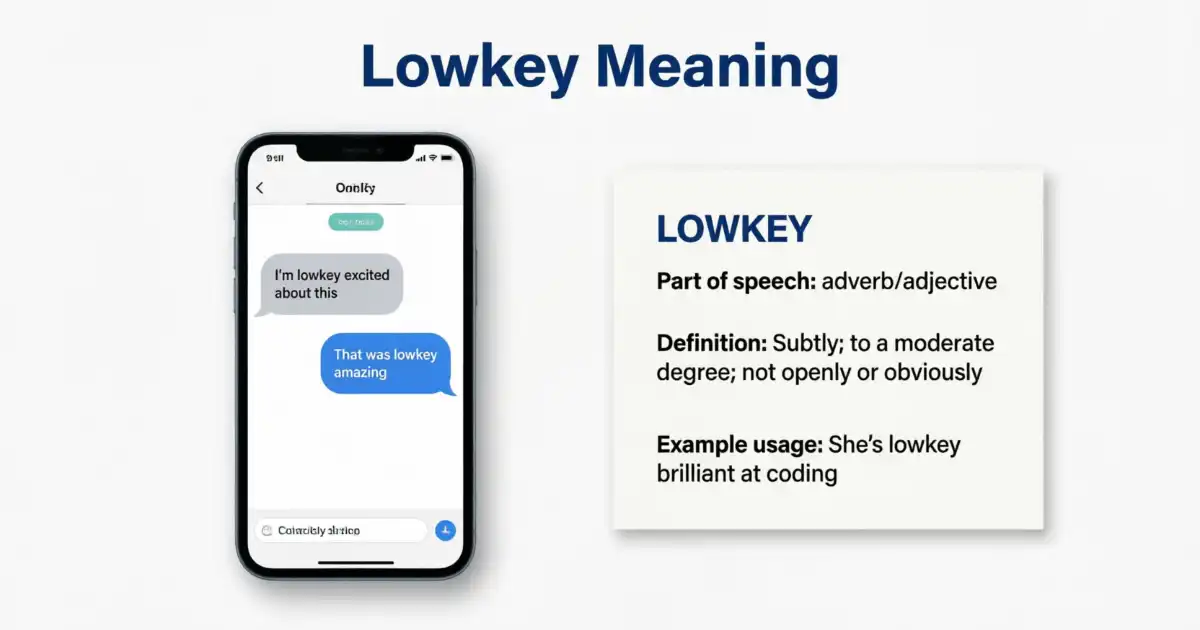
Lowkey is slang that usually means quietly, somewhat, secretly, or without making something obvious. In texting and social media, someone might say, “I lowkey love this song,” meaning they really like it but are expressing the feeling casually or without making a big deal about it.
Lowkey can also describe something relaxed, simple, quiet, or not attention seeking, such as a lowkey party or a lowkey weekend.
Introduction
If you have seen someone write “I lowkey want to go,” “that was lowkey funny,” or “I’m lowkey tired,” you may have wondered what lowkey actually means. The word appears frequently in texts, social media posts, comments, memes, and casual conversations. Its meaning can seem confusing because it does not always translate into one exact word.
In modern informal English, lowkey often softens or downplays a statement. It can suggest that someone has a feeling or opinion but does not want to emphasize it too strongly.
For example, “I lowkey love this movie” can mean the person genuinely loves it, but they are saying it in a casual, understated way. Depending on the sentence, lowkey can also mean somewhat, secretly, quietly, or surprisingly.
The word has an older meaning too. Low key traditionally describes something restrained, quiet, simple, or lacking strong intensity. Modern slang developed from this broader idea of keeping something understated. Understanding the context makes the meaning much easier to recognize.
What Does Lowkey Mean?
Lowkey usually means quietly, somewhat, secretly, or in an understated way when used as slang. It is often used before a feeling, opinion, action, or description to make the statement sound more casual or less strongly emphasized. Cambridge Dictionary also identifies lowkey as an informal adverb used when someone expresses an opinion without emphasizing it too much.
For example:
I lowkey want some pizza.
This means the speaker wants pizza, but they are expressing the thought casually.
Another example is:
I lowkey love her new album.
Here, lowkey does not necessarily mean the person secretly loves the album. It can simply make the statement feel relaxed, understated, or less dramatic.
Lowkey can also describe something that is quiet, simple, relaxed, or not designed to attract attention. For example:
We had a lowkey birthday party at home.
In this sentence, lowkey describes the type of party rather than modifying someone’s opinion.
The meaning therefore depends on how the word is used in the sentence.
Lowkey Meaning in Text and Social Media
In texts, comments, and social media, lowkey is usually an informal way to soften a statement or express a feeling without making it sound too serious or dramatic.
Someone might write:
I lowkey miss summer.
This means they miss summer, but the speaker is presenting the feeling casually.
Another person might say:
That show was lowkey amazing.
This means the show was surprisingly or genuinely very good, while the speaker keeps the tone relaxed.
Lowkey is especially useful when someone wants to communicate a thought without giving it too much emphasis. It can make a statement sound conversational rather than formal.
The word is also flexible. It can appear before verbs, adjectives, and other descriptions.
| Use | Meaning | Example |
|---|---|---|
| Lowkey like | Like somewhat or quietly | I lowkey like this song. |
| Lowkey want | Want something without making a big deal | I lowkey want that hoodie. |
| Lowkey funny | Surprisingly or somewhat funny | That video was lowkey funny. |
| Lowkey obsessed | Very interested but expressed casually | I am lowkey obsessed with this game. |
| Lowkey tired | Somewhat or genuinely tired | I am lowkey tired today. |
| Lowkey party | Quiet and relaxed gathering | We are having a lowkey party tonight. |
How Is Lowkey Used in a Sentence?
Lowkey can work as an adverb or adjective depending on the context.
As an adverb, it modifies an opinion, feeling, or action:
I lowkey want to leave early.
She lowkey loves that restaurant.
That movie was lowkey great.
I lowkey forgot about the meeting.
As an adjective, it can describe a person, event, place, style, or situation:
We had a lowkey dinner.
He has a very lowkey personality.
It was a lowkey weekend.
She prefers a lowkey celebration.
The adverbial slang use is especially common in online communication. The adjective use is closer to the traditional meaning of the word.
Lowkey vs. Low Key vs. Low-Key
You may see the word written in three different ways: lowkey, low key, and low-key.
They can refer to the same general idea, but usage depends on context and style.
| Form | Common Use | Example |
|---|---|---|
| Lowkey | Informal slang, texting, social media | I lowkey love this. |
| Low key | Informal phrase | We kept the event low key. |
| Low-key | Standard dictionary spelling and adjective use | It was a low-key event. |
Modern dictionaries recognize lowkey as a variation of low-key, particularly in informal slang usage.
In casual texting, lowkey is extremely natural. In formal writing, low-key is generally the safer spelling when you mean quiet, restrained, or understated.
What Does Lowkey Mean in Different Contexts?
The exact meaning can change slightly depending on the sentence.
Lowkey Meaning in Texting
In texting, lowkey often means somewhat, secretly, or without emphasizing the feeling.
I lowkey want to go with you.
The person is expressing interest without making a dramatic statement.
Lowkey Meaning on TikTok and Social Media
On social media, lowkey is often used to introduce an opinion or reaction in a casual way.
This is lowkey the best outfit.
The speaker is saying they think the outfit is very good, but the word makes the statement feel less intense.
Lowkey Meaning in Relationships
When someone says:
I lowkey have a crush on him.
They usually mean they have a crush but are not openly making a big deal about it.
Here, lowkey can suggest that the feeling is private, understated, or not widely known.
Lowkey Meaning for Plans
If someone says:
I want a lowkey weekend.
They usually mean they want something relaxed and uncomplicated rather than a busy schedule or large event.
A lowkey weekend might involve staying home, watching a movie, getting coffee, or spending time with a few close friends.
Examples of Lowkey in Everyday Conversation
Here are some natural examples:
- I lowkey want to order dessert.
- That restaurant is lowkey amazing.
- I am lowkey nervous about tomorrow.
- She lowkey knows everyone here.
- This song is lowkey catchy.
- I lowkey forgot to send the email.
- He is a pretty lowkey guy.
- We are keeping the birthday celebration lowkey.
- I lowkey miss my old school.
- That was lowkey one of the funniest things I have seen today.
- I lowkey want to buy those shoes.
- We had a lowkey night at home.
These examples show why there is no single replacement word that works in every situation. Depending on the context, lowkey can mean somewhat, quietly, privately, casually, or without much attention.
Lowkey vs. Highkey
Highkey is commonly used as a contrasting slang expression. While lowkey often softens or downplays a statement, highkey usually makes the feeling or opinion more obvious and emphatic.
| Term | Meaning | Tone | Example |
|---|---|---|---|
| Lowkey | Quietly, somewhat, or subtly | Understated | I lowkey love this song. |
| Highkey | Openly, strongly, or very clearly | Emphatic | I highkey love this song. |
The difference is mainly about intensity and presentation. If someone says, “I lowkey like it,” they are expressing the opinion casually. If they say, “I highkey like it,” they are making the feeling much more obvious.
Lowkey vs. Secretly
Lowkey and secretly can sometimes overlap, but they are not always interchangeable.
Secretly usually means something is intentionally kept hidden from other people.
Lowkey can suggest privacy, but it often simply makes a statement less intense or more casual.
For example:
I secretly bought the gift.
This strongly suggests that other people do not know about the purchase.
But:
I lowkey want that gift.
This does not necessarily mean the desire is being hidden. It can simply mean the speaker is expressing the desire casually.
Where Did Lowkey Come From?
The expression low-key has been used in English for a long time. Its earlier meanings were connected with low intensity, quietness, restraint, and subdued tones. Dictionary sources trace the word’s historical development back to descriptions involving a low or muted tone.
Over time, the expression expanded into descriptions of things that were quiet, restrained, modest, or understated.
The modern slang use developed from this idea of keeping something understated. By the late 2000s and 2010s, lowkey was increasingly used as an adverb in informal online communication and popular culture.
Today, lowkey is common in casual speech and online writing. Its meaning is often less literal than the traditional adjective and more focused on tone.
When Should You Use Lowkey?
Lowkey works best in casual situations where the conversation is relaxed.
You can use it in:
- Text messages
- Social media comments
- Casual conversations
- Group chats
- Informal posts
- Friendly messages
- Memes and online discussions
For example:
I lowkey need a vacation.
That new coffee shop is lowkey great.
I am lowkey excited for the weekend.
It is less appropriate in formal academic writing, professional reports, legal documents, or other situations where precise formal language is expected.
In those settings, you can usually replace lowkey with a more specific word such as somewhat, quietly, subtly, privately, casually, or understated, depending on the intended meaning.
Common Mistakes When Using Lowkey
One common mistake is assuming that lowkey always means secretly. It can suggest something private, but it does not always mean that something is hidden.
Another mistake is assuming that lowkey always means a little. In slang, it can soften a statement without necessarily reducing the actual strength of the feeling. Someone saying “I lowkey love this” may genuinely love it.
It is also easy to confuse lowkey with low key as a literal description. In “I lowkey want pizza,” the word is slang. In “The event was low key,” it describes something quiet or restrained.
Finally, avoid using lowkey in formal writing simply because it sounds natural in conversation. Choose wording that matches the audience and setting.
Conclusion
Lowkey usually means quietly, somewhat, subtly, or without making something a big deal. In texting and social media, it often softens an opinion or feeling, as in “I lowkey love this song.” It can also describe something relaxed or understated, such as a lowkey party or a lowkey weekend.
The easiest way to understand lowkey is to look at the context. When it modifies a feeling or opinion, it often creates a casual, understated tone. When it describes an event, person, or situation, it usually suggests something quiet, relaxed, simple, or not attention seeking.
FAQs About Lowkey
What does lowkey mean in texting?
In texting, lowkey usually means quietly, somewhat, secretly, or without putting too much emphasis on a feeling or opinion. The exact meaning depends on the sentence.
Does lowkey mean secretly?
Sometimes it can suggest something private or not openly expressed, but lowkey does not always mean secretly. It can also mean somewhat, casually, or in an understated way.
What does I lowkey like you mean?
“I lowkey like you” usually means the speaker has romantic or personal interest but is expressing it casually or without making the feeling sound too serious.
What does lowkey mean on social media?
On social media, lowkey is commonly used to soften an opinion or reaction. For example, “This song is lowkey amazing” means the speaker thinks the song is very good but expresses the opinion in a casual way.
Is lowkey the same as low key?
They are closely related. Lowkey is especially common as informal slang, while low-key is the standard dictionary form for meanings such as quiet, restrained, or understated. Dictionaries recognize lowkey as a variant used in informal contexts.
What is the opposite of lowkey?
In modern slang, highkey is often used as the opposite. Lowkey generally makes a statement feel understated, while highkey makes the feeling or opinion more open and emphatic.
Is lowkey formal English?
Lowkey is widely understood in modern informal English, but it is best suited to casual conversation, texting, and social media. For formal writing, a more precise word such as somewhat, quietly, subtly, or understated may be better.
Can lowkey describe a person?
Yes. Calling someone lowkey can mean they are relaxed, quiet, modest, or not interested in attracting a lot of attention. The exact meaning depends on the context.