
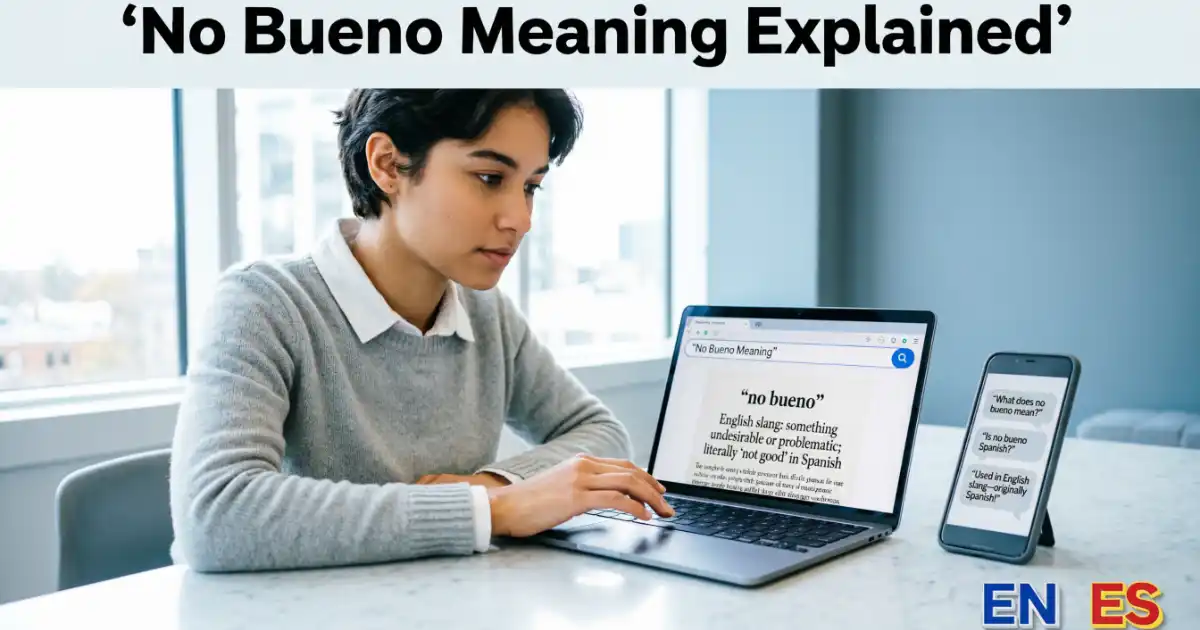
Quick Answer
No bueno means not good, no good, bad, or undesirable. In casual English, people often use it as a playful or informal way to show disappointment, disapproval, or concern about a situation. Dictionary sources list it as an American informal phrase meaning something that is not good or desirable.
The phrase uses Spanish words, with no meaning not and bueno meaning good. However, no bueno is generally treated as informal American English rather than standard Spanish. If someone wants to express the same idea naturally in Spanish, the wording depends on the situation.
Introduction
People often search for no bueno after seeing it in a text message, social media post, movie, TV show, workplace conversation, or casual joke. The phrase looks like Spanish, but English speakers often use it as an informal expression with a very simple meaning: something is bad, problematic, disappointing, or not acceptable.
For example, if someone discovers that their flight has been canceled, they might say, “No bueno.” If a friend burns dinner, another person might jokingly respond, “That is no bueno.” The expression usually communicates a negative reaction without sounding extremely serious.
The phrase can also create confusion because its individual words are Spanish, yet its common use in American English does not always follow standard Spanish grammar. SpanishDictionary translates no bueno as “not good,” while language resources note that the phrase works differently as an informal English expression than it does as standard Spanish.
This guide explains the no bueno meaning, pronunciation, tone, origins, examples, proper context, and the difference between using it as English slang and using Spanish correctly.
What Does No Bueno Mean?
In everyday English, no bueno means not good, no good, bad, or not acceptable. It can describe a situation, result, plan, experience, decision, or problem.
Dictionary.com defines the phrase as something that is not good, pleasing, or desirable. It can also function as an interjection when someone wants to react to something negative.
The meaning can range from mildly negative to clearly disapproving depending on the context.
For example:
- “My laptop stopped working. No bueno.”
- “The restaurant is closed today. No bueno.”
- “You forgot the tickets? No bueno.”
- “That plan is no bueno.”
In each example, the speaker communicates that something has gone wrong or does not meet expectations.
The phrase often has a humorous or casual tone. Saying “no bueno” can sound lighter than saying “this is unacceptable” or “this is a serious problem.” However, tone still matters. A person can use it jokingly, sarcastically, or as a genuine expression of disappointment.
No Bueno: Meaning, Tone, and Context
| Term | Meaning | Tone | Example |
|---|---|---|---|
| No bueno | Not good or undesirable | Casual, informal | “The weather is no bueno.” |
| Not good | Something is bad or unsatisfactory | Neutral | “The results are not good.” |
| No good | Not useful, successful, or acceptable | Casual | “That solution is no good.” |
| Bad | Poor or undesirable | Direct | “That was a bad decision.” |
| Not acceptable | Something should not be accepted | More serious | “That behavior is not acceptable.” |
The main difference comes from tone. No bueno often feels playful or conversational, while alternatives such as not acceptable sound more serious.
Is No Bueno Actually Spanish?
This is where the phrase becomes interesting.
The individual words are Spanish. No means no or not, and bueno commonly means good. However, the standalone phrase no bueno has become an informal expression in English rather than a standard way to construct a complete Spanish sentence. SpanishDictionary lists the literal translation as “not good,” while other language resources explain that the phrase is incomplete or nonstandard when treated as ordinary Spanish.
That distinction matters.
An English speaker saying “No bueno” to mean “That is not good” is usually using an established informal expression. They are not necessarily trying to speak grammatically correct Spanish.
If someone is actually speaking Spanish, the natural expression depends on what they want to say. For example, no está bien can mean “it is not okay” or “it is not right,” while other constructions can express that something is not good depending on the sentence.
So, it is useful to remember this simple distinction:
No bueno in casual English: informal expression meaning “not good.”
No bueno as standard Spanish: not generally the complete grammatical expression someone would choose for “not good.”
How Do You Pronounce No Bueno?
English speakers commonly pronounce no bueno approximately as:
noh BWEH noh
The Spanish pronunciation of bueno has a sound close to “BWEH noh.” SpanishDictionary gives the pronunciation of the phrase in a similar form.
In casual American English, pronunciation can vary slightly. Some speakers pronounce it closer to “noh BWAY noh,” especially when they have picked up the expression through English conversation rather than Spanish.
You do not need to exaggerate the Spanish pronunciation when using the phrase casually in English.
How People Use No Bueno in Everyday Conversation
People usually use no bueno when they want to point out that something has gone wrong or is undesirable.
When something fails
“I tried to print the report, but the printer is out of ink. No bueno.”
Here, the phrase means that the situation is inconvenient or problematic.
When a plan goes wrong
“The concert was canceled at the last minute. No bueno.”
The speaker expresses disappointment.
When someone makes a questionable choice
“Eating five slices of cake before dinner? No bueno.”
This example has a humorous tone.
When something looks suspicious
“That email asking for your password looks no bueno.”
Here, the phrase signals concern rather than simple disappointment.
When something is poor quality
“I tried the new software, and the performance was no bueno.”
The speaker means the performance was poor.
Examples of No Bueno in Texting
Because no bueno is short and expressive, it works well in casual text conversations.
Here are some natural examples:
Friend: “I forgot my wallet at home.”
Reply: “No bueno. Want me to bring it?”
Friend: “The movie starts in five minutes and we are still twenty minutes away.”
Reply: “No bueno 😂”
Coworker: “The presentation file disappeared.”
Reply: “Uh, no bueno. Check the backup folder.”
Friend: “The restaurant closed right before we arrived.”
Reply: “No bueno. Let’s find another place.”
These examples show why the phrase works well in informal communication. It quickly communicates a negative reaction without requiring a long explanation.
When No Bueno Sounds Funny or Playful
One reason people like no bueno is that it can make a complaint sound less dramatic.
Compare these statements:
“This is a terrible situation.”
“This is no bueno.”
The first sounds serious. The second can sound humorous, relaxed, or mildly annoyed.
That makes the expression useful for everyday problems that do not require a formal response.
For example:
“I accidentally ordered the extra spicy version. No bueno.”
The speaker probably is not describing a major crisis. They are making a lighthearted complaint.
Is No Bueno Formal or Informal?
No bueno is informal.
It fits naturally in:
- Text messages
- Casual conversations
- Social media posts
- Memes
- Informal commentary
- Jokes
- Friendly conversations
It usually does not belong in formal writing such as:
- Academic papers
- Legal documents
- Business reports
- Formal complaints
- Professional applications
- Official correspondence
For professional writing, clearer alternatives usually work better.
Instead of:
“The current results are no bueno.”
A professional version could be:
“The current results are not satisfactory.”
Or:
“The current results do not meet expectations.”
The choice depends on the audience and purpose.
No Bueno vs. No Good
These expressions communicate similar ideas, but they do not sound exactly the same.
| Phrase | Meaning | Tone | Example |
|---|---|---|---|
| No bueno | Not good or undesirable | Playful, informal | “That situation is no bueno.” |
| No good | Not useful, successful, or acceptable | Casual | “That plan is no good.” |
| Not good | Below expectations | Neutral | “The results are not good.” |
No good is normal English and has been used in many contexts. No bueno adds a playful pseudo Spanish flavor.
For example:
“This charger is no good.”
This sounds like a straightforward criticism.
“This charger is no bueno.”
This sounds more humorous or conversational.
No Bueno vs. Not Good
The basic meaning remains similar, but the emotional effect changes.
Not good sounds neutral.
No bueno sounds more expressive.
Consider:
“The traffic is not good.”
This simply describes poor traffic conditions.
“The traffic is no bueno.”
This sounds more like a casual complaint.
Neither is automatically better. The right choice depends on the audience and tone.
Common Situations Where People Say No Bueno
The phrase can appear in many everyday situations.
Food
“The pizza was cold. No bueno.”
Travel
“Our flight got delayed again. No bueno.”
Technology
“My phone battery died before I got home. No bueno.”
School
“I forgot to study for the quiz. No bueno.”
Work
“The file did not save. No bueno.”
Shopping
“They are sold out of my size. No bueno.”
Weather
“It is supposed to rain all weekend. No bueno.”
Plans
“The tickets are already sold out. No bueno.”
In each case, the phrase communicates a negative reaction without requiring a formal explanation.
Can You Use No Bueno in a Professional Setting?
You can, but context matters.
A workplace with a relaxed culture might use no bueno jokingly in a team chat. For example:
“The conference room projector is broken again. No bueno.”
However, a formal email to a client would usually benefit from clearer language.
Instead of:
“The delivery delay is no bueno.”
Use:
“The delivery delay may affect the project schedule.”
This communicates the actual business impact more clearly.
Is No Bueno Offensive?
The phrase itself is generally understood as a mild, informal expression rather than a profanity or inherently offensive term. However, its use can feel awkward when someone uses Spanish words as a joke without understanding Spanish or the cultural context.
Language resources describe no bueno as an Americanism or pseudo Spanish expression rather than standard Spanish.
The safest approach is simple: use it as a familiar informal English expression, not as evidence of Spanish fluency.
If the goal is to communicate naturally with Spanish speakers in Spanish, learning the appropriate Spanish construction for the specific situation is better than relying on no bueno.
Common Mistakes With No Bueno
Mistake 1: Assuming it is standard Spanish
The phrase looks like Spanish, but its common English slang use does not make it standard Spanish grammar.
Mistake 2: Using it in formal writing
The expression works best in casual communication. Formal writing usually benefits from direct English such as “not acceptable,” “unsatisfactory,” or “not ideal.”
Mistake 3: Thinking it always means something terrible
No bueno can describe something mildly inconvenient. It does not automatically indicate a serious problem.
Mistake 4: Ignoring tone
The phrase can be playful or genuinely concerned. Context determines the intended meaning.
Mistake 5: Treating it as a complete Spanish lesson
Knowing what no bueno means does not mean someone understands Spanish grammar. The phrase is better understood as an informal English expression with Spanish words.
Conclusion
No bueno means not good, no good, bad, or undesirable. In everyday English, it usually works as a casual expression that signals disappointment, concern, or disapproval. Dictionary sources recognize this informal American usage.
Although the phrase uses Spanish words, it should not automatically be treated as standard Spanish grammar. Its modern English use is more accurately understood as an informal expression with Spanish elements.
The easiest way to remember the no bueno meaning is simple: when someone says “no bueno,” they usually mean that something went wrong, failed to meet expectations, or simply is not good. Use it casually with friends, in texts, and in informal conversations, while choosing clearer and more formal wording for professional or academic situations.
Frequently Asked Questions About No Bueno
What does no bueno mean in English?
No bueno means not good, no good, bad, or undesirable. People commonly use it as a casual expression of disappointment or disapproval.
Is no bueno a slang phrase?
Yes. In common American English, no bueno functions as an informal phrase. It often sounds playful, humorous, or mildly disapproving.
Does no bueno literally mean not good?
Yes. The individual Spanish words correspond roughly to “no” and “good,” so the literal idea is “not good.” SpanishDictionary also lists the phrase as “not good.”
Is no bueno correct Spanish?
Not generally as a complete standard Spanish expression meaning “it is not good.” Spanish has other grammatical ways to express the idea depending on context. Language resources specifically identify no bueno as an Americanism rather than standard Spanish usage.
Can you say no bueno in a text?
Yes. It works especially well in casual texts and messages.
For example:
“The store is closed. No bueno.”
What is another way to say no bueno?
Depending on the situation, alternatives include not good, no good, not ideal, that is bad, not acceptable, or that is a problem.
Is no bueno rude?
Usually, no. It is generally a mild and informal expression. However, using Spanish words carelessly in situations where someone expects actual Spanish can come across as awkward or insensitive.