
International travel can be exciting, whether you are planning a vacation, attending a business conference, visiting family, or exploring a new country. However, before booking flights and packing your bags, understanding visa requirements for travel is essential.
Every country has its own immigration policies, entry regulations, and documentation requirements. Some destinations allow travelers to enter without a visa, while others require an approved visa before departure. Certain countries also offer electronic visas, visas on arrival, or electronic travel authorizations.
Failing to meet entry requirements can lead to denied boarding, travel delays, unexpected expenses, or refusal of entry at the destination.
This comprehensive guide explains everything you need to know about international travel visas, including visa types, passport requirements, application procedures, supporting documents, processing times, travel restrictions, and practical strategies for avoiding common mistakes.
What Are Visa Requirements for Travel?
Visa requirements for travel are the immigration conditions that foreign nationals must satisfy before entering, staying in, or transiting through another country.
A visa is an authorization issued by a country’s government that permits a traveler to seek entry for a specified purpose and period, subject to applicable immigration rules.
Visa requirements depend on several factors, including:
- Your passport nationality
- Your destination country
- The purpose of your visit
- Your intended length of stay
- Your immigration or residency status
- Your travel history
- Your intended activities
- Your transit route
For example, a traveler visiting another country for tourism may face different requirements from someone traveling for employment, education, or business.
Importantly, having a valid visa does not automatically guarantee entry. Immigration officers may still verify eligibility and supporting documents at the border.
Quick Answer: What Documents Do You Need for an International Travel Visa?
Most visa applications require a valid passport, a completed application form, a photograph, evidence of the travel purpose, and supporting financial or accommodation documents.
However, exact requirements vary significantly by destination and visa category.
| Document | Purpose |
|---|---|
| Valid passport | Establishes identity and nationality |
| Visa application form | Provides personal and travel details |
| Passport-size photograph | Supports identity verification |
| Travel itinerary | Explains intended travel plans |
| Accommodation details | Shows where the traveler plans to stay |
| Financial evidence | Demonstrates ability to cover expenses |
| Employment or business documents | Supports economic circumstances or trip purpose |
| Travel insurance | Required for certain destinations and visa categories |
| Invitation letter | May support family or business visits |
| Visa fee receipt | Confirms payment where required |
Some destinations require only a passport and electronic authorization, while others request extensive documentation and an interview.
Always follow the official requirements for your nationality, destination, and intended travel purpose.
Types of Travel Visas You Should Know
Understanding different visa categories is important because applying for the wrong visa can result in rejection or immigration problems.
Tourist Visa
A tourist visa permits eligible visitors to enter a country for activities such as sightseeing, holidays, and certain recreational visits.
Tourist visas generally do not authorize employment.
Their validity and permitted length of stay vary by destination.
Business Visa
A business visa is intended for specific business-related activities, which may include attending meetings, conferences, negotiations, or professional events.
Permitted activities differ by country.
A business visitor visa does not necessarily authorize paid work or employment in the destination country.
Student Visa
Student visas are designed for international students attending eligible educational institutions.
Applicants may need an admission letter, proof of financial support, academic records, and evidence of language proficiency.
Some countries permit limited student employment under specific conditions.
Work Visa
A work visa or employment authorization allows a foreign national to undertake qualifying employment.
Requirements may include employer sponsorship, professional qualifications, an employment contract, and government approval.
Employment visas often involve more extensive procedures than short-term tourist visas.
Transit Visa
A transit visa may be required when passing through another country on the way to a final destination.
Whether one is necessary can depend on nationality, airport, connection duration, baggage collection, and whether the traveler must pass through immigration.
Family Visit Visa
A family visit visa allows eligible travelers to visit relatives living abroad.
Some applications require an invitation letter, proof of family relationships, or evidence of the host’s legal residence.
Medical Visa
Medical visas are available in some countries for people traveling to receive medical treatment.
Applicants may need medical records, confirmation from a healthcare provider, and financial documentation.
Understanding Visa-Free Travel, eVisas, and Visas on Arrival
Not every international journey requires a traditional embassy-issued visa.
Several alternative entry arrangements exist.
| Entry Arrangement | How It Works |
|---|---|
| Visa-free entry | Eligible travelers enter without obtaining a visa |
| Electronic visa (eVisa) | Travelers apply for and receive a visa electronically |
| Visa on arrival | Eligible travelers obtain a visa at an authorized entry point |
| Electronic travel authorization | Eligible travelers obtain electronic permission before travel |
| Embassy or consular visa | Applicants apply through an embassy, consulate, or authorized visa center |
Visa-Free Travel
Visa-free travel allows qualifying passport holders to visit a destination without applying for a visa.
However, visa-free entry can still have conditions concerning the purpose of travel, length of stay, return tickets, and financial resources.
Some visa-exempt travelers must obtain an electronic travel authorization.
Electronic Visa (eVisa)
An eVisa is applied for and issued electronically, usually through an official government portal.
Depending on the country, applicants may need to upload passport information, photographs, and supporting documents.
Approval may be delivered electronically or made available through an online account.
Visa on Arrival
A visa on arrival is issued at an authorized airport, border crossing, or other designated entry point.
Travelers should confirm eligibility before departure because airlines may refuse boarding if entry conditions are not satisfied.
Electronic Travel Authorization
An electronic travel authorization is not always legally classified as a visa.
Systems such as the United States ESTA, Canada’s eTA, and the United Kingdom’s ETA apply to particular groups of travelers under their respective immigration rules.
An authorization generally must be approved before travel and does not guarantee admission.
Passport Requirements for International Travel
Your passport is one of the most important documents for traveling abroad.
Different countries impose different passport validity rules.
Passport Validity
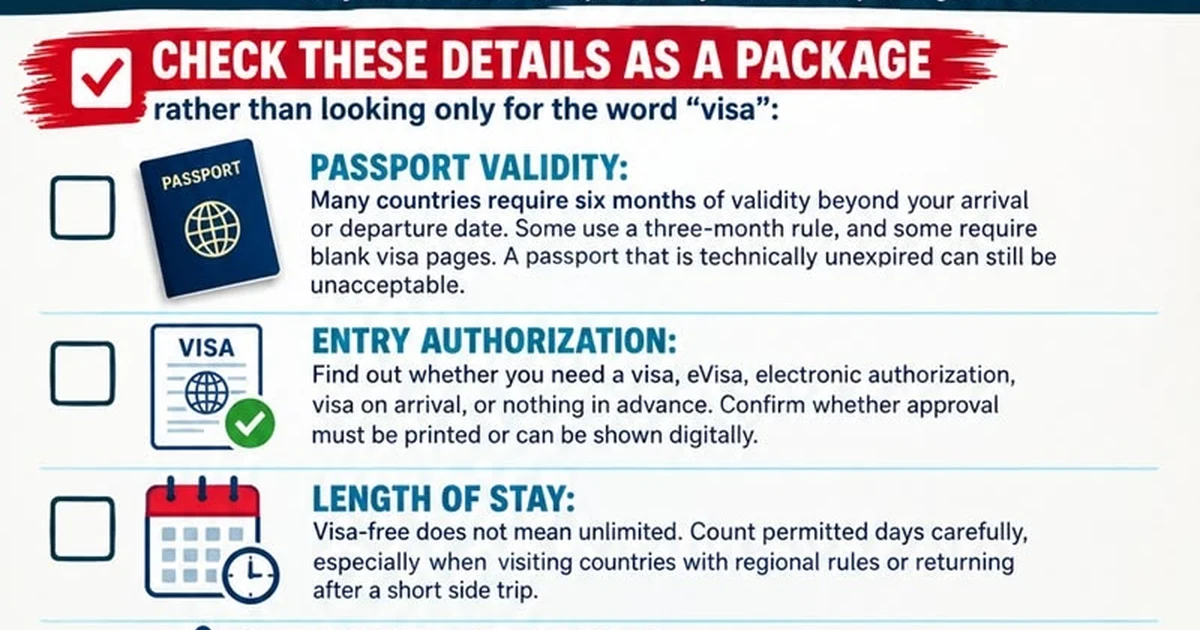
Some destinations require passports to remain valid for a certain number of months beyond arrival or departure.
Others have different rules based on nationality, residence status, or visa type.
For example, short-stay visitors to the Schengen Area are generally subject to a passport validity requirement extending at least three months beyond their intended departure, along with additional passport issuance conditions.
Do not assume that every country follows a universal six-month passport rule.
Blank Passport Pages
Some destinations require a certain number of blank passport pages for immigration stamps or visa stickers.
Requirements vary, so check them before applying.
Damaged or Expired Passports
A damaged passport may create problems during airline check-in or immigration inspection.
If your passport is expired, significantly damaged, or close to the destination’s validity limit, investigate renewal before making nonrefundable travel arrangements.
Visa Requirements for Popular Travel Destinations
Visa policies differ depending on the traveler’s nationality and immigration circumstances.
The following overview explains the main visitor visa systems for several popular destinations. It does not determine whether any particular passport holder is eligible.
| Destination | Common Visitor Entry System |
|---|---|
| United States | B-1/B-2 visa or Visa Waiver Program with ESTA for eligible travelers |
| United Kingdom | Standard Visitor visa or visa-free entry with ETA where applicable |
| Canada | Visitor visa or eTA for eligible travelers |
| Schengen Area | Short-stay Schengen visa or applicable visa exemption |
| Australia | Visitor visa or eligible electronic travel authorization/visa |
| United Arab Emirates | Visa-free entry, visa on arrival, or advance visa depending on nationality |
| Japan | Short-term visa or visa exemption for eligible nationalities |
| Singapore | Entry visa for designated nationalities or visa-exempt short visits |
United States Visa Requirements
Travelers visiting the United States for tourism or qualifying business activities may need a B-1/B-2 visitor visa.
Eligible nationals of Visa Waiver Program countries may instead travel under the program with approved ESTA authorization, subject to its conditions.
Visitor visa applicants may need to complete Form DS-160, pay the applicable fee, and attend an interview.
Official information is available through the U.S. Department of State.
United Kingdom Visa Requirements
The United Kingdom operates visitor visa and electronic travel authorization systems.
Some travelers need a Standard Visitor visa, while others can visit without a visa but may need an ETA.
Requirements depend on nationality, travel purpose, and other circumstances.
Check the UK government visa checker before traveling.
Canada Visa Requirements
Canada generally requires eligible visitors to hold either a visitor visa or an electronic travel authorization, depending on nationality and travel circumstances.
Some travelers are exempt from both.
Canada also has specific rules concerning entry by air, land, and sea.
Check the Government of Canada visitor guidance.
Schengen Visa Requirements
The Schengen Area includes numerous European countries that generally apply common short-stay entry rules.
A short-stay Schengen visa normally permits qualifying visits of up to 90 days within a rolling 180-day period, subject to visa conditions.
Visa-exempt travelers are also generally subject to the applicable short-stay limits.
Official guidance is available from the European Commission.
Australia Visa Requirements
Australia requires most noncitizens to hold an appropriate visa before travel.
Visitor visa options depend on nationality, purpose, and eligibility.
Travelers should verify their visa conditions through the Australian Department of Home Affairs visa finder.
United Arab Emirates Visa Requirements
The UAE offers different visitor entry arrangements based on passport nationality.
Some travelers qualify for visa-free entry or a visa on arrival, while others must arrange a visa in advance.
Visa duration, sponsorship, and eligibility conditions vary.
How to Apply for a Travel Visa
Although procedures vary between countries, most travel visa applications follow a similar general process.
Determine the Correct Visa Category
Identify the purpose of your visit and select the appropriate visa.
Tourism, employment, study, and business activities can have different immigration requirements.
Check Official Eligibility Requirements
Visit the destination government’s immigration website or contact its authorized diplomatic mission.
Verify whether your nationality requires a visa, whether online applications are available, and which documents are mandatory.
Complete the Application Form
Provide accurate personal details, passport information, employment information, and travel plans.
Ensure that your name, passport number, and other identifying details match your supporting documents.
Prepare Supporting Documents
Collect the required evidence, including financial records, accommodation information, travel plans, and invitation letters where applicable.
Documents may need translation, certification, or legalization.
Pay the Application Fee
Pay through the official application portal or authorized payment channel.
Some visa fees are nonrefundable even if an application is refused.
Attend Biometrics or an Interview
Certain countries require fingerprints, photographs, or a personal interview.
Other visa applications can be completed entirely online.
Wait for the Decision
Processing times vary based on visa type, nationality, application volume, security checks, and individual circumstances.
Avoid assuming approval until the responsible authority has issued a decision.
Verify the Issued Visa
Once approved, review the visa carefully.
Check your name, passport details, validity dates, permitted entries, and authorized activities.
If you notice an error, contact the issuing authority before traveling.
How Much Does a Travel Visa Cost?
Visa fees vary widely between countries and application categories.
Your total expense may include more than the government application fee.
| Potential Expense | Explanation |
|---|---|
| Government visa fee | Charge for processing the application |
| Visa center service fee | Fee charged by an authorized application center |
| Biometrics fee | May apply to fingerprints or identity collection |
| Document translation | Required for some supporting records |
| Courier or passport return | Delivery-related expenses |
| Travel insurance | Required for certain visas or destinations |
| Priority processing | Optional expedited service where offered |
Some destinations offer free visas or visa-free entry for eligible nationalities.
Always check official fee schedules because charges can change.
How Long Does It Take to Get a Travel Visa?
There is no universal visa processing timeline.
Some electronic travel authorizations are issued quickly, while traditional visa applications may take several weeks or longer.
Processing depends on the destination, visa category, supporting evidence, application season, and whether additional checks are required.
Applicants should distinguish between three separate periods: the time needed to secure an appointment, the government’s processing time, and the time required for passport return.
A published processing estimate does not guarantee approval by a particular date.
Apply early enough to accommodate possible delays, but follow any rules restricting how far in advance applications may be submitted.
Financial Requirements for Travel Visas
Many countries require applicants to demonstrate that they can financially support themselves during their visit.
This helps immigration authorities evaluate whether travelers can afford accommodation, transportation, meals, and other expenses.
Bank Statements
Bank statements may be used to establish available funds and financial history.
Some destinations specify a minimum amount, while others assess whether the funds are reasonable for the proposed trip.
Employment and Income Evidence
Employment letters, salary statements, tax records, or business documents may help explain an applicant’s financial circumstances.
Sponsored Travel
If another person is funding the trip, authorities may request a sponsorship letter and evidence of the sponsor’s financial ability or relationship with the traveler.
A sponsor does not automatically eliminate the applicant’s other eligibility requirements.
Travel Insurance and Medical Requirements
Some destinations require travelers to hold medical or travel insurance meeting specific standards.
For example, certain Schengen visa applicants must provide travel medical insurance satisfying prescribed coverage conditions.
Other countries may have vaccination, health declaration, or medical examination requirements for particular travelers or visa categories.
Health-related entry rules can change in response to public health conditions.
Check official requirements shortly before departure.
Common Reasons Travel Visa Applications Get Rejected
Visa refusals can occur for many reasons, including incomplete applications, inconsistent information, or failure to meet immigration criteria.
Incomplete Documentation
Missing required documents may delay processing or lead to refusal.
Use the official checklist for your visa category.
Insufficient Financial Evidence
An application may be refused if the applicant cannot adequately demonstrate access to funds for the proposed visit.
Unclear Travel Purpose
Immigration authorities may question an application when the stated purpose is inconsistent with the itinerary or supporting documents.
Incorrect Information
Errors in passport details, travel dates, or personal information can create problems.
Deliberately providing false information can have serious immigration consequences.
Previous Immigration Violations
Past overstays, deportations, entry refusals, or violations of visa conditions may affect future applications.
Failure to Meet Visa Eligibility Rules
Even a complete application can be refused if the applicant does not satisfy the legal requirements for the requested visa.
If your application is refused, review the official decision carefully before considering a new application, administrative review, or appeal where available.
Can You Travel Without a Visa?
Yes, depending on your nationality and destination.
Some countries maintain bilateral or regional arrangements allowing eligible travelers to enter without obtaining a visa.
However, visa-free travel does not mean unrestricted travel.
You may still need to demonstrate a valid travel purpose, sufficient funds, accommodation arrangements, and an intention to comply with the permitted period of stay.
You may also need electronic authorization before boarding.
Visa Requirements for Connecting Flights and Airport Transit
Travelers sometimes assume that a transit visa is unnecessary because they do not intend to leave the airport.
This assumption can be incorrect.
Transit requirements may depend on whether you remain in the international transit area, pass through passport control, collect checked baggage, or change airports.
Certain nationalities may require an airport transit visa even when remaining airside.
If your journey involves separate airline tickets or a self-transfer, check whether you must formally enter the transit country.
Confirm requirements for every transit point, not just the final destination.
Single-Entry vs. Multiple-Entry Visas
Visas can differ in the number of entries permitted.
Single-Entry Visa
A single-entry visa generally allows one entry during its validity period.
Leaving the country may exhaust that entry authorization, even if the printed visa validity period has not ended.
Multiple-Entry Visa
A multiple-entry visa permits repeated entries during its validity period, subject to applicable conditions.
However, multiple-entry permission does not necessarily allow unlimited stays.
Travelers must comply with any maximum stay per visit or cumulative stay limit.
Visa Validity vs. Permitted Duration of Stay
These terms are not interchangeable.
Visa validity generally refers to the period during which the visa may be used, while the authorized duration of stay determines how long a traveler may remain.
Some immigration systems determine the permitted stay at the border.
Always check the rules that apply to your particular visa.
Can You Extend a Tourist Visa While Abroad?
Some countries allow eligible visitors to request an extension, while others impose strict limits.
Extensions may depend on the reason for remaining, immigration status, application timing, and supporting documentation.
Travelers should not assume that an extension will be granted.
Overstaying can result in fines, removal, future entry restrictions, or other penalties.
If your plans change, consult the destination’s immigration authority before your authorized stay expires.
Travel Visa Requirements for Children and Families
Children often need their own passports and visas or travel authorizations, depending on the destination.
Additional documentation may be necessary when a minor travels with only one parent, a guardian, or another adult.
Examples include birth certificates, parental consent documents, custody orders, or evidence of legal guardianship.
The exact requirements depend on the child’s nationality, destination, family circumstances, and transportation arrangements.
Families should also confirm whether children must attend biometric appointments or interviews.
Essential Travel Documents to Carry
Even after receiving a visa, travelers should prepare for possible immigration checks.
A practical travel document checklist includes:
- Valid passport
- Approved visa or electronic travel authorization, where required
- Flight itinerary or onward travel evidence, where applicable
- Accommodation confirmation
- Travel insurance documents, where required
- Evidence of sufficient funds, if requested
- Invitation letter or supporting travel documents, where applicable
- Emergency contact information
Store secure digital copies of important documents and keep necessary originals accessible.
Avoid carrying sensitive financial records unnecessarily unless required for your trip.
Tips for a Successful Travel Visa Application
Good preparation can reduce avoidable application problems.
Begin by reviewing official entry requirements for your passport nationality and destination. Make sure you understand the difference between a visa, electronic travel authorization, and visa exemption.
Provide truthful, consistent information throughout the application. Check that dates, names, passport numbers, and travel plans agree across documents.
Allow sufficient time for appointments and processing. Where possible, avoid making expensive nonrefundable bookings before approval unless they are specifically required and you understand the financial risk.
Use official government portals and authorized visa centers rather than relying solely on social media advice or third-party agents.
Finally, review your approved visa and immigration conditions before departure.
Frequently Asked Questions About Visa Requirements for Travel
Do I Need a Visa to Travel Internationally?
It depends on your nationality, destination, purpose of travel, and other circumstances. Some countries permit visa-free entry for eligible travelers, while others require advance authorization.
Can I Apply for a Travel Visa Online?
Many countries offer online applications, electronic visas, or electronic travel authorizations. However, some visa categories still require embassy appointments, biometric collection, or passport submission.
Is a Visa Required for Every Country?
No. Visa requirements differ according to nationality and destination. A passport holder may enjoy visa-free access to some countries while needing a visa for others.
Can I Book My Flight Before Visa Approval?
You can often make travel reservations before receiving a visa, but purchasing nonrefundable tickets can create financial risk. Some applications require an itinerary rather than a fully paid ticket. Follow the destination’s official instructions.
Can I Travel If My Passport Expires in Three Months?
Possibly, but it depends on the destination’s passport validity rules, your nationality, and your travel dates. Some countries require additional validity beyond the planned stay.
What Is the Difference Between a Passport and a Visa?
A passport is an official travel and identity document generally issued by your country of nationality. A visa is an authorization issued under another country’s immigration system for a particular travel purpose or status.
Can a Travel Visa Be Rejected After Approval?
A visa may be revoked or canceled under applicable immigration rules. Additionally, an approved visa does not guarantee admission at the border.
Do Children Need Separate Travel Visas?
In many cases, yes. Children may need individual passports, visas, or electronic travel authorizations, depending on their nationality and destination.
Can I Work Abroad on a Tourist Visa?
Tourist visas generally do not permit employment. Some countries allow narrowly defined business activities under visitor rules, but travelers should obtain the appropriate authorization before undertaking work.
Where Can I Check Official Visa Requirements?
Use the destination government’s immigration website, its embassy or consulate, or an officially authorized visa application center. Recheck requirements before departure because immigration policies can change.
Conclusion
Understanding visa requirements for travel is an essential part of planning a successful international journey. Whether you are traveling for tourism, business, education, or family visits, knowing the correct entry requirements helps you prepare documents, manage costs, and reduce avoidable delays.
Start by checking the rules for your passport nationality and destination. Identify the correct visa category, review passport validity conditions, prepare accurate supporting documents, and submit your application through an authorized channel.
Remember that visa policies, fees, eligibility requirements, and processing times can change. Information that applied to a previous trip may not apply to your next journey.
By preparing early, using reliable government sources, and following immigration conditions carefully, you can approach international travel with greater confidence and focus on enjoying your trip.