
Quick Answer
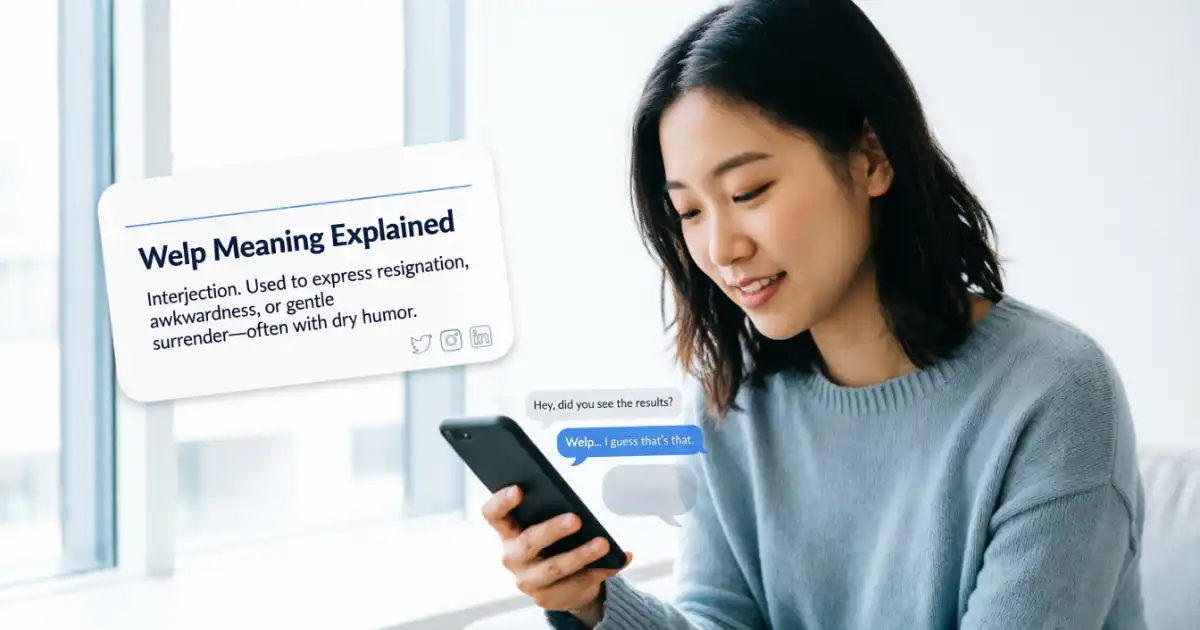
Welp is an informal version of well, usually used in texting, social media, and casual conversation to react to an awkward, disappointing, surprising, or unavoidable situation. It often communicates a feeling like well, that happened, I guess that is that, or what can you do? The word can sound humorous, resigned, sarcastic, or slightly awkward depending on the context.
For example: Welp, I forgot my keys again.
Introduction
You may see welp in a text message, social media comment, meme, group chat, or online conversation and wonder what the person actually means. Unlike many slang terms, welp does not usually introduce a completely new idea. Instead, it changes the tone of the familiar word well.
People often use welp when something does not go as planned and there is not much left to say. Someone might type it after making a mistake, receiving disappointing news, realizing an awkward situation, or accepting an outcome they cannot easily change. It can also add humor to an otherwise frustrating moment.
Understanding the tone matters because welp can communicate more than simple acknowledgment. Depending on the situation, it may express resignation, surprise, embarrassment, amusement, or acceptance.
This guide explains what welp means, where it comes from, how people use it in texting and social media, how it differs from well, and how to use it naturally in everyday communication.
What Does Welp Mean?
Welp is a casual, playful variation of well. People commonly use it as an informal reaction when something unexpected, awkward, disappointing, or inevitable happens.
The closest meanings include:
- Well, I guess that happened.
- I suppose there is nothing to do now.
- That did not go as planned.
- Oh well.
- What can you do?
- I guess that is the situation.
The exact meaning depends heavily on context.
For example, imagine someone plans to cook dinner but accidentally burns the food. They might text:
Welp, looks like we are ordering pizza.
Here, welp expresses acceptance and mild humor.
Someone could also write:
Welp, I completely forgot about the meeting.
In this example, the word signals embarrassment and resignation.
Welp usually feels more casual and expressive than well. It can make a message sound conversational rather than formal.
Is Welp a Real Word?
Welp is widely recognized as an informal expression, especially in online communication and casual speech. It does not function like the standard form well in formal writing.
You would generally avoid welp in academic essays, professional reports, formal business correspondence, or other situations that require polished language.
In casual texting, however, it works naturally because informal communication often uses playful spellings to capture emotion and speech patterns.
Welp vs. Well: What Is the Difference?
Although welp comes from well, the two expressions often create different impressions.
| Term | Meaning | Tone | Example |
|---|---|---|---|
| Well | Introduces a thought or response | Neutral | Well, I think we should leave. |
| Welp | Accepts or reacts to a situation | Casual, resigned, humorous | Welp, I guess we are staying home. |
| Oh well | Accepts an unfortunate outcome | Resigned | Oh well, maybe next time. |
| Whatever | Shows indifference or dismissal | Casual, sometimes rude | Whatever, it is fine. |
| I guess | Shows uncertainty or acceptance | Casual | I guess that works. |
The main difference involves emotional tone. Well can appear in almost any type of conversation, while welp usually signals a reaction to something that has already happened or seems unavoidable.
How Is Welp Used in Texting?
In texting, welp often appears at the beginning of a message. It acts like a quick reaction before the speaker explains what happened.
For example:
Welp, I missed the bus.
Welp, there goes my weekend.
Welp, that was awkward.
Welp, I tried.
The expression works especially well when the situation contains a little humor or disappointment.
Someone might also send welp as a standalone response:
Friend: I accidentally sent the screenshot to the person we were talking about.
You: Welp.
That one word can communicate surprise, awkwardness, and amused resignation without requiring a longer response.
What Does Welp Mean on Social Media?
On social media, welp often appears in comments, captions, memes, and reactions to unexpected events.
Users may write it when a situation takes an unfortunate or funny turn. The expression often creates a sense of shared humor.
For example:
Welp, that plan lasted about five minutes.
Or:
Welp, guess I am learning how to fix a flat tire today.
The word works well online because it is short and immediately communicates an attitude. Readers generally understand that the person is acknowledging an outcome with some combination of humor and acceptance.
It can also appear after a surprising update:
Welp, that escalated quickly.
In this context, welp helps introduce a reaction rather than provide detailed information.
What Tone Does Welp Have?
The tone of welp can change depending on the situation, punctuation, and surrounding words.
Resigned
A person may use welp when they accept that something cannot be changed.
Welp, the tickets are sold out.
The speaker sounds disappointed but ready to move on.
Humorous
Welp can make a minor mistake sound funny.
Welp, I just put my phone in the refrigerator.
The speaker is joking about an unusual mistake.
Awkward
People sometimes use it when they do not know how to respond to an uncomfortable situation.
Welp, that conversation got weird.
Surprised
The word can introduce an unexpected result.
Welp, I definitely did not see that coming.
Sarcastic
In some conversations, welp can express playful sarcasm.
Welp, excellent decision making on my part.
The speaker knows they made a questionable choice and is joking about it.
Examples of Welp in Everyday Conversation
The easiest way to understand this slang term is to see it in realistic situations.
After Making a Mistake
Welp, I forgot to save the document.
The speaker accepts responsibility while keeping the tone light.
After Bad Timing
Welp, there goes the last train.
The speaker recognizes an inconvenient situation.
After an Awkward Moment
Welp, that got awkward fast.
The expression acknowledges the uncomfortable change in the conversation.
After an Unexpected Result
Welp, I guess we are taking the scenic route.
The speaker accepts an unexpected change in plans.
After Giving Up on a Plan
Welp, the weather ruined our beach plans.
The speaker sounds disappointed but accepting.
In a Group Chat
Welp, nobody remembered to bring snacks.
The message can express mild frustration while keeping the mood friendly.
As a Short Reaction
Friend: I just realized the deadline was yesterday.
Reply: Welp.
This response communicates a mixture of surprise and resignation.
When Should You Use Welp?
Welp works best in casual communication where an informal tone feels appropriate.
Good situations include:
- Text messages with friends
- Group chats
- Social media comments
- Casual online conversations
- Memes and humorous posts
- Informal personal messages
- Lighthearted conversations
The expression works particularly well when something has gone wrong but the situation does not require a serious response.
For example:
Welp, time to clean the kitchen.
This sounds casual and slightly humorous.
When Should You Avoid Welp?
Because welp is informal slang, it does not fit every situation.
Avoid it in formal contexts such as:
- Academic assignments
- Professional reports
- Formal presentations
- Job applications
- Business proposals
- Official correspondence
- Serious professional discussions
Instead of writing:
Welp, we missed the deadline.
A professional message could say:
Unfortunately, we missed the deadline.
The second version communicates the information directly and professionally.
Is Welp the Same as Oh Well?
Welp and oh well can communicate similar feelings, but they are not interchangeable in every sentence.
Oh well generally expresses acceptance of something disappointing.
Welp often functions as a reaction that acknowledges an awkward, surprising, or unavoidable situation.
Compare these examples:
Oh well, I can try again tomorrow.
This sounds like straightforward acceptance.
Welp, I guess I am trying again tomorrow.
This sounds more conversational and may contain a little humor or resignation.
Welp can therefore feel more expressive and internet friendly.
Where Did Welp Come From?
Welp developed as an informal variation of well, reflecting the way people sometimes alter sounds when speaking casually.
Its popularity grew alongside informal internet communication, social media, forums, memes, and texting. Written forms such as welp allow people to capture a conversational reaction that might otherwise be difficult to express through standard spelling.
The term does not have one single modern meaning separate from well. Its usefulness comes primarily from the tone it adds.
People generally understand welp as a playful or resigned form of well rather than as a completely independent concept.
Is Welp Considered Slang?
Yes, welp is generally treated as informal slang or an informal colloquial expression.
It appears most naturally in casual digital communication and conversational writing. Its meaning is easy to understand for many English speakers, especially those familiar with internet culture.
Still, slang changes over time. The popularity of individual expressions can vary between age groups, online communities, and regions.
The safest approach is to consider the audience. Welp is perfectly natural in a casual text but may look too informal in a workplace document.
Common Mistakes When Using Welp
Understanding the tone helps prevent awkward usage.
Treating Welp Like Formal English
Welp is casual. Using it in a formal report can make the writing sound unprofessional.
Assuming It Always Means Disappointment
Welp can express disappointment, but it can also communicate humor, surprise, awkwardness, or simple acceptance.
Using It in Serious Situations
A message such as welp, that is terrible news may sound insensitive depending on the circumstances. A serious situation usually calls for clearer and more considerate language.
Confusing Welp With a Completely Different Word
Welp is primarily a variation of well. It does not have a standard technical, medical, legal, or academic definition that changes its everyday slang meaning.
Overusing It
Because welp is expressive, repeating it in every message can make writing feel forced. It works best when the situation naturally calls for a resigned or humorous reaction.
How to Reply When Someone Says Welp
Your response depends on what happened.
If the person is joking, you can respond casually:
Yeah, pretty much.
Honestly, same.
I know, right?
If they are disappointed, a supportive response works better:
Maybe tomorrow will go better.
That is frustrating.
If they simply acknowledge an awkward situation, you can keep the response short:
Yep.
Pretty much.
What can you do?
The important thing is to respond to the situation rather than the word itself.
Conclusion
Welp is a casual expression that works as a playful or resigned version of well. People commonly use it when something unexpected, awkward, disappointing, or unavoidable happens. Its meaning depends on context, but the overall feeling often involves acceptance with a touch of humor or frustration.
In texting and social media, welp can be an effective way to communicate a reaction without writing a long explanation. It works especially well in phrases such as welp, I tried, welp, that was awkward, or welp, guess we are ordering pizza.
The main thing to remember is its informal tone. Use welp with friends, in group chats, and in casual online conversations, but choose standard wording for formal or serious communication.
FAQs About Welp
What does welp mean in texting?
Welp is an informal version of well that often expresses resignation, surprise, awkwardness, humor, or acceptance after something happens.
Is welp rude?
Usually, no. Welp is generally casual and playful. However, it can sound dismissive or insensitive if someone uses it when discussing a serious or emotional situation.
Is welp the same as well?
Welp comes from well, but the tone differs. Well is standard English, while welp is an informal expression often used as a reaction to an unexpected or undesirable situation.
Can welp be used in a professional email?
It is better to avoid welp in professional emails unless the workplace culture is extremely casual and the context clearly supports informal language.
What does welp mean on social media?
On social media, welp usually signals that someone is reacting to an unexpected, awkward, funny, or disappointing situation with a sense of acceptance or resignation.
Can welp be used by itself?
Yes. A person can reply simply with welp when the context already explains the situation. This often communicates a humorous or resigned reaction.
Is welp a real word?
Welp is a recognized informal expression, but it is not the standard formal spelling of well. It mainly appears in casual speech and online communication.
What is another word for welp?
Depending on the context, alternatives include oh well, I guess, what can you do, or simply well. The best choice depends on the intended tone.