
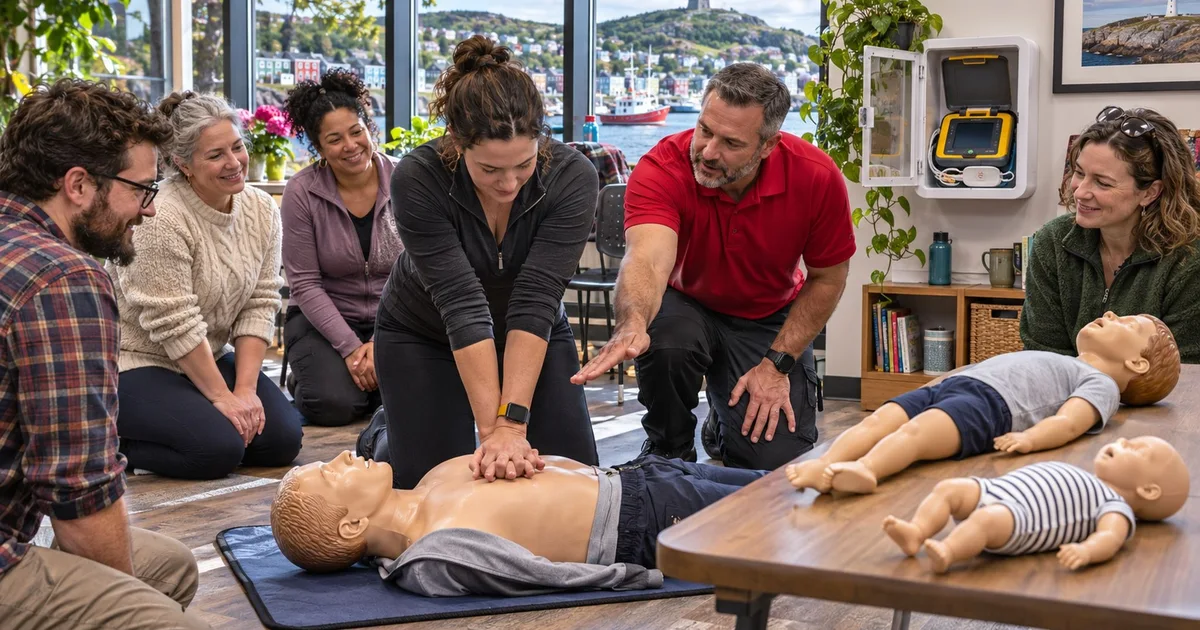
CPR C is a course level that teaches adult, child, and infant CPR plus how to use an AED. An AED is a portable device that checks the heart’s rhythm and shocks only when one is needed. Together, these skills let everyday people act in the first minutes of a cardiac emergency, before paramedics arrive.
You’ve probably seen these letters on a course listing or a wall-mounted box and wondered what they really mean. If you’re searching for CPR C and AED training in St. John’s, a quick decoder will help you pick the right class.
What Does “CPR C” Actually Mean?
CPR stands for cardiopulmonary resuscitation. It’s the mix of chest compressions and, for trained rescuers, rescue breaths that keeps blood moving when a heart stops.
The “C” is the course level. Level C is the most complete option for most non-healthcare learners. It covers CPR for adults, children, and infants, so you’re ready whether the person in trouble is a coworker, a toddler, or a baby.
Lower levels usually focus on adults only. That’s fine for some roles, but parents, coaches, babysitters, and teachers often need the full set.
What Is an AED, and Is It Hard to Use?
AED stands for automated external defibrillator. You’ll find them in malls, arenas, schools, and office lobbies, usually in a bright box on the wall.
Here’s the part that surprises people: an AED talks to you. Once you open it and turn it on, it gives spoken instructions. It tells you where to place the pads, then checks the heart rhythm on its own. It only delivers a shock if the person needs one.
You can’t hurt someone by using an AED correctly. The device decides, not you. Training simply takes away the fear of opening the box.
Why Do These Skills Matter in Canada?
The numbers are sobering. According to Heart & Stroke, an estimated 60,000 cardiac arrests happen outside hospitals in Canada every year, and only about one in 10 people survive.
Time is the whole story. Heart & Stroke notes that survival chances drop roughly 10% for every minute without CPR or defibrillation. Using CPR with an AED can double the chance of survival.
Paramedics are fast, but they can’t be everywhere at once. The person standing nearby is often the only one who can start. That’s why bystander skills carry so much weight.
Which Other Emergency Terms Get Mixed Up?
Emergency language is full of shorthand. Here’s a quick glossary:
- BLS: Basic Life Support. A healthcare-provider level with team-based skills, advanced airway steps, and more detail than a standard community course.
- First aid: Care for injuries and sudden illness, like bleeding, burns, choking, and allergic reactions.
- Hands-only CPR: Chest compressions without breaths. It’s often taught as a starting point for untrained bystanders.
- Cardiac arrest: The heart stops pumping effectively. The person collapses and isn’t breathing normally.
- Heart attack: A blocked blood vessel starves part of the heart. The person is usually awake and in pain.
The last two get confused constantly. A heart attack is a plumbing problem. Cardiac arrest is an electrical one. A heart attack can lead to cardiac arrest, but they’re not the same thing.
What Happens in a CPR C and AED Class?
Expect a hands-on, low-pressure session. You’ll practise on manikins, not on each other. Instructors show you the skills, then you try them until they feel natural.
Most classes cover:
- Spotting the signs of cardiac arrest and calling for help.
- Giving compressions at the right depth and pace.
- Using rescue breaths for adults, children, and infants.
- Placing and following AED pads and prompts.
- Helping a choking adult, child, or infant.
You don’t need medical experience. Many people arrive nervous and leave surprised by how doable it feels.
Who Should Take a CPR C and AED Course?
Almost everyone. A few groups benefit most:
- Parents and grandparents, who may care for infants and young kids.
- Teachers, coaches, and childcare staff, who supervise groups every day.
- Workplace safety leads, who want a team that can respond calmly.
- Lifeguards, camp staff, and volunteers, who are often first on the scene.
- Anyone who spends time near water, rinks, or trails, where emergencies can happen quickly.
In a place like St. John’s, where winter weather can slow response times and families spend time on the water, trails, and ice, being prepared is just practical.
How Do You Choose the Right Course?
Start with the level. If you need adult, child, and infant skills with AED training, look for Level C. Then check three things.
First, ask whether the class includes hands-on practice. Skills stick when your hands do the work. Second, confirm the certificate meets what your employer or school asks for. Third, look for small groups, so you get real time with the manikins and trainers.
Not sure which one you need? Ask your employer or program coordinator before booking. A two-minute question can save you from repeating a class.
What’s the Takeaway?
Those letters on the course listing aren’t scary. CPR C means you’re trained for adults, kids, and babies. AED means you know how to use the box on the wall. Put them together, and you’ve got skills that can matter when seconds count.
If you are looking for CPR and first aid training in St. John’s or nearby communities, then you may reach out to Coast2Coast First Aid & Aquatics in that area.