
Quick Answer
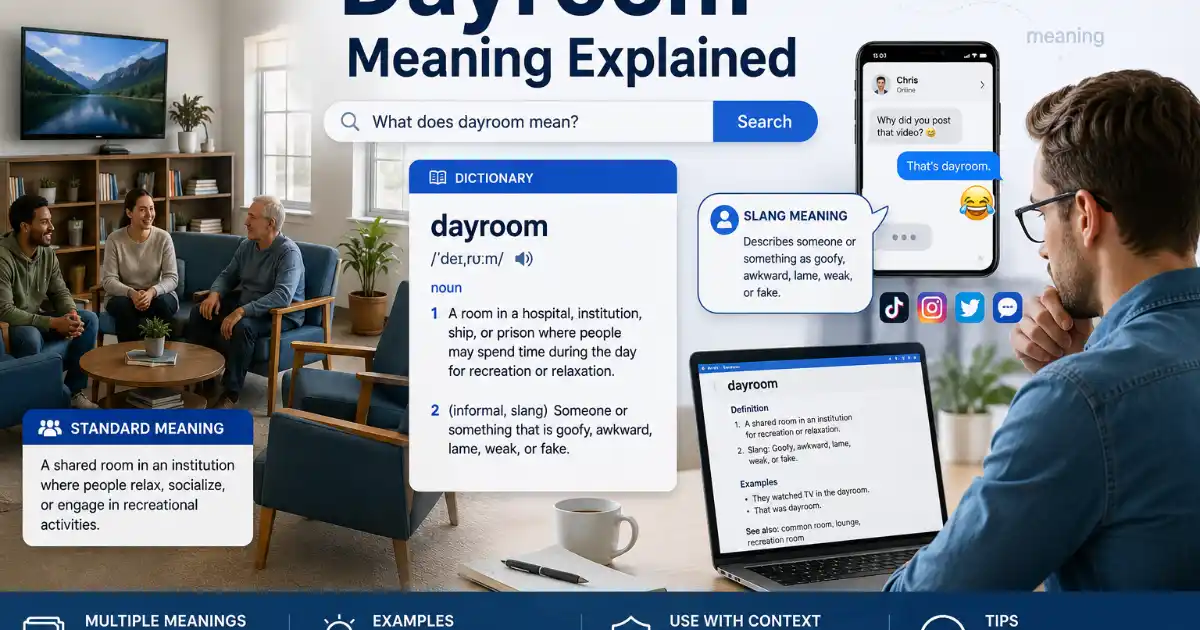
Dayroom can have two important meanings. In standard English, a dayroom is a shared room in an institution where people can relax, socialize, watch TV, read, or take part in recreational activities. Hospitals, military facilities, dormitories, and correctional institutions can have dayrooms.
In informal slang, dayroom can describe someone or something as goofy, awkward, fake, weak, embarrassing, or socially off. The exact sense varies by community and context. If someone says, “That’s dayroom,” they are usually criticizing the behavior rather than describing an actual room.
Introduction
People often search for dayroom after seeing the word in a text, TikTok comment, meme, conversation, or discussion about institutional settings. The confusion comes from the fact that the word has a straightforward dictionary meaning but also appears as informal slang.
The standard meaning is fairly simple. A dayroom is a communal space where people can spend time during the day. Depending on the setting, it may include chairs, tables, a television, books, games, or other recreational facilities. Dictionaries list hospitals and other institutions among its common settings.
The slang meaning requires more attention to context. Online and informal communities may use dayroom as a negative description for behavior that seems foolish, awkward, lame, fake, or embarrassing. Some slang sources also use it for someone who switches up or acts inauthentically. Because slang changes between communities, readers should not assume that every use has exactly the same meaning.
This guide explains both meanings, shows how the word works in sentences, and explains how to tell which meaning someone intends.
| Meaning | Where It Is Used | Simple Explanation | Example |
|---|---|---|---|
| Dayroom | Hospitals and institutions | Shared room for recreation or relaxation | “The patients spent time in the dayroom.” |
| Dayroom | Military or residential settings | Common room for leisure activities | “They met in the dayroom after lunch.” |
| Dayroom | Correctional settings | Shared area outside individual cells or rooms | “He was in the dayroom during recreation time.” |
| Dayroom | Informal slang | Someone or something viewed as goofy, weak, awkward, or fake | “That was dayroom.” |
What Does Dayroom Mean?
The traditional meaning of dayroom refers to a common or recreational room in an institution. It gives people a place to relax and socialize during the day rather than staying in their individual rooms or designated private spaces.
In a hospital, for example, a dayroom may provide a place where patients can sit, watch television, read, or interact with other people. In military or residential institutions, the room can serve a similar recreational purpose. American dictionaries also recognize dayroom as an alternative form of day room.
The word also appears in correctional settings. There, a dayroom generally refers to a communal area connected to a housing unit where incarcerated people may spend time outside their cells, subject to facility rules and schedules.
The informal slang meaning is different. In some contemporary slang communities, calling someone dayroom can mean that the person is acting goofy, awkward, weak, fake, or embarrassing. One slang source describes the term as an insult for behavior that feels corny or socially off, while another records a sense involving someone who switches up or acts fake.
That difference makes context especially important. If someone says, “The patients were sitting in the dayroom,” they mean an actual room. If someone says, “Why are you acting dayroom?” they are using the word as slang.
Dayroom as Slang
When dayroom appears in slang, it usually works as a criticism of a person, action, attitude, or situation.
Depending on the community, it can suggest:
- Goofy behavior
- Awkward behavior
- Lame behavior
- Weak behavior
- Embarrassing behavior
- Socially unaware behavior
- Fake or inconsistent behavior
These meanings overlap, but they are not identical. One speaker may use dayroom to mean “corny,” while another may use it to mean “fake” or “switching up.” Recent online slang explanations show this variation clearly.
For that reason, dayroom does not have one universal slang definition. The surrounding sentence, speaker, and online community can change the intended meaning.
For example:
“Bro, that was dayroom.”
This could mean the person did something embarrassing or goofy.
“You’re moving dayroom.”
Here, the speaker is criticizing the person’s behavior, suggesting that they are acting weak, foolish, or otherwise out of line.
“That whole plan was dayroom.”
Here, the word describes a plan rather than a person.
What Does Dayroom Mean in Texting?
In texting, dayroom usually functions as informal slang rather than as a reference to an actual room.
If someone sends:
“Nah, that’s dayroom.”
They probably mean that something seems lame, awkward, foolish, or embarrassing.
The word can also appear when someone reacts to another person’s behavior:
“Why would you post that? That’s dayroom.”
The speaker is criticizing the decision and suggesting that it makes the person look socially awkward or foolish.
Because slang varies between groups, the safest way to interpret dayroom in text is to examine what happened immediately before the word appeared. Look at whether the conversation concerns a physical location or someone’s behavior.
What Does Dayroom Mean on Social Media?
On social media, dayroom can appear in comments, captions, messages, and casual discussions. Its slang use often acts as a short reaction to something that viewers consider awkward, goofy, weak, or embarrassing.
For example, someone might comment:
“That response was dayroom.”
The commenter is not talking about a room. They are judging the response.
Another example is:
“Bro is moving dayroom.”
This criticizes someone’s behavior or attitude.
Social media makes this kind of slang difficult to define with one fixed dictionary meaning because communities can develop slightly different interpretations. A term may also spread from one online group to another and pick up additional shades of meaning.
That is why context matters more than a simple one word translation.
Where Did the Slang Meaning Come From?
The literal word dayroom comes from the straightforward combination of “day” and “room.” Its traditional meaning refers to a common room where people can socialize or participate in recreational activities.
The connection between the institutional meaning and modern slang is less straightforward. Some slang sources connect the informal usage with prison or institutional language and later circulation through urban slang and online culture. Other sources describe the modern slang without presenting a detailed or independently verified origin story.
It is therefore better to treat claims about one exact origin as uncertain rather than presenting a single story as proven fact.
What is clear is that dayroom has developed meanings beyond its traditional noun sense, and modern informal usage can differ significantly from the dictionary definition.
How Is Dayroom Used in a Sentence?
The easiest way to understand the slang is to see it in realistic sentences.
Describing something as awkward
“Posting that private argument was dayroom.”
Here, dayroom suggests that the action was embarrassing or socially inappropriate.
Calling out goofy behavior
“Why are you acting dayroom right now?”
The speaker thinks the person’s behavior is foolish or awkward.
Criticizing a decision
“Skipping the meeting and then complaining about it was dayroom.”
The word describes the decision as poor or embarrassing.
Describing someone who acts fake
“He acts friendly around us, then talks behind our backs. That’s dayroom.”
In this context, dayroom carries the sense of fake or inconsistent behavior.
Using the traditional meaning
“We watched TV in the dayroom after lunch.”
Here, dayroom has its literal meaning and refers to a communal room.
Dayroom vs Day Room
The spelling can create another source of confusion.
Dayroom and day room can refer to the same traditional concept. Dictionaries recognize both forms, although usage can vary by publication and context.
| Term | Meaning | Typical Context |
| Dayroom | Common or recreational room | Institutional and residential settings |
| Day room | Same basic meaning | Hospitals and other institutions |
| Dayroom as slang | Informal criticism of behavior | Texting, social media, casual speech |
If someone writes day room in a hospital description, the meaning is usually literal. If someone writes dayroom in a casual social media comment, it may be slang.
Dayroom vs Similar Slang Terms
The slang meaning can overlap with several informal words, but they are not exact replacements.
| Term | Meaning | Best Use | Example |
| Dayroom | Goofy, awkward, weak, fake, or embarrassing depending on context | Informal slang | “That was dayroom.” |
| Corny | Uncool or overly predictable | Casual criticism | “That joke was corny.” |
| Cringe | Embarrassing or uncomfortable to watch | Online reactions | “That video is cringe.” |
| Goofy | Silly or foolish | Casual conversation | “You look goofy doing that.” |
| Fake | Not genuine or sincere | Calling out dishonesty | “He is being fake.” |
| Lame | Uncool, disappointing, or boring | General casual speech | “That excuse is lame.” |
The closest replacement depends on what the speaker means by dayroom. If the intended meaning involves fake behavior, “fake” may fit. If it means awkward behavior, “cringe” may be closer.
When Is It Appropriate to Use Dayroom?
The slang form is highly informal. It makes the most sense when speaking with people who already understand the expression.
It may fit naturally in:
- Text messages
- Casual conversations
- Social media comments
- Online communities
- Friendly joking
- Informal group chats
It generally does not belong in:
- Formal business emails
- Academic essays
- Job applications
- Professional reports
- Formal presentations
- Official documents
The literal noun is different. A sentence such as “The patients gathered in the dayroom” is perfectly appropriate in a formal description because it uses the standard meaning.
Common Mistakes When Using Dayroom
One common mistake is assuming that dayroom always means an insult. It does not. The traditional noun refers to a physical communal room and remains a legitimate English term.
Another mistake is assuming that the slang meaning always means “fake.” Some communities use the word for fake or inconsistent behavior, while others use it more broadly for goofy, awkward, weak, or embarrassing behavior.
A third mistake involves using slang with people who may not know it. Because dayroom has a standard dictionary meaning, a listener could interpret it literally.
It is also easy to overuse slang. If every awkward situation gets labeled dayroom, the word loses its intended emphasis and can make casual conversation sound forced.
Finally, avoid treating slang definitions found online as universal rules. Informal language changes quickly, and different communities may attach different meanings to the same expression.
Is Dayroom a Bad Word?
Dayroom is not inherently a profanity. The standard noun is completely neutral.
The slang version can function as an insult or put down. Its seriousness depends on the speaker, relationship, and situation. Among friends, it may work as playful teasing. In a hostile conversation, it can become a sharper criticism.
If someone calls another person dayroom in public, the comment may embarrass them. That makes tone and context important.
Is Dayroom the Same as Calling Someone Fake?
Not necessarily.
Some slang references use dayroom for someone who switches up or behaves in a fake way.
Other contemporary explanations use it more broadly for behavior that seems goofy, lame, awkward, weak, or socially unaware.
So “fake” can be one interpretation, but it should not be treated as the only meaning.
How to Understand Dayroom From Context
When you encounter the word, ask three simple questions.
First, is the person talking about a physical place? If the answer is yes, dayroom probably means a communal or recreational room.
Second, is the word describing someone’s behavior? If so, it is probably slang.
Third, what happened immediately before the word appeared? If someone made an awkward joke, posted something embarrassing, or behaved strangely, dayroom probably expresses criticism of that behavior.
This approach works better than memorizing one rigid slang definition.
Conclusion
The meaning of dayroom depends heavily on context. In standard English, it refers to a communal room used for relaxation, recreation, or socializing, especially in hospitals and other institutions.
In modern informal slang, dayroom can describe someone or something as goofy, awkward, lame, weak, embarrassing, or fake. Different communities use the term differently, so the surrounding conversation matters.
The simplest way to remember it is this: dayroom can describe a real shared room or, in slang, behavior that someone considers socially off or uncool. Always check the context before deciding which meaning applies.
FAQs About Dayroom
What does dayroom mean in slang?
In slang, dayroom can describe behavior or a person as goofy, awkward, lame, weak, embarrassing, or fake. The exact meaning depends on the community and context.
What does dayroom mean in a hospital?
A dayroom in a hospital is a shared space where patients can sit, relax, socialize, watch television, or participate in recreational activities.
What does dayroom mean in prison?
In a correctional setting, a dayroom generally refers to a communal area where incarcerated people can spend time outside their individual cells, subject to facility rules and schedules.
Is dayroom a slang word?
It can be. Dayroom is an established noun with a traditional meaning, but it also appears as informal slang with meanings that vary across communities.
Is dayroom offensive?
The slang form can be insulting because it criticizes someone’s behavior or character. However, it is not inherently profanity, and friends may use it playfully.
Can dayroom mean fake?
Yes, in some slang usage. Some sources define it as describing someone who switches up or acts fake. Other uses focus more on goofy, awkward, weak, or embarrassing behavior.
Is dayroom appropriate for professional writing?
The slang meaning is not appropriate for formal professional or academic writing. The literal noun is fine when describing an actual communal room.
What is another word for dayroom?
For the literal meaning, alternatives include common room, recreation room, or lounge, depending on the setting. For the slang meaning, possible alternatives include goofy, corny, awkward, cringe, lame, or fake, depending on the intended meaning.