
Quick Answer
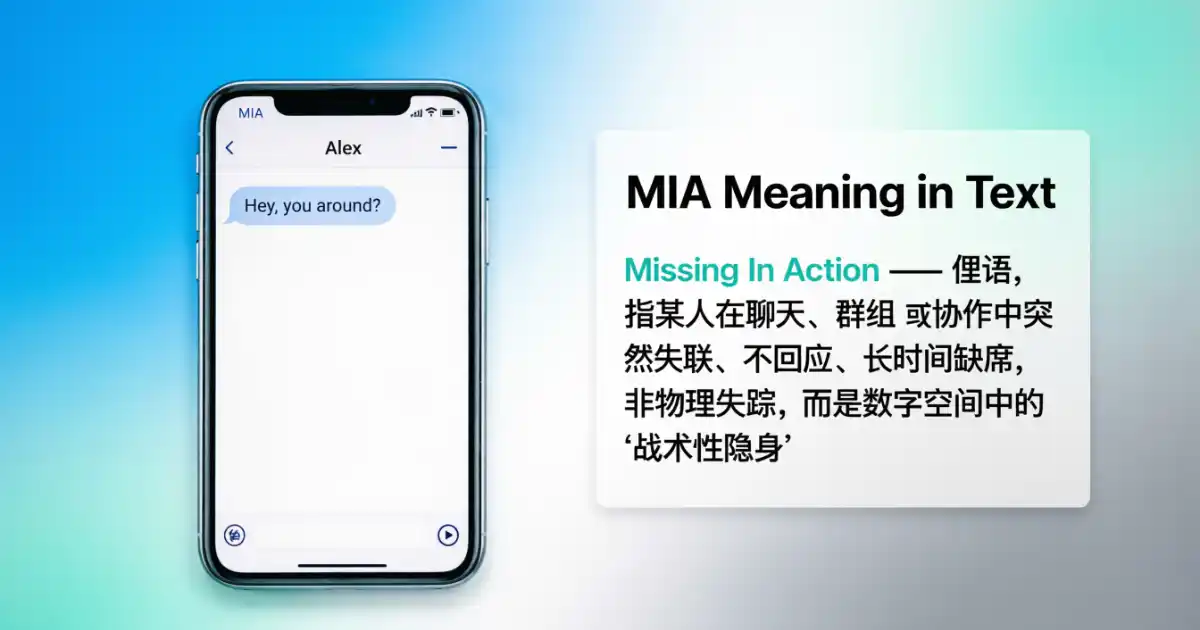
MIA usually means Missing In Action. In texting, social media, and everyday conversation, people commonly use MIA to describe someone who has been absent, unusually quiet, unavailable, or not responding to messages.
For example, “You have been MIA all week” usually means “I have not heard from you or seen you lately.” The original military meaning is more serious and refers to a service member whose whereabouts are unknown.
Introduction
If you have seen someone write “You have been MIA” in a text, group chat, social media post, or comment, the meaning is usually much simpler than it first appears. In casual communication, MIA means Missing In Action, but people often use the expression figuratively to describe someone who has disappeared from a conversation or has not been around lately.
The phrase can describe a friend who stopped answering texts, a coworker who has not appeared in the office, or someone who suddenly stopped posting online.
Depending on the situation, MIA can sound playful, concerned, curious, or slightly annoyed. Context and the relationship between the people involved usually determine the tone.
MIA also has meanings outside texting. In military contexts, Missing In Action has a specific and serious meaning. In travel conversations, MIA can refer to Miami or Miami International Airport. The abbreviation can also refer to the recording artist M.I.A. when music is being discussed. Knowing the context helps you choose the correct meaning.
What Does MIA Mean in Text?
In texting, MIA stands for Missing In Action. Most of the time, however, it is not being used in its literal military sense. Instead, it describes someone who is absent, unavailable, quiet, or difficult to contact.
| Term | Meaning | Tone | Example |
|---|---|---|---|
| MIA | Missing In Action | Casual or concerned | “You have been MIA lately.” |
| MIA in texting | Absent or not responding | Informal | “Sorry, I was MIA yesterday.” |
| Gone MIA | Suddenly disappeared | Casual | “He went MIA after the meeting.” |
| Military MIA | Missing In Action | Serious | “The soldier was listed as MIA.” |
| MIA in travel | Miami or Miami International Airport | Neutral | “My flight lands at MIA.” |
When someone says they have been MIA, they may simply mean they have been busy, away from their phone, taking a break from social media, or dealing with other responsibilities.
MIA Meaning and Definition
The original phrase behind MIA is Missing In Action. In military use, it refers to a service member who is missing during or after military operations and whose status has not been confirmed. This is a formal and serious use of the abbreviation.
Everyday English uses the phrase more loosely. If a friend has not answered your messages for several days, you might say that they have gone MIA. You are usually not suggesting that the person is literally missing. You are simply pointing out that they have been noticeably absent.
For example:
“Where have you been? You have been MIA all weekend.”
This usually means:
“I have not heard from you all weekend.”
The expression can apply to more than texting. Someone can be MIA from a group chat, workplace, class, social event, gaming group, or social media account.
The meaning also changes according to context. A sentence about a military operation should be understood literally, while a message from a friend saying “You are MIA 😂” is probably casual or teasing.
How People Use MIA in Texting
MIA is popular in casual messages because it quickly communicates the idea of absence. Instead of writing “You have not responded to my messages and I have not seen you lately,” someone can simply say, “You have been MIA.”
It can describe a temporary absence or a longer period of silence.
Someone Is Not Replying
A friend may use MIA when you have not responded to texts.
Example:
“Hey, you have been MIA. Everything okay?”
Here, the person is probably checking whether you are doing well.
Someone Is Away From Social Media
MIA can also describe someone who has stopped posting or interacting online.
Example:
“She has been MIA on Instagram lately.”
This means she has not been active or visible on Instagram recently.
Someone Is Missing From a Group
You can use MIA when someone has stopped participating in a shared activity.
Example:
“Jake has been MIA from the group chat.”
The sentence simply points out that Jake has not been participating.
Someone Takes a Break
People can also describe themselves as MIA when they intentionally step away from communication.
Example:
“I am going MIA this weekend. I need some time away from my phone.”
Here, MIA means the person plans to be unavailable or less active.
Examples of MIA in Everyday Conversation
The meaning becomes easier to understand when you see how people naturally use it.
With Friends
“Where have you been? You have been MIA all week.”
This can be friendly teasing or genuine concern.
At Work
“Mark has been MIA since this morning.”
This could mean Mark has not been available, has stepped away, or has not responded.
In a Group Chat
“Everyone is MIA today.”
This means the group has been unusually quiet.
On Social Media
“I have been MIA from social media lately.”
This means the person has not been posting or interacting much.
In Dating Conversations
“You went MIA after our date.”
This can sound more serious because it may suggest that someone suddenly stopped communicating.
About Yourself
“Sorry I went MIA yesterday. Work was crazy.”
This is a casual way to explain why you were unavailable.
What Does Going MIA Mean?
Going MIA means becoming absent or difficult to reach, usually without much communication about the absence.
For example:
“I am going MIA for a few days.”
This usually means:
“I will be taking a break and probably will not respond much.”
The phrase does not automatically mean that someone is ignoring you. A person may go MIA because they are busy, traveling, studying, working, resting, or simply taking a break from their phone.
That is why context matters before assuming someone is deliberately avoiding communication.
MIA vs. Ghosting, AFK, and Offline
MIA overlaps with several other expressions, but the terms are not identical.
| Term | Meaning | Best Use | Example |
|---|---|---|---|
| MIA | Absent or difficult to reach | General casual communication | “She has been MIA.” |
| Ghosting | Deliberately stopping communication | Dating or relationships | “He ghosted me after our date.” |
| AFK | Away from keyboard or device | Gaming and online activity | “I will be AFK for 10 minutes.” |
| Offline | Not currently connected or active | Digital status | “I am offline right now.” |
| BRB | Be Right Back | Short announced absence | “BRB, grabbing food.” |
The biggest difference is that MIA does not necessarily suggest intentional avoidance. Someone can be MIA because life became busy. Ghosting usually carries a stronger suggestion that someone intentionally stopped communicating without explanation.
Other Meanings of MIA
Although Missing In Action is the main meaning in casual conversation, context can point to other uses.
MIA in Military Contexts
In military language, MIA has its original meaning: Missing In Action. It refers to a service member whose whereabouts are unknown following military operations. This use is much more serious than the casual slang version.
MIA in Travel
In travel conversations, MIA can refer to Miami International Airport, whose airport code is MIA.
For example:
“I am flying into MIA tonight.”
Because the sentence involves a flight, MIA clearly refers to the airport rather than someone being absent.
M.I.A. as an Artist
M.I.A. can also refer to the musician and artist who performs under that name.
For example:
“I have been listening to M.I.A. lately.”
In this case, capitalization, punctuation, and the surrounding music context make the meaning clear.
Mia as a Person’s Name
If someone writes “Mia is coming over at 7,” they are probably using Mia as a person’s name, not the abbreviation MIA.
This is an important distinction because capitalization and sentence structure can change the interpretation.
Is MIA Casual or Rude?
MIA is generally casual and is not automatically rude. Its tone depends on the situation, wording, and relationship between the people involved.
“You have been MIA 😂” may be playful between close friends.
“You have been MIA for three days. Why have you not answered?” sounds more frustrated.
“Are you okay? You have been MIA lately” sounds concerned.
So, MIA itself does not determine the emotion. The surrounding words do.
For formal workplace communication, clearer wording such as “unavailable,” “absent,” or “I have not been able to reach you” may be more appropriate.
How to Reply When Someone Says You Are MIA
Your response can depend on why you were unavailable and the tone of the original message.
If you were simply busy, you could say:
“Sorry, I have been really busy lately.”
If you needed some personal time:
“I needed a little break from my phone.”
If you missed a message:
“My bad. I just saw this.”
If the person sounds concerned:
“I am okay. I have just had a lot going on.”
If the comment is playful:
“Lol, I know. I disappeared for a bit.”
There is no single correct response. The best reply simply explains your absence at the level of detail you are comfortable sharing.
Common Mistakes About MIA
One common mistake is assuming that MIA always has a serious meaning. In everyday texting, it is usually a casual way to describe someone’s absence.
Another mistake is treating MIA and ghosting as exact synonyms. They overlap, but MIA does not necessarily imply that someone intentionally cut off communication.
It is also easy to miss the meaning when the abbreviation appears in a different context. A message about flights may use MIA for Miami International Airport, while a military discussion may use it in the original Missing In Action sense.
Finally, do not assume that “Mia” always stands for an abbreviation. It can simply be someone’s name.
Conclusion
The most common MIA meaning in texting and casual conversation is Missing In Action. People use it to describe someone who has been absent, quiet, unavailable, or difficult to contact. The expression can be playful, concerned, or slightly critical depending on the situation.
MIA also has a serious military meaning, while travel conversations may use MIA for Miami International Airport. If you are unsure which meaning applies, look at the surrounding words and context. In a normal text such as “You have been MIA all week,” the intended meaning is almost always that someone has been noticeably absent.
Frequently Asked Questions
What does MIA mean in text?
MIA means Missing In Action. In texting, it usually describes someone who has been absent, unavailable, quiet, or not responding.
What does MIA mean in slang?
In slang, MIA means someone has disappeared or has not been around or communicating as expected. It is usually casual and does not imply that the person is literally missing.
What does it mean when someone says you are MIA?
It usually means they have noticed that you have been absent, quiet, or difficult to reach. The comment can be playful, concerned, or annoyed depending on the context.
Is MIA the same as ghosting?
No. MIA simply means absent or unavailable. Ghosting usually suggests that someone intentionally stopped communicating without explanation.
What does going MIA mean?
Going MIA means becoming unavailable or disappearing from normal communication for a period of time. Someone may go MIA because they are busy or want a break.
What does MIA mean at an airport?
In travel contexts, MIA refers to Miami International Airport. The airport code makes this meaning different from the slang expression.
Is MIA appropriate for work messages?
MIA is widely understood, but it is informal. In professional communication, words such as “unavailable,” “absent,” or “out of contact” may be clearer.
Can MIA mean someone’s name?
Yes. Mia can simply be a person’s name. You need to look at the sentence and surrounding context to determine whether MIA is an abbreviation or a name.