
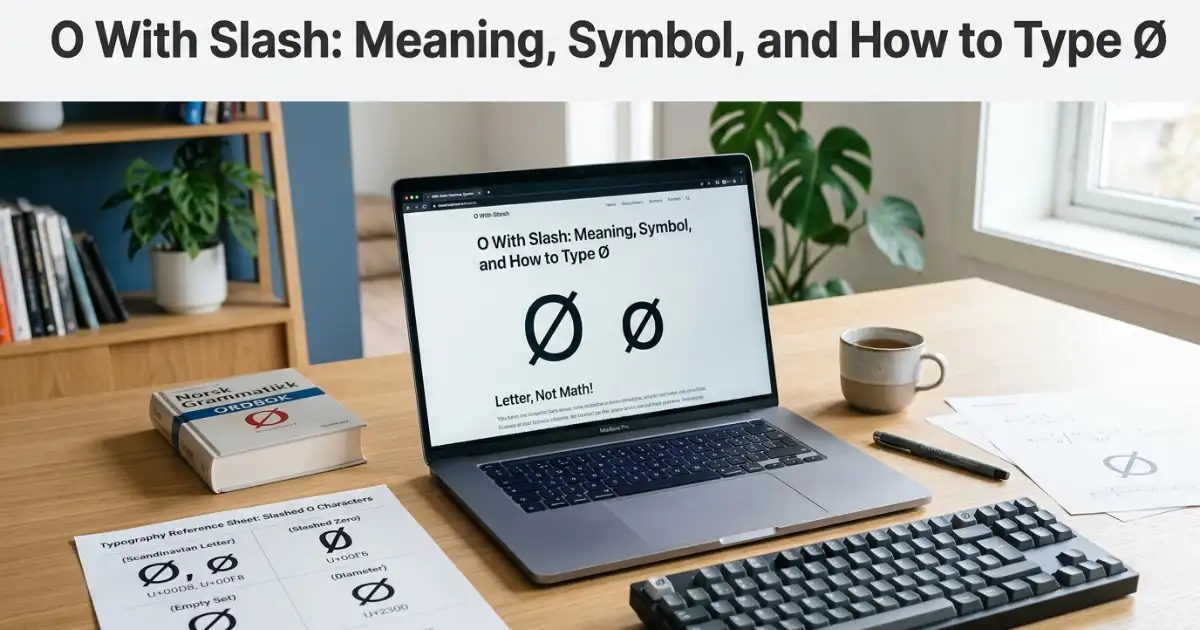
Quick Answer
The o with slash, written as Ø or ø, is a real letter called O with stroke. It appears as a distinct letter in languages such as Danish, Norwegian, and Faroese. It is not simply a decorative version of the English letter O. In Unicode, Ø is U+00D8 and ø is U+00F8. The character can also appear in phonetic writing and other specialized contexts.
People often confuse Ø with a slashed zero, the mathematical empty set symbol ∅, or the diameter symbol ⌀. These characters may look similar, but they have different meanings and uses.
Introduction
Searching for o with slash can lead to several different answers because similar looking symbols appear in language, mathematics, engineering, computing, and online communication. The most common interpretation is the letter Ø or ø, which has its own place in several alphabets and its own pronunciation.
For an English speaker, the character can look like an O that someone simply crossed with a line. That impression can cause confusion, especially when it appears in a foreign name, a keyboard layout, a technical document, or a digital file. However, Ø is not merely a modified English O. Unicode identifies it as the Latin capital letter O with stroke, while ø is the corresponding lowercase letter.
This guide explains what the symbol means, where people use it, how it differs from similar characters, how it is pronounced, and how to type it. It also covers O/ in texting because some searches for o with slash may refer to a completely different character combination.
What Does O With Slash Mean?
The most common meaning of o with slash is the letter Ø or ø, formally known as Latin capital letter O with stroke and Latin small letter O with stroke. Unicode lists both as individual characters rather than treating them as an ordinary O combined with a separate slash.
In Danish, Norwegian, and Faroese, ø functions as a letter of the alphabet. It represents a vowel sound that does not have an exact equivalent in standard English. The exact pronunciation can vary depending on the language and surrounding sounds.
For example, someone learning Norwegian may encounter words containing ø and need to pronounce the character as part of the word rather than reading it as English O.
The uppercase and lowercase forms are:
| Form | Character | Unicode | Basic Name |
|---|---|---|---|
| Uppercase | Ø | U+00D8 | O with stroke |
| Lowercase | ø | U+00F8 | O with stroke |
| English O | O | U+004F | Capital O |
| English o | o | U+006F | Small o |
The important point is simple: Ø and ø are letters, not ordinary O characters with a decorative slash.
Where Is the O With Slash Used?
The letter ø has several important uses. Its most familiar role appears in Scandinavian languages, especially Danish and Norwegian, as well as Faroese. Unicode specifically associates the character with Danish, Faroese, Norwegian, and other linguistic uses.
It can appear in:
- Personal names
- Place names
- Everyday words
- Books and documents
- Language learning materials
- Dictionaries
- Linguistic and phonetic writing
- Digital text and websites
- Keyboard layouts for languages that use the letter
The character also has a place in the International Phonetic Alphabet, where it represents a particular vowel sound. That means its appearance in a phonetic transcription does not necessarily mean that the surrounding text uses Danish or Norwegian.
O With Slash in Danish and Norwegian
For people learning Danish or Norwegian, ø is not an optional symbol. It forms part of the written alphabet.
A useful comparison is the German letter ü. An English reader may see ü as a modified version of u, but German treats it as a distinct letter with its own pronunciation and spelling rules. Similarly, Danish and Norwegian use ø as part of their writing systems.
This distinction matters when reading names or words. Replacing ø with a normal O can change the spelling and sometimes make a word or name incorrect.
In digital writing, preserving the correct character also matters for names, search queries, usernames, documents, and other text where exact spelling is important.
How Is Ø Pronounced?
English does not have one exact sound that matches ø.
The pronunciation varies between languages, and learners often find it easier to understand after hearing a native speaker. In broad terms, the sound involves producing a vowel while rounding the lips, creating a sound that differs from the normal English O.
The International Phonetic Alphabet also uses ø for a rounded front vowel. Unicode lists the character as being used in the IPA as well as in Danish, Norwegian, and Faroese.
The safest approach is to learn the pronunciation from the specific language rather than assuming that every occurrence of ø sounds exactly the same.
O With Slash vs Similar Symbols
Several characters look close to Ø, but they do not mean the same thing. Understanding the differences prevents mistakes when reading technical documents or copying symbols online.
| Symbol | Meaning | Common Use | Example |
| Ø | Letter O with stroke | Danish and Norwegian writing | A word containing ø |
| ø | Lowercase O with stroke | Language and phonetics | Norwegian text |
| 0̸ | Slashed zero | Number identification | Technical or computing text |
| ∅ | Empty set | Mathematics | A set containing no elements |
| ⌀ | Diameter symbol | Engineering and technical drawings | Diameter measurement |
| O/ | Two typed characters | Informal online contexts | Chat or emoticon use |
Unicode explicitly distinguishes Ø from the empty set symbol ∅ and the diameter symbol ⌀.
Is Ø the Same as a Zero With a Slash?
No. Ø is not the same character as a slashed zero.
A slashed zero is a modified representation of the number 0, usually created to make zero easier to distinguish from the capital letter O. This can be useful in technical environments where a mistake between O and 0 could cause confusion.
The letter Ø, however, is an actual alphabetic character.
The difference becomes especially important in passwords, serial numbers, programming, account codes, and technical documents. Copying one character in place of the other can change the information entirely.
Is Ø the Same as the Empty Set Symbol?
No. The mathematical empty set symbol is ∅.
The empty set represents a set containing no elements. For example, a mathematical expression may use ∅ to indicate that a particular set has nothing in it.
Although ∅ resembles Ø, the two characters have different identities and purposes. Unicode lists ∅ separately as the empty set symbol and Ø as the Latin capital letter O with stroke.
This distinction matters when writing mathematics because substituting one symbol for another can make an expression technically incorrect.
Is Ø the Same as the Diameter Symbol?
No. The diameter symbol is ⌀, which appears frequently in engineering, manufacturing, architecture, and technical drawings.
For example, a technical drawing may use ⌀ before a measurement to indicate diameter. It can look similar to Ø at a glance, but it represents a technical measurement rather than a letter.
The Unicode character names also distinguish these symbols. The letter is LATIN CAPITAL LETTER O WITH STROKE, while ⌀ is separately identified as the diameter sign.
What Does O With Slash Mean in Texting?
There is another possible interpretation of o with slash: the typed combination O/.
This is different from the single character Ø.
In some online communities, O/ has appeared as a simple text based gesture or emoticon. Some users interpret it as a raised hand, wave, or similar gesture, but this usage is informal and context dependent. Because there is no universal meaning, readers should look at the surrounding conversation before assigning a specific interpretation.
This is also why searching for the exact character Ø is different from searching for O/. One is a Unicode letter, while the other is a combination of two ordinary characters.
How to Type O With Slash on a Keyboard
Typing Ø or ø depends on the device and operating system.
Windows
Windows users can enter the uppercase character with an Alt code:
Alt + 0216 = Ø
For lowercase:
Alt + 0248 = ø
These shortcuts depend on using a compatible keyboard setup and numeric keypad.
Mac
On a Mac, the common shortcuts are:
Option + O = ø
Option + Shift + O = Ø
These shortcuts provide a quick way to insert the character without opening a symbol menu.
iPhone and Android
On many mobile keyboards, press and hold the O key. A selection of accented or alternative characters may appear. If ø is available on the installed keyboard, select it from that menu.
The exact options can vary by keyboard, language settings, and device.
Copy and Paste
If typing shortcuts are inconvenient, the simplest option is to copy the characters directly:
Ø
ø
This works well when entering a name, language exercise, document, search query, or other text that requires the exact character.
What Are the Unicode Codes for Ø and ø?
Unicode gives the two characters their own code points.
Ø is U+00D8.
ø is U+00F8.
Unicode identifies them as Latin capital and small letters O with stroke.
Unicode matters because computers need a consistent way to identify characters. Without standardized character encoding, the same symbol could display incorrectly across different programs, websites, or devices.
For developers, designers, translators, and content creators, knowing the Unicode value can be useful when working with HTML, databases, search systems, fonts, or international text.
Why Does O With Slash Look Like a Special O?
The visual design can make Ø look like a normal O with a slash added afterward. Technically, however, Unicode treats it as its own encoded character.
A Unicode discussion also explains that ø was encoded as an atomic character rather than as a normal O plus a separate combining mark.
That distinction helps explain why copying ø and trying to recreate it manually with an O and slash may produce a different result.
For normal writing, using the actual ø character is usually the better choice when the intended text requires that letter.
Common Uses of the O With Slash
The character appears in several practical situations.
Names and Places
People may encounter ø in Scandinavian names and geographical names. Keeping the original spelling helps preserve the correct form.
Language Learning
Students learning Danish, Norwegian, or Faroese may need to read and type ø regularly.
Phonetics
Linguists and language students may encounter ø in phonetic contexts because it represents a specific rounded vowel in the International Phonetic Alphabet.
Digital Writing
The character can appear in websites, usernames, documents, search queries, and international communications.
Technical Contexts
Readers may encounter symbols that resemble Ø in engineering and mathematics. In these situations, identifying the exact character matters because a similar looking symbol can have a completely different meaning.
Common Mistakes With O With Slash
The biggest mistake is assuming that every circle with a diagonal line represents the same thing.
Here are the most common errors to avoid:
Mistaking Ø for Zero
Ø is a letter. 0 is a number.
A slashed zero may be used to make the number easier to identify, but it does not turn the number into the letter Ø.
Confusing Ø With ∅
The empty set symbol belongs to mathematics. The letter Ø belongs primarily to writing systems and linguistic notation.
Confusing Ø With ⌀
The diameter sign appears in technical contexts. It should not automatically replace the letter Ø.
Replacing ø With O
In a Scandinavian word or name, replacing ø with o can create incorrect spelling.
Assuming Every O/ Means the Same Thing
The text combination O/ can have informal meanings online, but its interpretation depends on the community and surrounding conversation.
O With Slash, O With Stroke, and Slashed O
You may see several names for the same character.
O with slash is a common descriptive phrase.
O with stroke is closer to the formal Unicode name.
Slashed O is another informal description used by English speakers.
For the uppercase character, the formal Unicode name is LATIN CAPITAL LETTER O WITH STROKE. The lowercase version is LATIN SMALL LETTER O WITH STROKE.
These names generally refer to Ø and ø, although informal descriptions can sometimes cause confusion with other slashed symbols.
Conclusion
The o with slash usually refers to Ø or ø, a real Latin letter known formally as O with stroke. It plays an important role in languages such as Danish, Norwegian, and Faroese and also appears in phonetic writing.
The most important thing to remember is that Ø is not a slashed zero, empty set symbol, or diameter sign. Those characters may look similar, but each serves a different purpose. If you need the letter for writing or copying, use Ø or ø directly rather than trying to recreate it with an ordinary O and slash.
Understanding that difference makes the character much easier to recognize in foreign languages, technical documents, mathematics, digital communication, and everyday online searches.
Frequently Asked Questions
What is the o with slash called?
The character Ø is commonly called O with slash, slashed O, or O with stroke. Its formal Unicode name is Latin Capital Letter O With Stroke. The lowercase character is ø.
Is Ø a letter or a symbol?
Ø is a letter. It is used as a distinct letter in languages including Danish, Norwegian, and Faroese, and it also appears in phonetic writing.
What does ø mean in Norwegian?
In Norwegian, ø is a vowel and a distinct letter of the alphabet. Its pronunciation differs from the English letter O.
How do you type ø?
On many Mac keyboards, press Option + O. On Windows, Alt + 0248 can produce lowercase ø when the appropriate numeric keypad input works. On phones, pressing and holding O may provide the character.
Is Ø the same as ∅?
No. Ø is a letter with stroke, while ∅ is the mathematical empty set symbol. They look similar but have different meanings.
Is Ø the same as the diameter symbol?
No. The diameter symbol is ⌀. It is used in engineering and technical contexts to indicate diameter. Ø is a letter.
Can I copy and paste the o with slash?
Yes. The characters are Ø for uppercase and ø for lowercase. You can copy either character directly when you need it.
What does O/ mean in texting?
O/ is different from Ø. In some online communities, it can function as an informal text gesture or emoticon. Its exact meaning depends on context and the community using it.