
Quick Answer
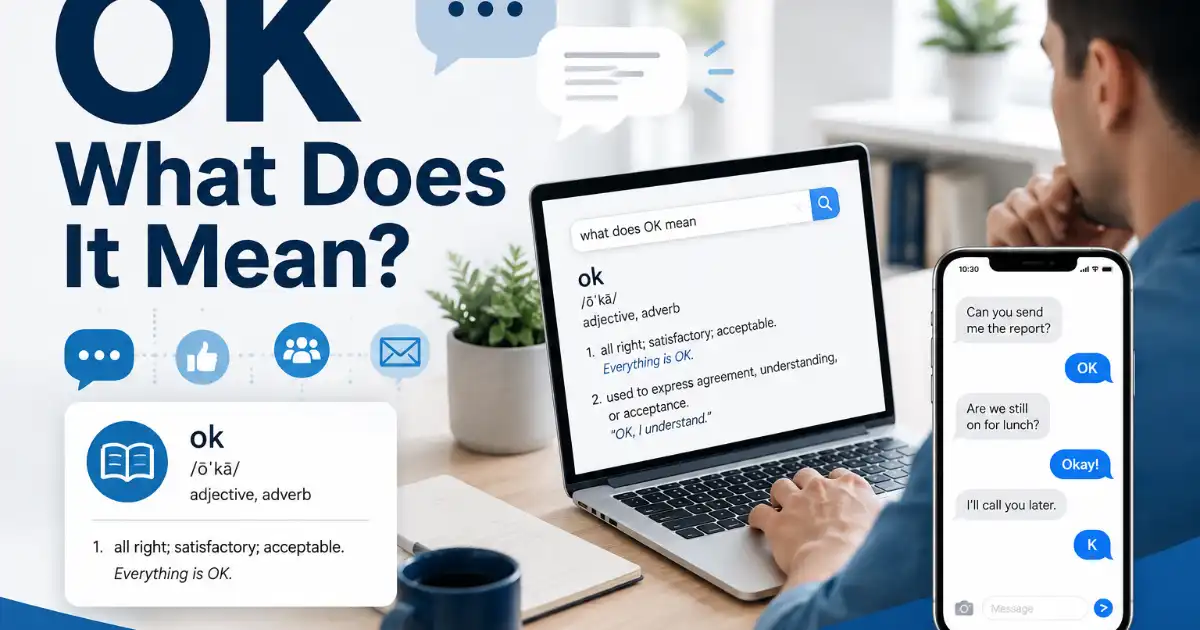
If someone searches ok what does it, they are usually looking for the meaning of OK or the phrase OK, what does it mean? In everyday English, OK generally means agreement, acceptance, acknowledgment, or that something is acceptable. In texting, however, the tone can change depending on the situation. A simple OK may mean I understand, while OK… can sometimes suggest hesitation, annoyance, or disbelief. The surrounding conversation matters more than the word alone.
Introduction
The phrase ok what does it looks incomplete when it appears by itself. In most cases, a person typing this search is probably asking something similar to OK, what does it mean? They may have seen the word OK in a text, social media comment, conversation, workplace message, or online discussion and want to understand what the speaker intended.
The word OK is one of the most common expressions in everyday English. People use it to agree with someone, confirm information, show that they understand, accept a suggestion, describe something as satisfactory, or move a conversation forward. Its meaning can also change because of punctuation, capitalization, timing, and the relationship between the people communicating.
This guide explains what OK means, why its tone can vary, how people use it in texts and conversations, and how to understand responses such as okay, OK, k, and OK…. The goal is to make the expression easier to understand without assuming that every short reply carries a hidden meaning.
What Does OK Mean?
OK usually means that something is acceptable, understood, agreed upon, or satisfactory. Someone might say OK when they agree to a plan, acknowledge information, or indicate that they are ready to continue.
For example, if a friend says, We can meet at 6 PM, replying OK normally means the person understands and accepts the plan.
The expression can work in several grammatical roles. It can describe a situation, confirm an action, or function as a short response.
Examples include:
Are you OK? means Are you all right?
The movie was OK. means The movie was satisfactory, but perhaps not especially impressive.
OK, let’s go. means I am ready, so let’s continue.
OK, I understand. means I acknowledge what you said and understand it.
The exact feeling behind the word depends heavily on context. A friendly conversation can make OK sound warm and cooperative, while the same word during an argument can sound impatient or dismissive.
Is OK the Same as Okay?
Yes. OK and okay generally have the same basic meaning. Both can express agreement, acknowledgment, acceptance, or a satisfactory condition.
The difference usually comes from style rather than meaning. Okay can look slightly more conversational in some situations, while OK is common in texting, messages, signs, forms, workplace communication, and everyday speech.
| Term | Meaning | Tone | Example |
|---|---|---|---|
| OK | Agreement or acknowledgment | Neutral | OK, I understand |
| Okay | Agreement or acknowledgment | Neutral and conversational | Okay, that works |
| K | Short acknowledgment | Can feel dismissive | K, see you later |
| OK… | Acknowledgment with possible hesitation | Depends on context | OK… if you say so |
| A OK | Everything is fine | Positive | Everything is A OK |
Neither OK nor okay automatically indicates anger or annoyance. The surrounding conversation provides the important clues.
Where Did the Word OK Come From?
The history of OK is more interesting than its simple everyday meaning suggests. The expression became popular in the United States during the 19th century and later spread widely through American English and global communication.
One commonly documented explanation connects OK with a humorous spelling of all correct as oll korrect. The abbreviation appeared in print during the 1830s as part of a period when playful abbreviations became popular.
The expression eventually became much more widespread. Today, people recognize OK across many English speaking communities, and it appears in spoken conversation, writing, texting, digital interfaces, workplace communication, and international communication.
Its long history also explains why OK now feels like an ordinary English expression rather than a specialized abbreviation.
What Does OK Mean in Texting?
In texting, OK most often means I understand, I agree, or I acknowledge your message.
For example:
Person 1: Can you send me the address?
Person 2: OK.
This response does not necessarily contain any hidden emotion. It can simply confirm that the message was received.
However, texting removes many signals that people use during face to face conversations. There is no voice tone, facial expression, or body language. Because of that, a short message such as OK can sometimes feel colder than the sender intended.
Consider these examples:
OK
Usually neutral.
Okay!
Can feel more enthusiastic.
OK, sounds good.
Usually clear and friendly.
OK…
May suggest hesitation or uncertainty.
K
Can feel abrupt or dismissive depending on the relationship.
This does not mean that every person uses these forms in exactly the same way. Personal texting habits vary.
Can OK Sound Rude?
OK is not inherently rude. In most situations, it is a normal way to acknowledge or accept something.
The word can feel rude when the context suggests frustration, disagreement, or emotional distance. For example, someone who receives a long explanation and responds only with OK might make the other person wonder whether they are annoyed.
Compare these messages:
OK, thanks for explaining.
This sounds cooperative and appreciative.
OK.
This is more neutral and could be interpreted in several ways.
OK…
This may suggest uncertainty, skepticism, or discomfort.
The difference comes from context rather than the letters themselves. Online discussions about texting also show that people often interpret a short OK differently depending on the preceding conversation and the sender’s usual communication style.
What Does OK Mean During an Argument?
During an argument, OK can have several meanings.
Someone might use it because they genuinely understand the other person’s point. They might also use it because they do not want to continue arguing.
For example:
Person 1: I think we should discuss this tomorrow when we’re calmer.
Person 2: OK.
Here, OK probably indicates acceptance.
But consider:
Person 1: You never listen to what I say.
Person 2: OK.
The response could mean several things. The person might feel frustrated, want to end the discussion, disagree without wanting to continue, or simply acknowledge the statement.
It is better to consider the entire conversation instead of assuming that OK automatically means anger.
What Does OK Mean in a Workplace Message?
In workplace communication, OK often serves a practical purpose. It can confirm that someone received information or accepts a task.
For example:
Manager: Please review the document before 3 PM.
Employee: OK, I’ll review it.
The second response clearly confirms understanding.
A simple OK can also work, especially when the request is straightforward. However, adding a few words can make professional communication clearer.
Instead of:
OK
A person could write:
OK, I’ll take care of it.
Or:
Got it. I’ll send the updated file this afternoon.
These responses remove uncertainty and make the intended action clear.
Examples of OK in Everyday Conversation
The meaning of OK becomes easier to understand when it appears in realistic situations.
Agreement
A: Want to grab lunch at noon?
B: OK.
Here, OK means agreement.
Understanding
A: Turn left after the gas station.
B: OK, got it.
Here, the response confirms understanding.
Accepting a change
A: The meeting moved to Thursday.
B: OK, thanks for letting me know.
Here, OK acknowledges the information.
Checking someone’s condition
A: Are you OK?
B: Yeah, I’m fine.
Here, OK refers to a person’s condition rather than agreement.
Showing mild disappointment
A: The tickets are sold out.
B: OK. Maybe next time.
Here, OK can acknowledge disappointing news without necessarily expressing enthusiasm.
What Does OK Mean on Social Media?
On social media, OK can function as a simple reaction, acknowledgment, disagreement marker, or conversational response.
Someone might comment OK because they understand a post. Another person might use OK then to signal that they accept a situation and want to move on.
Context becomes especially important in social media comments because short responses can appear without the facial expressions and vocal cues that normally communicate emotion.
For example:
OK, that makes sense.
Clearly signals understanding.
OK then.
May signal acceptance, resignation, or a desire to end the discussion.
OK…
May suggest doubt or hesitation.
A reader should look at the full thread before deciding what the response means.
How Punctuation Changes the Tone of OK
Punctuation can influence how people interpret a short message.
| Message | Possible Interpretation |
| OK | Neutral acknowledgment |
| Okay | Neutral or conversational |
| OK! | Positive or enthusiastic |
| OK, thanks | Appreciative acknowledgment |
| OK… | Hesitation or uncertainty |
| OK? | Request for confirmation |
| OK. | Firm or final acknowledgment |
These interpretations are not fixed rules. Someone who normally writes short messages may use OK. without intending to sound upset.
This is especially important when interpreting messages from friends, coworkers, family members, or romantic partners. A person’s normal communication style provides better information than punctuation alone.
How to Tell What Someone Means by OK
The safest approach is to examine the context.
First, consider what happened immediately before the response. If you asked someone to confirm a meeting time and they replied OK, the meaning is probably straightforward.
Next, consider how the person normally texts. Someone who regularly sends one word responses may not be communicating frustration.
Also look at punctuation and additional words. OK, thanks communicates more information than OK alone.
Finally, consider the relationship. A short response from a close friend may feel different from the same response from a manager or unfamiliar person.
If the meaning really matters, asking a simple follow up question is better than guessing.
For example:
Just checking, are we good?
Or:
Did that make sense?
These questions can prevent unnecessary misunderstandings.
OK vs K: Why the Difference Matters
Although OK and K can both acknowledge a message, they may create different impressions.
OK contains the complete expression and usually feels neutral.
K is a shortened version. Some people use it casually without any negative intention. Others interpret it as abrupt, annoyed, or dismissive.
For example:
A: I’ll call you after work.
B: OK.
This normally feels neutral.
A: I’ll call you after work.
B: K.
The second response may feel colder, although the sender may simply prefer short messages.
The relationship and communication habits matter more than the abbreviation itself.
Common Mistakes When Interpreting OK
People often make the mistake of assuming that every OK has the same emotional meaning. It does not.
Another common mistake involves treating punctuation as a definite emotional signal. While OK… can suggest hesitation, it does not prove that the person feels annoyed.
It is also easy to confuse OK as an agreement with OK as a description of something being satisfactory. For example, The food was OK does not necessarily mean the speaker loved the food. It usually means the food was acceptable or average.
Finally, readers sometimes overanalyze a short text response. A person may simply be busy, distracted, or naturally brief in their communication style.
When Should Someone Use OK?
OK works well in casual conversations, quick confirmations, everyday discussions, and many workplace situations.
It works especially well when the intended message is simple.
Examples include:
OK, I’ll be there.
OK, that works for me.
OK, I understand.
OK, thanks.
For more sensitive conversations, adding a few words can make the message clearer. Instead of sending only OK, someone could explain whether they agree, understand, or need more information.
That small addition can prevent confusion.
Conclusion
When someone searches ok what does it, they are most likely trying to understand OK or asking what a particular OK response means. In everyday English, OK usually expresses agreement, acknowledgment, acceptance, or a satisfactory condition.
The important point is that the meaning can change with context. OK, okay, OK!, OK…, and K can create different impressions, especially in texting. Still, none of these forms has a guaranteed emotional meaning.
When interpreting an OK message, look at the conversation, the person’s usual communication style, and what happened before the response. If the meaning remains unclear, asking directly is usually more reliable than overthinking a two letter message.
Frequently Asked Questions About OK What Does It Mean
What does OK mean in a text?
In a text, OK usually means that the person understands, agrees, accepts something, or acknowledges the message. The exact tone depends on context.
Does OK mean yes?
Sometimes. If someone asks, Can we meet at 5? and the response is OK, it usually means yes or agreement. However, OK can also simply mean that the person received or understood the information.
Is OK a rude response?
Not automatically. OK is normally neutral. It can seem rude or dismissive in certain situations, especially after an emotional or detailed message, but the context matters.
What does OK mean from a girl or guy?
There is no universal meaning based on gender. A person may use OK to agree, acknowledge a message, end a conversation, or show uncertainty. The surrounding conversation provides more useful clues.
What does OK with three dots mean?
OK… can suggest hesitation, uncertainty, skepticism, disappointment, or an unfinished thought. It can also simply reflect someone’s writing style, so it should not automatically be interpreted as anger.
Is OK the same as okay?
Yes. OK and okay generally communicate the same basic idea. The choice between them usually reflects writing style and context rather than a major difference in meaning.
What does K mean compared with OK?
K is a shorter form of OK. Some people use it casually, while others perceive it as abrupt or dismissive. OK usually provides a more neutral impression.
Why does OK sometimes sound angry in a text?
Text messages do not include vocal tone or facial expressions. Because OK is so short, readers may attach emotion to it based on the previous conversation, punctuation, or relationship. The word itself does not automatically indicate anger.