
Quick Answer
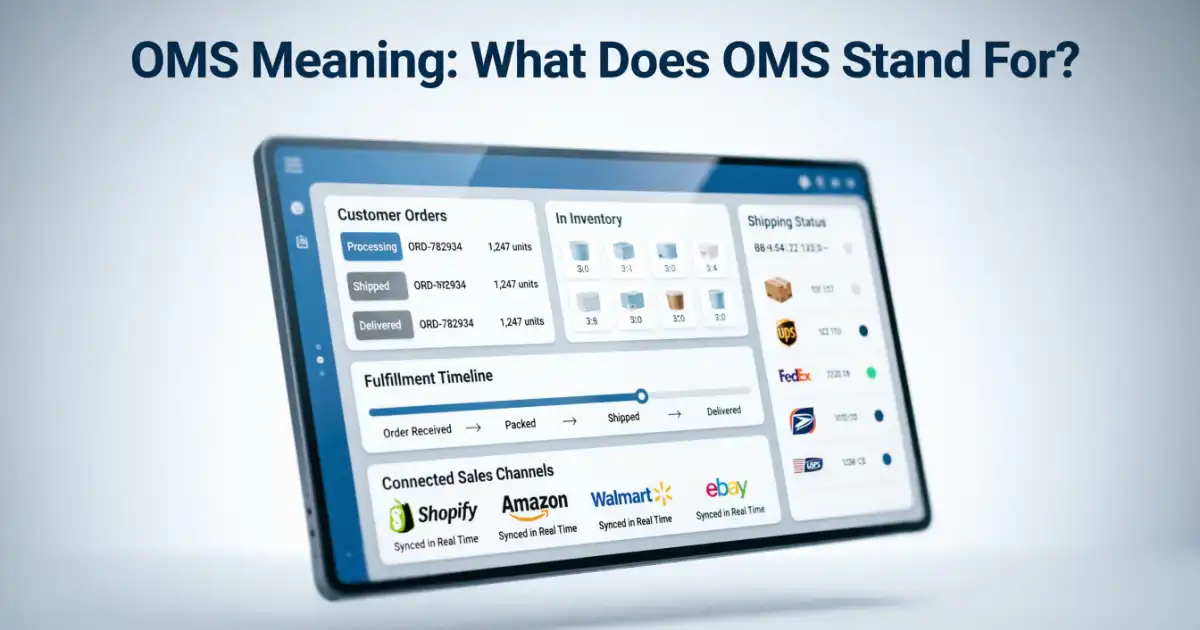
OMS usually stands for Order Management System, especially in ecommerce, retail, logistics, and business technology. It refers to software that captures, tracks, routes, and manages customer orders from the time they are placed through fulfillment, delivery, and sometimes returns.
OMS can also have other meanings depending on the context, including Oral and Maxillofacial Surgery, Orbital Maneuvering System, and Outage Management System.
Introduction
If you searched for OMS meaning, you may have encountered the abbreviation in an online store, business article, workplace conversation, technical document, medical context, or another specialized field. The meaning is not always the same because OMS is used as an abbreviation in several industries.
For most business, ecommerce, retail, and supply chain discussions, OMS means Order Management System. An OMS helps a company manage the journey of an order after a customer places it.
It can connect sales channels with inventory, warehouses, fulfillment providers, shipping systems, and other business software.
However, context matters. In healthcare, OMS can refer to Oral and Maxillofacial Surgery. In aerospace, it can mean Orbital Maneuvering System. Utilities may use OMS for Outage Management System. Understanding where you saw the abbreviation is the easiest way to identify the intended meaning.
This guide explains the main OMS meanings, how an Order Management System works, where businesses use it, and how to avoid confusing different definitions.
What Does OMS Mean?
The most common business meaning of OMS is Order Management System. It is software designed to manage and coordinate customer orders across their lifecycle.
An OMS can collect orders from multiple sources, such as an ecommerce website, marketplace, physical store, business portal, or other sales channel. It can then check inventory, determine where an order should be fulfilled, send the order to the appropriate fulfillment operation, and track its progress.
The exact features vary between systems. Some focus heavily on ecommerce and omnichannel fulfillment, while others support more complex wholesale, retail, or enterprise operations.
In simple terms, an OMS helps answer questions such as:
- What did the customer order?
- Is the item available?
- Where is the inventory located?
- Which location should fulfill the order?
- Has the order shipped?
- What is the current order status?
- Does the customer need a return or refund?
An OMS is different from simply having an online checkout system. The checkout may capture the purchase, while the OMS coordinates what happens to that order afterward.
OMS Meanings by Context
Because OMS has several meanings, the surrounding topic usually tells you which definition applies.
| Meaning | Where It Is Used | Simple Explanation | Example |
|---|---|---|---|
| Order Management System | Ecommerce, retail, logistics | Software that manages customer orders | The retailer uses an OMS to route orders |
| Oral and Maxillofacial Surgery | Medicine and dentistry | A surgical specialty involving the mouth, jaw, face, and related structures | She was referred to an OMS practice |
| Orbital Maneuvering System | Aerospace | A system used for spacecraft orbital maneuvers | The Space Shuttle used its OMS engines |
| Outage Management System | Utilities | Software used to monitor and manage power outages | The utility uses an OMS during an outage |
| On My Soul | Informal slang or texting | A phrase used to emphasize sincerity | OMS, I really saw it happen |
The Order Management System meaning is particularly common in ecommerce and business technology. Other meanings become more likely when the surrounding conversation involves medicine, aerospace, utilities, or informal messaging.
How Does an Order Management System Work?
An OMS generally sits between the systems that receive orders and the systems that fulfill them. It keeps information about orders, inventory, fulfillment, and status coordinated across connected channels.
For example, imagine a customer buys a pair of shoes from an online store. The OMS may receive the order and check available inventory at several fulfillment locations.
If the shoes are available at a nearby warehouse, the system can route the order there. The warehouse then receives the fulfillment request, the order is picked and packed, and shipping information is sent back into the order record.
The customer may then receive tracking information while customer service can see the same order status.
A simplified process looks like this:
- Order placement: A customer places an order.
- Order capture: The OMS receives the order information.
- Inventory check: The system checks available inventory.
- Order routing: The system determines an appropriate fulfillment location.
- Fulfillment: The order is picked, packed, and prepared for shipment.
- Shipping: The package is handed to a carrier.
- Tracking: The order status is updated.
- Post purchase service: Returns, exchanges, refunds, or other exceptions can be managed.
The exact workflow depends on the company’s technology and business rules.
What Does an OMS Do for a Business?
An OMS can bring several order related processes into one coordinated system. This becomes especially useful when a business sells through multiple channels or keeps inventory in multiple locations.
Centralizes Order Information
Instead of managing orders separately in different systems, an OMS can provide a central view of orders from connected sales channels.
This can help teams see what was ordered, where the order came from, and what stage it has reached.
Improves Inventory Visibility
An OMS can connect order information with inventory data so businesses have a clearer view of available stock.
This is particularly important when the same products are sold through a website, marketplace, store, or other channels.
Routes Orders to Fulfillment Locations
A business may have several warehouses or stores capable of fulfilling an order. An OMS can apply business rules to determine where the order should go.
Factors can include inventory availability, location, fulfillment rules, and other operational requirements.
Tracks Order Status
An OMS can maintain information about the order as it moves through the fulfillment process.
That gives employees and, depending on the setup, customers better visibility into whether an order is being processed, shipped, delivered, returned, or delayed.
Supports Returns
Many modern OMS platforms also support parts of the return and exchange process. This can help businesses keep the original order and its post purchase activity connected.
OMS vs ERP vs WMS
OMS is often confused with other business systems, especially ERP and WMS. They can work together, but they serve different purposes.
| Term | Meaning | Main Focus | Example |
|---|---|---|---|
| OMS | Order Management System | Customer orders and fulfillment coordination | Routes an order to the right location |
| ERP | Enterprise Resource Planning | Broader business operations | Manages finance, purchasing, inventory, and other functions |
| WMS | Warehouse Management System | Warehouse operations | Helps manage picking, packing, and warehouse movement |
| CRM | Customer Relationship Management | Customer relationships and interactions | Stores customer information and sales activity |
An OMS does not necessarily replace an ERP or WMS. In many business environments, these systems connect so information can move between sales, orders, inventory, finance, and warehouse operations.
When Does a Business Need an OMS?
A small business with one sales channel and a simple fulfillment process may be able to manage orders using its ecommerce platform and basic operational tools.
The need for dedicated order management generally becomes more apparent as complexity increases.
For example, an OMS may become useful when a business:
- Sells through several sales channels
- Has multiple warehouses or stores
- Manages a large number of orders
- Needs centralized inventory visibility
- Ships orders from different locations
- Wants automated order routing
- Handles frequent returns or exchanges
- Needs different teams to access consistent order information
The important factor is not simply company size. Order complexity matters. A smaller company with several sales channels and fulfillment locations may have more need for centralized order management than a larger company with a very simple operation.
OMS in Ecommerce and Retail
In ecommerce, an OMS can connect online orders with inventory and fulfillment operations.
Consider a retailer that sells the same product through its website, physical stores, and an online marketplace. Without coordinated systems, each channel could have difficulty maintaining an accurate picture of inventory.
An OMS can help bring those orders together and coordinate fulfillment across available locations. This is one reason order management becomes increasingly important as businesses adopt omnichannel selling.
For a customer, the benefit may be simple: the website shows more accurate availability, the order gets routed correctly, and tracking information remains connected to the purchase.
For the business, the underlying process can involve several systems working together.
OMS in Medical Context
In healthcare, OMS can mean Oral and Maxillofacial Surgery.
Oral and maxillofacial surgery is a surgical specialty involving conditions, injuries, and procedures affecting areas such as the mouth, jaws, face, and related structures.
If you see OMS in a dental or medical setting, the business software meaning may not apply. For example, a medical document discussing a specialist, surgical procedure, or clinical practice may use OMS in this medical sense.
Context is especially important with healthcare abbreviations because the same abbreviation can have unrelated meanings in other industries.
OMS in Aerospace
In aerospace, OMS can mean Orbital Maneuvering System.
The term is associated with the Space Shuttle and refers to propulsion hardware used to perform orbital maneuvers.
If you encounter OMS in a discussion about spacecraft, rockets, orbital mechanics, or the Space Shuttle, this aerospace meaning is more relevant than Order Management System.
OMS in Utilities
In the utility industry, OMS can mean Outage Management System.
An outage management system helps electric utilities monitor and coordinate responses to power outages. It can support the process of identifying outages, managing restoration activity, and keeping operational information organized.
Therefore, a sentence about electrical service interruptions, utility crews, or power restoration is likely using OMS in this sense.
OMS in Texting and Slang
OMS can also appear as an informal abbreviation in online communication. One documented slang expansion is On My Soul, which is used to emphasize that someone is being sincere or strongly confirming something.
For example:
OMS, I am telling you the truth.
The exact meaning of a short abbreviation like this depends heavily on the conversation. If you see OMS in a text message between friends, it may have nothing to do with business software.
Before interpreting an abbreviation, look at the words around it and the setting where it appears.
Common OMS Examples
Here are a few examples showing how context changes the meaning.
Business:
Our OMS automatically routes online orders to the appropriate fulfillment center.
Here, OMS means Order Management System.
Medical:
He scheduled an appointment with an OMS specialist.
Here, OMS can refer to Oral and Maxillofacial Surgery.
Aerospace:
The spacecraft used its OMS for an orbital maneuver.
Here, OMS refers to the Orbital Maneuvering System.
Utilities:
The utility’s OMS showed several outages in the area.
Here, OMS means Outage Management System.
Texting:
OMS, I swear that really happened.
Here, OMS can mean On My Soul.
Common Mistakes When Understanding OMS
One of the biggest mistakes is assuming that OMS always means Order Management System.
That meaning is highly relevant in ecommerce, retail, logistics, and business technology, but it is not universal.
Another mistake is confusing an OMS with an entire ecommerce platform. An ecommerce platform may handle storefront functions, checkout, and other commerce activities, while an OMS focuses on coordinating orders and fulfillment across connected operations.
It is also easy to confuse an OMS with a WMS. The OMS generally coordinates the order lifecycle and fulfillment decisions, while the WMS focuses more specifically on physical warehouse execution.
Finally, avoid interpreting OMS without considering the source. A medical document and a retail technology article can use exactly the same abbreviation while referring to completely different things.
Conclusion
OMS most commonly means Order Management System when the topic involves ecommerce, retail, logistics, or business software. It helps businesses coordinate orders, inventory, fulfillment, shipping, and related processes across sales channels.
However, OMS is a context dependent abbreviation. It can also refer to Oral and Maxillofacial Surgery, Orbital Maneuvering System, Outage Management System, or an informal texting expression such as On My Soul. The surrounding words and industry usually reveal which meaning applies.
If you encounter OMS in a business or ecommerce setting, think Order Management System first. If you see it in a medical, aerospace, utility, or texting context, check the surrounding information before assuming the meaning.
FAQs About OMS
What does OMS stand for?
OMS most commonly stands for Order Management System in ecommerce, retail, logistics, and business technology. It can also have different meanings in medicine, aerospace, utilities, and informal communication.
What is an OMS in ecommerce?
An OMS in ecommerce is software that helps manage customer orders from different sales channels. It can coordinate inventory, fulfillment, order routing, tracking, and returns.
Is OMS the same as WMS?
No. An OMS primarily coordinates orders and their fulfillment, while a WMS focuses on warehouse operations such as inventory movement, picking, and packing. The two systems can work together.
Is OMS the same as ERP?
No. An ERP covers a much broader range of business functions. An OMS focuses on order management and fulfillment coordination, although an ERP may include order management capabilities.
What does OMS mean in medical terms?
In a medical or dental context, OMS can refer to Oral and Maxillofacial Surgery. The intended meaning depends on the document and surrounding terminology.
What does OMS mean in aerospace?
In aerospace, OMS can mean Orbital Maneuvering System, a propulsion system associated with the Space Shuttle’s orbital maneuvering capabilities.
What does OMS mean in texting?
In texting, OMS can mean On My Soul. It is an informal expression used to emphasize sincerity or strongly confirm a statement. The meaning can vary depending on the conversation.
How do I know which OMS meaning is intended?
Look at the context. Ecommerce or logistics usually points to Order Management System. Medical discussions may indicate Oral and Maxillofacial Surgery, while aerospace and utility discussions can point to their respective meanings. Text messages may use an informal slang meaning.