
Quick Answer
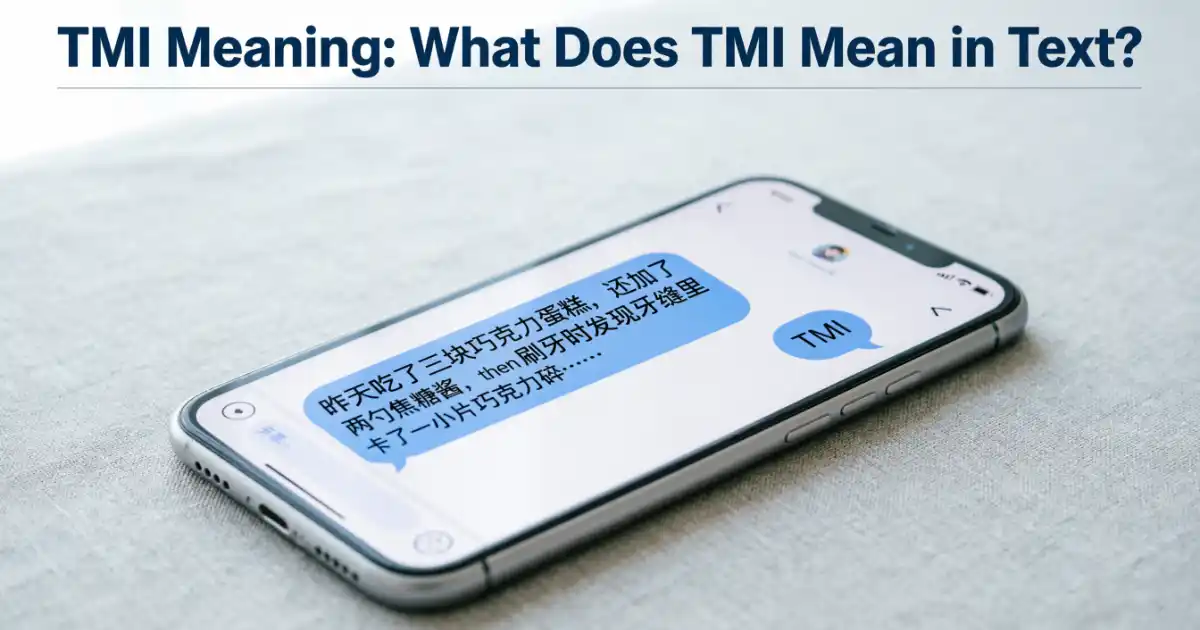
TMI means too much information. People use TMI in texts, chats, social media, and everyday conversation when someone shares more personal or unnecessary detail than the listener wanted to know.
It can be serious, playful, or teasing depending on the situation. For example, if a friend describes the private details of a medical appointment, you might reply, TMI!
Introduction
If you have seen TMI in a text, comment, group chat, or social media post, you may wonder what those three letters mean. TMI is a common internet and texting abbreviation that stands for too much information.
It usually appears when someone shares details that feel overly personal, embarrassing, graphic, awkward, or simply unnecessary for the conversation.
The meaning is usually easy to understand from context, but the tone can change. A person might use TMI as a genuine request to stop sharing details, or they might say it jokingly when a friend gives an unnecessarily detailed story. Understanding that difference can help you respond appropriately without making a casual conversation awkward.
This guide explains what TMI means, how people use it in texts and social media, examples of TMI in everyday conversations, related expressions, common mistakes, and when the abbreviation may not be appropriate.
What Does TMI Mean?
TMI stands for too much information. It is commonly used when someone gives more personal or detailed information than another person wants or needs to hear.
The abbreviation is especially common in informal communication. You may see it in text messages, group chats, comments, memes, social media conversations, and casual conversations between friends.
For example:
Friend: I barely slept because I spent half the night dealing with stomach problems.
You: TMI!
Here, TMI does not necessarily mean the information was completely inappropriate. It simply suggests that the speaker shared more personal detail than the listener wanted.
The phrase can also be used humorously. Someone might tell a friend an extremely detailed story about a date, family argument, embarrassing moment, or minor health issue. The listener may respond with TMI to playfully signal that the story has crossed the line into oversharing.
TMI Meaning at a Glance
| Term | Meaning | Tone | Example |
|---|---|---|---|
| TMI | Too much information | Casual or humorous | TMI, I did not need to know that! |
| Too much information | More detail than wanted | Direct | That is a little too much information. |
| Oversharing | Sharing excessive personal details | Neutral or critical | He was oversharing in the group chat. |
How Is TMI Used in Texting?
In texting, TMI is often a quick way to react to an overly personal message. Instead of typing the full phrase, someone can simply send TMI.
For example:
Friend: I have not washed my hair in four days.
You: TMI 😂
The meaning depends heavily on the relationship between the people involved. Close friends may use TMI jokingly without causing offense. In a professional conversation, however, using TMI could sound dismissive or disrespectful.
TMI can also appear after someone reveals an embarrassing detail:
I accidentally waved at someone who was not waving at me. TMI, but I had to tell someone.
In this example, the speaker uses TMI to acknowledge that the detail may not be especially important or necessary.
What Does TMI Mean on Social Media?
On social media, TMI has essentially the same meaning. People use it when a post, comment, or reply contains more personal information than expected.
It can describe things such as:
- Very personal relationship details
- Embarrassing stories
- Unnecessary bathroom or health details
- Extremely detailed dating stories
- Private family situations
- Personal experiences that feel inappropriate for a public audience
For example:
Someone posts a long and extremely detailed story about their recent breakup.
A commenter might simply write:
TMI!
The comment could be serious or humorous depending on the surrounding conversation.
Social media also makes TMI relevant to privacy. Something that feels harmless when shared with close friends can become uncomfortable when posted publicly. Before sharing personal information online, it is worth considering who can see it and whether the details need to be public.
TMI Examples in Everyday Conversation
The easiest way to understand TMI is to see how people use it naturally.
Example 1: Health Details
Sam: My doctor had me describe every detail of my digestion.
Alex: Okay, TMI.
The response suggests that the speaker does not want to hear additional personal details.
Example 2: Dating
Jamie: Our first date lasted five hours, and then they told me all about their ex.
Taylor: TMI about the ex.
Here, TMI signals that the dating story included more personal information than expected.
Example 3: Family Conversation
Mom: Your brother used to sleepwalk and once walked into the kitchen wearing only…
Son: Mom, TMI!
This is likely playful rather than genuinely angry.
Example 4: Group Chat
Chris: I am not coming tonight because my stomach has been acting up all day.
Jordan: We get it. TMI.
The response indicates that the group did not need the extra personal detail.
Example 5: Self Awareness
I was so nervous during the interview that I started sweating through my shirt. TMI, but it was embarrassing.
Here, the person uses TMI to acknowledge that they are sharing an unusually personal detail.
When Should You Use TMI?
TMI works best in casual conversations where people understand informal internet language.
You can use it when:
- A friend shares an overly personal detail.
- Someone gives unnecessary information about their body or health.
- A story becomes much more detailed than expected.
- A friend tells an embarrassing story.
- Someone makes a joke about oversharing.
- You want to humorously signal that you have heard enough.
The abbreviation works especially well among friends and people who regularly communicate through text or social media.
However, context matters. If someone is sharing important information about a serious problem, responding with TMI could come across as insensitive. Sometimes a person needs support rather than a joke about oversharing.
TMI vs. Oversharing
TMI and oversharing are closely related, but they are not exactly the same.
TMI is often a reaction to information someone has already shared. Oversharing describes the act of giving too many personal details.
For example:
She told us every detail about her breakup.
You could describe that as oversharing.
If you were reacting to her story, you might say:
TMI!
So, oversharing describes the behavior, while TMI often describes the reaction.
TMI vs. Too Much Information
There is no meaningful difference in basic meaning between TMI and too much information. TMI is simply the abbreviated form.
The difference is mostly about style.
TMI feels informal and conversational. It is common in texts, social media, chats, and casual speech.
Too much information can sound more direct and may work better when you want to be completely clear.
For example:
TMI! I did not need that level of detail.
or:
That is too much information for me.
Both communicate a similar idea.
Is TMI Rude?
TMI can be rude depending on how you use it. With close friends, it is often harmless teasing. With someone you do not know well, it can sound dismissive.
Consider the difference between these situations:
Friend: I have been dealing with a weird stomach problem all week.
You: TMI 😂
This could be friendly teasing.
But if a coworker tells you about a serious health issue and you respond with TMI, they might feel embarrassed or ignored.
A safer response in a serious conversation is to acknowledge the person and change the subject gently if needed.
Common Mistakes When Using TMI
Understanding the basic definition is easy, but the tone can cause confusion.
Using TMI in Serious Conversations
TMI is not always appropriate when someone is discussing a serious personal issue. A person sharing sensitive information may need empathy rather than a joke.
Assuming TMI Always Means Something Inappropriate
TMI does not necessarily refer to sexual or graphic information. It can apply to any unnecessary personal detail.
A long story about someone’s bathroom habits, family argument, or embarrassing mistake could all qualify as TMI.
Using TMI With Everyone
The abbreviation is most natural in informal settings. Avoid automatically using it with customers, supervisors, teachers, clients, or people you barely know.
Confusing TMI With a Complete Rejection of the Speaker
Saying TMI does not always mean you are angry. Among friends, it can simply mean, I did not need to know that, said in a playful way.
The relationship and tone of the conversation matter.
Conclusion
TMI means too much information, and it is commonly used in texting, social media, and casual conversation when someone shares more detail than necessary. It can be a serious request to stop, but it is often used jokingly among friends.
The most important thing to remember is that TMI depends on context and tone. A playful TMI may be perfectly normal between close friends, while the same response could seem insensitive during a serious conversation. When in doubt, consider the relationship and the type of information being shared before using it.
FAQs About TMI
What does TMI mean in texting?
TMI means too much information in texting. It usually indicates that someone has shared more personal or unnecessary detail than the other person wanted to hear.
What does TMI mean on social media?
On social media, TMI also means too much information. People may comment TMI when a post contains unusually personal, embarrassing, or unnecessary details.
Is TMI slang?
Yes. TMI is an informal abbreviation commonly associated with texting, internet communication, social media, and casual conversation.
Is TMI a bad word?
No. TMI is not a profanity or inherently offensive expression. However, saying TMI to someone can sound rude or dismissive depending on the situation.
Can TMI be used as a joke?
Yes. TMI is frequently used humorously between friends. Someone might say TMI after hearing an embarrassing or overly detailed story.
What is the difference between TMI and oversharing?
Oversharing means giving excessive personal information. TMI is often the reaction to that information. Someone can overshare, and another person can respond with TMI.
Can you say TMI in a professional setting?
It is usually better to avoid TMI in formal or professional communication. A clearer and more polite response would be to redirect the conversation or simply say that the details are not necessary.
Does TMI always refer to private information?
No. TMI can refer to any information that feels excessive or unnecessary. It does not have to be highly private or sensitive.