
Quick Answer
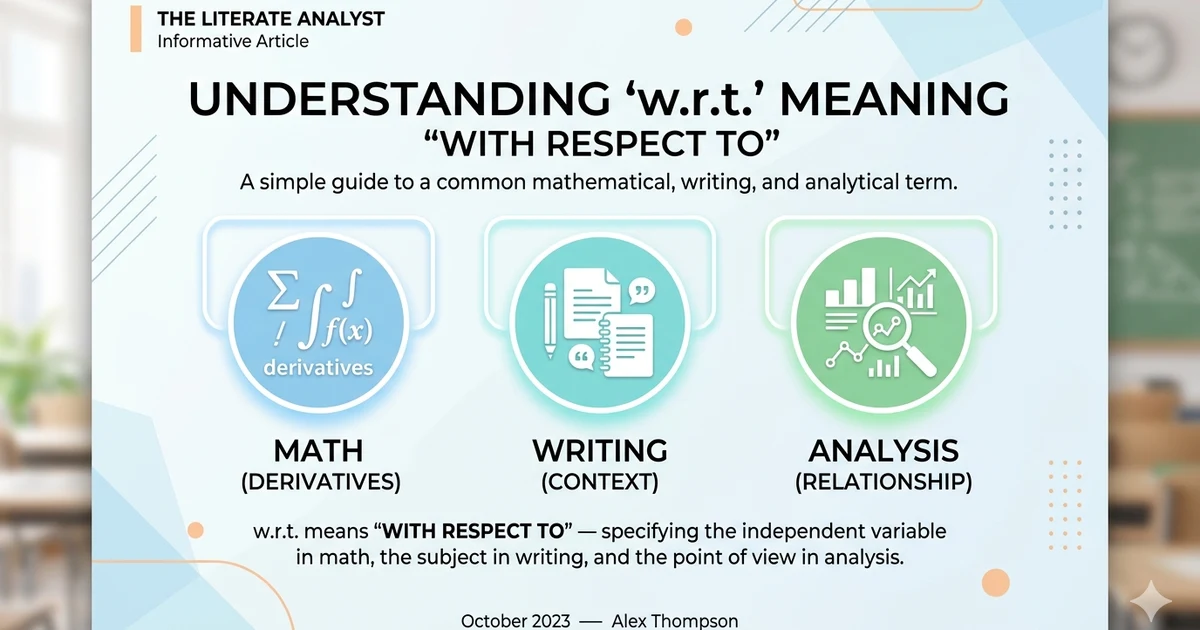
W R T stands for with respect to. It is commonly used in academic writing, mathematics, engineering, business communication, and technical discussions to show that something is being explained or analyzed in relation to a specific topic or variable. For example, a statement like change in sales w r t time means sales are being discussed in relation to time.
In simple terms, w r t helps you connect one idea to another so the reader understands the reference point clearly. It is a shorthand used to save time and make explanations more precise in structured writing.
Introduction
The abbreviation w r t appears often in academic papers, technical documents, and even online discussions, yet many people are unsure what it actually means or how to use it correctly. Because it is not commonly used in everyday conversation, readers often search for its meaning when they encounter it in math problems, engineering notes, or business reports.
Understanding w r t is important because it improves clarity in writing and helps you interpret complex explanations where relationships between variables or ideas are involved. For example, when someone says acceleration w r t time, they are explaining how acceleration changes in relation to time.
In this guide, you will learn the full meaning of w r t, how it is used in different fields, simple examples, common mistakes, and similar expressions. The goal is to make this abbreviation easy to understand so you can confidently use or interpret it in any context.
Meaning and Definition of W R T
W R T stands for with respect to. It is used to indicate that one thing is being discussed in relation to another thing. This phrase helps define a reference point, which is essential in subjects like mathematics, physics, statistics, and engineering.
In simple language, it means you are comparing or analyzing something based on a specific factor.
For example:
If someone says profit w r t time, it means profit is being studied based on changes over time. Time becomes the reference point.
In mathematics and science, w r t is especially useful because it helps describe how one variable changes compared to another. It is often used when dealing with graphs, formulas, and functions.
In business or writing, it can also mean in relation to or regarding. For example, a report may say customer behavior w r t pricing, meaning customer behavior is being analyzed based on pricing changes.
The meaning stays consistent across fields, but the context changes. That is why understanding the surrounding sentence is important when interpreting w r t.
Comparison Table for W R T Meaning
| Meaning | Where It Is Used | Simple Explanation | Example |
|---|---|---|---|
| With respect to | Math and science | Shows relationship between two variables | Speed w r t time |
| In relation to | Business writing | Explains connection between ideas | Sales w r t marketing strategy |
| Regarding | General communication | Refers to a specific topic | Policy changes w r t employees |
How W R T Is Used in Practical Situations
W R T is mainly used to make relationships between ideas more precise. It helps the reader understand exactly what is being compared or analyzed.
In mathematics, it is used in derivatives, functions, and graphs. For example, when studying how a function changes, you might see change in y w r t x, meaning y is being studied as x changes.
In physics, it is used to describe motion and forces. For instance, velocity w r t time means how velocity changes as time passes.
In business, it is used in reports and analysis. A company might evaluate performance w r t revenue or customer satisfaction w r t product quality.
In academic writing, it helps make arguments clearer by showing relationships between concepts instead of treating them separately.
Examples of W R T in Sentences
Here are simple examples to help you understand how w r t is used:
- The temperature is increasing w r t time during the experiment
- The company analyzed sales w r t seasonal demand
- We studied the growth of plants w r t sunlight exposure
- The engineer measured pressure w r t depth in water
- Student performance improved w r t study hours
Each example shows a clear relationship between two factors. One is always the reference point.
Common Use Cases of W R T
W R T appears in many fields where relationships need to be explained clearly.
In education, teachers use it to explain formulas and graphs. In science labs, it helps describe how one measurement changes compared to another. In business analysis, it helps compare performance indicators.
It is also commonly used in research papers where clarity and precision are important. Instead of writing long explanations, researchers use w r t to keep sentences short and structured.
Even in coding or data analysis, w r t is sometimes used informally in comments or documentation to explain relationships between variables.
Similar Terms and Related Phrases
W R T is not the only phrase used to show relationships. Several other expressions carry similar meanings.
| Term | Meaning | Best Use | Example |
|---|---|---|---|
| With respect to | Formal reference phrase | Academic writing | Speed with respect to time |
| In relation to | General comparison | Business writing | Sales in relation to marketing |
| Regarding | Topic reference | Everyday communication | Policy regarding employees |
| As a function of | Mathematical relationship | Science and math | Distance as a function of time |
These phrases are often interchangeable depending on context, but w r t is more common in technical and academic writing.
Common Mistakes People Make With W R T
Many readers misunderstand w r t because it is an abbreviation that is not widely used in everyday speech.
One common mistake is assuming it means something different in each context. While the examples may vary, the core meaning always stays as with respect to or in relation to.
Another mistake is overusing it in casual writing. W r t is more suitable for technical or formal contexts, not everyday conversations or informal messages.
Some people also misinterpret it when reading quickly and ignore the reference relationship. This can lead to confusion in math or science problems.
It is also important not to treat w r t as a standalone concept. It always connects two ideas, and ignoring the second part of the relationship can lead to misunderstanding.
Conclusion
W R T is a simple but powerful abbreviation that stands for with respect to. It is widely used in mathematics, science, business, and academic writing to show relationships between two ideas or variables. Understanding w r t helps you interpret technical content more easily and improves clarity when you are writing structured explanations.
The key thing to remember is that w r t always connects one concept to another. Once you understand this relationship, reading or using it becomes straightforward and practical in many fields.
FAQs About W R T
What does w r t mean in texting or chat?
It usually means with respect to or regarding, but it is not commonly used in casual texting.
Is w r t used in mathematics?
Yes, it is widely used in math to describe relationships between variables.
Can I use w r t in formal writing?
Yes, especially in technical, academic, or analytical writing.
Is w r t the same as regarding?
They are similar, but w r t is more technical and structured.
What is the full form of w r t?
The full form is with respect to.
Why do people use w r t instead of writing full words?
It saves space and makes technical writing more efficient.
Is w r t used in business reports?
Yes, it is often used to describe performance or comparisons in reports.
Does w r t always mean the same thing?
Yes, the meaning stays consistent, but the context changes how it is applied.