
Quick Answer
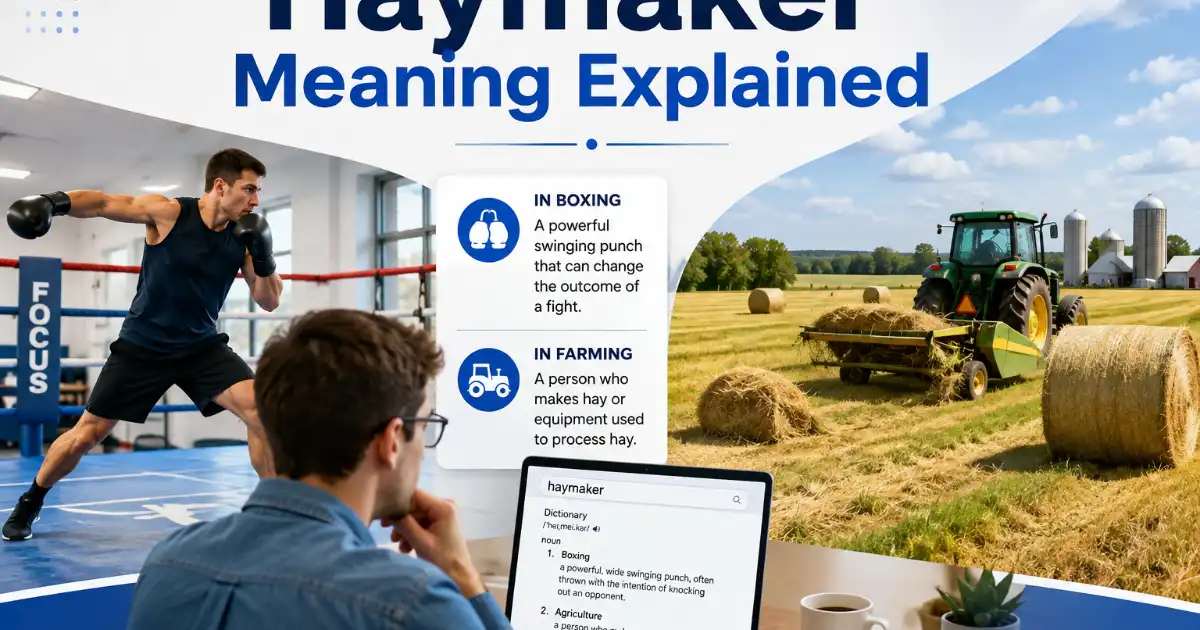
A haymaker usually means a very powerful, wide swinging punch, especially in boxing. It often describes a punch thrown with significant force and a large motion, sometimes with the intention of scoring a knockout. In other contexts, haymaker can mean a person who makes or gathers hay, or a machine used to process hay for drying. The intended meaning depends on context.
Introduction
If someone says a boxer landed a haymaker, they are usually talking about a hard, swinging punch that could dramatically change the fight. The word appears frequently in boxing coverage, sports discussions, movies, and everyday descriptions of physical confrontations. It can also appear in figurative expressions, where a person describes a major setback, criticism, decision, or action as a haymaker.
The word has a less familiar agricultural meaning as well. A haymaker can refer to a person who cuts, turns, spreads, or carries hay. It can also describe farm equipment that helps process hay so it dries more evenly.
Understanding the context makes the word much easier to interpret. This guide explains the main meanings of haymaker, how the boxing meaning differs from a hook or jab, how people use it figuratively, where the word comes from, and how to use it naturally in conversation and writing.
Haymaker Meaning and Definition
In modern American English, the most recognizable meaning of haymaker is a powerful punch. Dictionaries commonly describe it as a forceful punch, particularly one that can produce a knockout. In boxing discussions, the term often suggests a large, swinging motion rather than a compact, controlled strike.
The word also has an agricultural meaning. Traditionally, a haymaker can be a person who works with hay, including cutting and spreading it for drying. The term can also refer to machinery involved in preparing hay.
The meaning changes according to the surrounding words:
| Meaning | Where It Is Used | Simple Explanation | Example |
|---|---|---|---|
| Powerful punch | Boxing and sports | A very forceful swinging punch | The boxer landed a haymaker. |
| Hay worker | Farming | A person who makes or handles hay | The haymaker worked through the afternoon. |
| Farm machine | Agriculture | Equipment used to process hay | The farmer repaired the haymaker. |
| Decisive blow | Figurative speech | A powerful action or setback | The announcement was a haymaker for the company. |
When you encounter haymaker in a sports article, the punch meaning is usually intended. When the surrounding discussion involves fields, crops, livestock, or farm equipment, the agricultural meaning makes more sense.
What Is a Haymaker in Boxing?
In boxing, a haymaker is a powerful, often wide swinging punch. The punch may travel through a large arc and carry substantial force. Cambridge describes the boxing sense as a very powerful and sometimes uncontrolled punch.
A haymaker differs from a basic straight punch because it usually involves a larger swinging motion. That large motion can create opportunities for an opponent to see the punch coming and respond.
The term does not necessarily describe one precise technical punch in the same way that terms such as jab, cross, hook, and uppercut identify established boxing techniques. Instead, haymaker focuses more on the character of the punch: big, forceful, and often swinging.
That is why commentators might describe a dramatic punch as a haymaker even when fighters use slightly different mechanics.
Haymaker vs. Jab vs. Hook
These boxing terms describe different ideas, so confusing them can make sports commentary harder to understand.
| Term | Meaning | Typical Character | Example |
| Jab | A quick straight punch | Fast and direct | He used his jab to create distance. |
| Hook | A curved punch | Compact and rotational | She landed a clean left hook. |
| Haymaker | A very powerful swinging punch | Wide and forceful | He threw a huge haymaker. |
A jab generally prioritizes speed, timing, and distance control. A hook uses a curved path and can generate considerable power through coordinated body rotation.
A haymaker usually emphasizes the size and force of the swing. It can be effective when it lands, but a large motion can also make the punch easier to anticipate or leave the person throwing it vulnerable to a counter.
Why Is It Called a Haymaker?
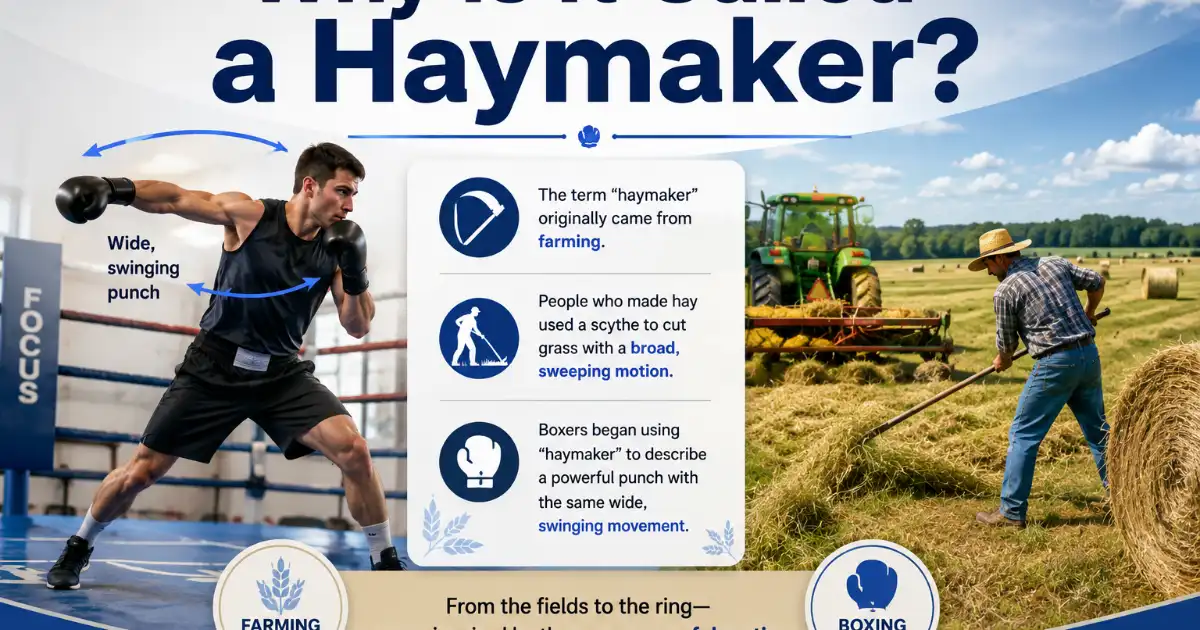
The word haymaker originally had an agricultural connection. The noun appeared centuries ago in the sense of someone involved in making hay. The boxing sense emerged in the early twentieth century. Etymological sources connect the later meaning with the broad swinging motion associated with cutting hay, particularly the movement of a scythe.
The imagery is straightforward. Someone cutting hay with a scythe makes a broad, sweeping motion. A large swinging punch can look similar in its overall movement.
The boxing meaning became established around the early 1900s. The agricultural meaning is much older.
This history explains why the same word can refer to farming and a powerful punch without the two meanings seeming completely unrelated.
How Haymaker Is Used in Sports
Sports writers use haymaker when they want to emphasize the potential impact of a powerful play, strike, or attack.
Boxing provides the clearest example:
The fighter landed a haymaker in the final round.
Here, the word describes a powerful punch.
The term can also appear in discussions of other combat sports or athletic competition. A commentator may use it loosely to describe a major strike that suddenly changes the momentum of a contest.
The word often creates a sense of drama. A haymaker suggests that one moment can alter the outcome, especially when the action involves a potential knockout or major shift in momentum.
What Does Throw a Haymaker Mean?
Throw a haymaker means to throw a powerful swinging punch.
For example:
The fighter threw a haymaker but missed.
The phrase does not necessarily mean that the punch landed. Throw describes the action of attempting the punch, while words such as land, connect, or hit indicate that it reached the intended target.
Consider the difference:
He threw a haymaker.
This means he attempted a powerful swinging punch.
He landed a haymaker.
This means the powerful punch connected.
That distinction can help when reading boxing reports or sports commentary.
What Does Land a Haymaker Mean?
To land a haymaker means to successfully connect with a powerful punch.
For example:
She landed a haymaker that changed the momentum of the fight.
The phrase often carries a strong sense of impact. It can suggest that the punch hurt the opponent, changed the course of the contest, or created a possible finishing opportunity.
However, the expression does not automatically guarantee a knockout. A haymaker can be powerful without ending the fight immediately.
Can Haymaker Be Used Figuratively?
Yes. Haymaker can also describe a powerful or decisive action outside physical fighting.
For example:
The new evidence was a haymaker in the trial.
In this sentence, haymaker means something highly impactful rather than a literal punch.
You might also see the word in discussions about business, politics, entertainment, sports, or public debate. A major announcement, criticism, policy decision, or strategic move can be described as a haymaker when it has a strong effect.
This figurative use comes from the central idea of a powerful blow that can change the situation.
Examples of Haymaker in Everyday English
The meaning becomes clearer when you see the word in different contexts.
Boxing Examples
The boxer waited for an opening before throwing a haymaker.
He avoided the first haymaker and countered quickly.
The crowd reacted when the fighter landed a huge haymaker.
These examples use the word literally.
Figurative Examples
The unexpected resignation was a haymaker for the organization.
Her final argument was a haymaker during the debate.
The surprise announcement hit the industry like a haymaker.
These examples use the word metaphorically to describe something powerful or disruptive.
Farming Examples
The haymaker worked in the field during the harvest season.
The farmer checked the haymaker before starting the equipment.
Here, the context clearly points to agriculture rather than boxing.
Haymaker as a Figurative Expression
When someone says something hit like a haymaker, they usually mean it had a sudden and powerful effect.
For example:
The news hit him like a haymaker.
The sentence does not normally mean that someone physically punched him. Instead, it compares the emotional or psychological impact of the news to the force of a powerful punch.
This figurative use works because readers already understand the basic image of a haymaker as something forceful and potentially fight changing.
Other natural examples include:
The price increase hit customers like a haymaker.
The unexpected result was a haymaker for the team.
The announcement delivered a political haymaker.
The exact meaning depends on context, but the common idea remains impact.
Haymaker in Farming and Agriculture
The agricultural meaning is less common in everyday conversation than the boxing meaning, but it remains a legitimate definition.
A haymaker can refer to a person involved in making hay. The work can include cutting, turning, spreading, and carrying hay. In American English, the term can also refer to a person or machine that cuts hay and spreads it for drying.
Farm equipment can help condition or process hay so it dries more efficiently. Collins also lists a hay conditioner as an agricultural meaning associated with the word.
If you see haymaker in an agricultural article, look at nearby words such as field, grass, livestock, harvest, bale, tractor, or drying. Those clues usually make the intended meaning obvious.
Common Situations Where You May See Haymaker
The word appears in several types of writing and conversation.
| Situation | Likely Meaning | Example |
| Boxing article | Powerful punch | He avoided the haymaker. |
| Sports commentary | Major strike or attack | That punch was a haymaker. |
| Movie dialogue | Powerful punch | He threw a haymaker. |
| Business article | Decisive action | The merger was a haymaker. |
| Political discussion | Powerful move or criticism | The proposal was a political haymaker. |
| Farming article | Hay worker or equipment | The haymaker was ready for the field. |
Context usually provides enough information to identify the correct meaning.
Is a Haymaker the Same as a Knockout Punch?
Not exactly. A haymaker describes a powerful swinging punch, while a knockout punch describes a punch that causes a knockout.
A haymaker can produce a knockout, but it does not have to. Likewise, a knockout can come from other types of punches.
For example, a precise hook or straight punch can end a fight without being described as a haymaker.
The terms therefore overlap, but they are not interchangeable in every situation.
Is a Haymaker a Good Boxing Technique?
The word haymaker often carries a suggestion of a large or uncontrolled swing rather than polished technical execution. Cambridge specifically notes that the punch can be uncontrolled.
A large swinging motion can generate substantial force, but it can also create defensive problems. A fighter who commits heavily to a wide punch may leave openings or become easier to read.
That does not mean every punch described as a haymaker represents poor boxing. Sports commentators may use the term simply because a punch looked especially powerful or dramatic.
For anyone learning boxing, technique should come from qualified coaching rather than trying to imitate a dramatic punch from a movie or fight clip.
Common Mistakes When Using Haymaker
Several misunderstandings can make the word confusing.
Assuming It Only Means a Punch
The boxing meaning is common, but it is not the only definition. Agriculture has an older and literal meaning.
Treating Every Powerful Punch as a Haymaker
A punch can be extremely powerful without being a haymaker. The term often suggests a broad or swinging motion in addition to force.
Assuming a Haymaker Always Causes a Knockout
A haymaker can knock someone out, but the word itself does not guarantee a knockout.
Confusing Haymaker With Hook
A hook follows a curved path, but a haymaker usually emphasizes a much larger, more dramatic swing. The terms can overlap in casual speech, but they are not exact technical equivalents.
Missing the Figurative Meaning
In news, business, or political writing, haymaker can describe a decisive action rather than a physical punch.
Haymaker vs. Roundhouse Punch
The terms can overlap in casual descriptions of large swinging punches, but they do not always carry exactly the same emphasis.
A haymaker usually highlights force and a big swing. Roundhouse often emphasizes the circular or sweeping motion.
Because boxing terminology can vary between commentators, trainers, and contexts, readers should pay attention to how the writer uses each term rather than assuming they are always perfect synonyms.
How to Pronounce Haymaker
Haymaker is pronounced approximately:
HAY may ker
The emphasis falls on the first syllable.
The pronunciation is straightforward because the word combines the familiar words hay and maker.
Its plural form is haymakers.
For example:
The fighters exchanged haymakers.
Haymaker Synonyms and Related Words
The best related word depends on which meaning you intend.
For the boxing meaning, useful related terms include:
- punch
- blow
- knockout punch
- heavy punch
- swinging punch
For the figurative meaning, related expressions include:
- decisive blow
- major setback
- powerful move
- major impact
For the agricultural meaning, related words include:
- hay worker
- haymaking
- hay conditioner
- farm equipment
These words are related but do not always carry exactly the same meaning.
Conclusion
The meaning of haymaker depends on context, but the word most often brings to mind a powerful swinging punch in modern sports and informal English. In boxing, it describes a forceful punch that may have enough impact to change a fight or produce a knockout. The term can also work figuratively for a decisive action, major setback, or powerful argument.
The older meaning connects haymaker to agriculture, where it can describe someone who makes or handles hay or equipment used during hay preparation.
The easiest way to understand the word is to look at the surrounding context. If the discussion involves boxing, sports, or conflict, it probably means a powerful punch. If it involves farming, fields, or hay, the agricultural meaning is more likely. In business or everyday figurative speech, it usually means something with a strong and potentially decisive impact.
Frequently Asked Questions About Haymaker
What does haymaker mean in slang?
In informal English, especially boxing language, haymaker means a very powerful swinging punch. It can also describe a major or decisive action figuratively.
What is a haymaker punch?
A haymaker punch is a powerful, usually wide swinging punch. It often suggests a large motion and significant force.
Does haymaker mean knockout?
Not necessarily. A haymaker can cause a knockout, but the word describes the type or character of the punch rather than guaranteeing its result.
Is a haymaker the same as a hook?
Not exactly. A hook is a recognized curved punch, while haymaker usually describes a particularly powerful and often wide swinging punch. The terms can overlap in casual sports language.
Why do people call it a haymaker?
The boxing meaning developed in the early twentieth century. The name is commonly connected with the broad swinging motion associated with cutting hay with a scythe.
What does it mean when someone says something was a haymaker?
It usually means that something had a powerful or decisive impact. For example, a major business decision could be described as a haymaker even though no physical punch occurred.
Can haymaker refer to farming?
Yes. A haymaker can refer to a person involved in making hay or to equipment used to process hay.
Is haymaker a formal word?
The boxing meaning is informal. The agricultural meaning is a standard dictionary definition.