

Quick Answer
Folie à deux is a French term that literally means madness shared by two. In psychiatry, it describes a rare situation in which two or more closely connected people share the same or very similar delusional belief.
Modern clinical terminology generally refers to this as shared psychosis or describes it as delusional symptoms occurring in the context of a relationship with someone who has prominent delusions.
The condition can occur between partners, family members, or other people with a very close relationship. It is not simply two people agreeing about an unusual idea. The shared belief involves a delusion, meaning a firmly held belief that does not match reality and persists despite evidence to the contrary. Professional evaluation matters because several mental health conditions can involve delusions.
Introduction
People often search for folie à deux after encountering the expression in a psychology article, medical discussion, movie, television show, book, or news story. The French phrase sounds unusual in everyday English, so its meaning can seem unclear at first. It has a specific historical connection to psychiatry, where clinicians used it to describe delusional beliefs shared between closely connected people.
The term remains widely recognized, but modern psychiatric language has changed. In current clinical discussions, professionals often use terms such as shared psychosis rather than treating folie à deux as a separate diagnosis. The DSM 5 TR places the phenomenon under Other Specified Schizophrenia Spectrum and Other Psychotic Disorders.
This guide explains what folie à deux means, how shared delusions differ from ordinary agreement, why close relationships can matter, what examples may look like, how clinicians approach the situation, and when professional help becomes important. It also explains related expressions so readers can understand the terminology without confusing a psychiatric concept with casual expressions about people influencing one another.
| Term | Meaning | Best Context | Simple Example |
|---|---|---|---|
| Folie à deux | Historical term for shared delusions | Psychiatry and general discussion | Two closely connected people share the same fixed false belief |
| Shared psychosis | Modern clinical term often used for the phenomenon | Mental health | A delusional belief becomes shared within a close relationship |
| Delusion | A firmly held false belief that persists despite contrary evidence | Psychiatry | Believing someone is secretly monitoring you despite evidence otherwise |
| Psychosis | A broader state involving loss of contact with reality | Psychiatry | Delusions, hallucinations, or disorganized thinking |
What Does Folie à Deux Mean?
Folie à deux literally translates from French as madness of two or madness shared by two. Psychiatry adopted the phrase to describe a situation in which a delusional belief becomes shared by people who have a close relationship. The term folie à deux was introduced by French psychiatrists Charles Lasègue and Jules Falret in the 19th century.
The central feature involves a shared delusion. One person may have a significant psychotic disorder involving delusions, while another closely connected person adopts the same or a closely related belief. In some situations, more than two people can become involved, so the phenomenon is not literally restricted to two people.
For example, imagine two family members who spend most of their time together and become socially isolated. One develops a firm belief that a particular group is secretly watching the family. The other person gradually adopts the same belief and interprets ordinary events as evidence supporting it.
That situation differs from simply sharing an opinion. People can agree about politics, religion, family concerns, or unusual ideas without experiencing psychosis. A delusion involves a much more serious disturbance in the person’s interpretation of reality.
How Is Folie à Deux Different From Ordinary Agreement?
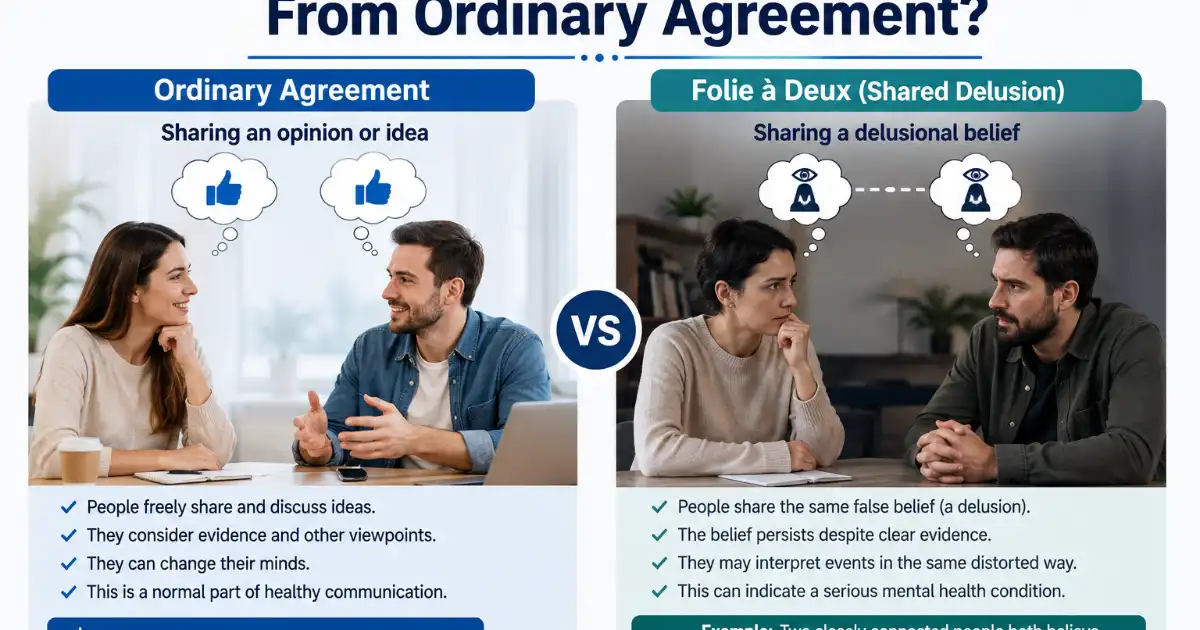
The most important distinction involves the nature of the belief.
Two friends might strongly believe that a workplace decision is unfair. They could discuss it repeatedly and eventually reach the same conclusion. That does not mean they have folie à deux.
A shared psychotic belief involves a delusional idea, not merely an unpopular opinion. The belief remains firmly fixed even when reliable evidence challenges it.
Close relationships can also make beliefs more influential. Spending extensive time together, sharing the same environment, becoming socially isolated, and relying heavily on one another can create circumstances in which one person’s unusual beliefs strongly influence another person.
What Is a Shared Delusion?
A delusion is a firmly held belief that does not correspond with reality. The person generally continues to believe it despite evidence that contradicts the belief.
In shared psychosis, the unusual belief becomes shared between people who have a close relationship. The belief may involve persecution, surveillance, threats, special powers, relationships, health concerns, or other themes.
The specific content can vary considerably. The important feature is not whether the belief sounds strange to someone else. Clinicians look at the person’s overall mental state, evidence surrounding the belief, persistence of the belief, and other symptoms.
A person who disagrees with friends or family does not automatically have a delusion. Likewise, someone who accepts another person’s inaccurate statement does not automatically have shared psychosis.
Why Can Two People Share the Same Delusional Belief?
Researchers and clinicians have considered several factors that may contribute to shared psychotic experiences. The relationship itself can play an important role, especially when people spend extensive time together or become socially isolated.
A relationship may become particularly influential when one person has a prominent psychotic disorder and the other person depends heavily on that individual for information, companionship, or decision making.
Other individual factors may also matter. Mental health history, vulnerability to psychosis, stress, social circumstances, and the structure of the relationship can influence how symptoms develop.
However, there is no simple formula that predicts when folie à deux will occur. Researchers have also questioned some older theories about which types of people are more likely to become the primary or secondary person in these situations.
What Does Folie à Deux Look Like in Real Life?
The presentation can vary, but the shared belief often becomes part of the pair’s everyday life.
For example, two closely connected relatives might both become convinced that an ordinary neighborhood event represents a coordinated attempt to harm them. They may interpret unrelated events as connected evidence and discuss the belief repeatedly.
Another example could involve partners who both become convinced that an outside person is secretly communicating with them through ordinary objects or routine events. Their shared interpretation may affect where they go, whom they trust, and how they respond to everyday situations.
These examples illustrate the concept without suggesting that every unusual belief indicates a psychiatric disorder. Only a qualified clinician can evaluate an actual situation.
Who Can Experience Folie à Deux?
Shared psychosis can occur among different types of close relationships. Historically, cases have involved couples, siblings, parents and children, and other family members. The condition can also involve groups larger than two people.
The important factor is the closeness and influence within the relationship rather than a particular family structure.
Some cases involve substantial social isolation. When people have little contact with outside perspectives, there may be fewer opportunities for their shared interpretation of events to be challenged. Clinical literature has described shared psychosis occurring among closely connected and socially isolated people.
Is Folie à Deux a Current Psychiatric Diagnosis?
Not as a separate diagnosis in the DSM 5 TR.
The term remains useful historically and descriptively, but the modern DSM 5 TR classification places shared psychotic symptoms under Other Specified Schizophrenia Spectrum and Other Psychotic Disorders. Merck Manual describes the modern concept as delusional symptoms occurring in the context of a relationship with an individual who has prominent delusions.
This distinction matters because readers may encounter different terminology depending on the source.
Older articles may use:
- Folie à deux
- Shared psychotic disorder
- Shared paranoid disorder
- Induced psychotic disorder
- Induced delusional disorder
Modern clinical language may use different diagnostic terminology depending on the classification system and the individual circumstances.
What Are the Historical Types of Folie à Deux?
Older psychiatric literature described several forms of shared psychotic phenomena. These categories help explain the history of the concept, although they should not be treated as a simple modern diagnostic checklist.
One historically described form involved a person with psychosis influencing another person who later adopted the delusion. Another involved two people developing psychotic beliefs around the same time. Other historical categories described situations in which the secondary person continued to experience the belief after separation.
These older classifications demonstrate why modern clinicians tend to focus on the actual symptoms and relationship rather than relying only on historical labels.
How Do Clinicians Evaluate Shared Psychosis?
A clinician does not diagnose folie à deux simply because two people tell the same story.
The evaluation usually requires understanding both individuals separately and examining the relationship between them. Clinicians may consider:
- The specific beliefs each person holds
- Whether the beliefs qualify as delusions
- Each person’s psychiatric history
- Other symptoms of psychosis
- Medical conditions that could affect mental functioning
- Substance or medication factors
- The level of social isolation
- The nature of the relationship
- Whether the beliefs change when the individuals are separated
Separating the individuals can sometimes provide useful diagnostic information. In some cases, the secondary person’s delusional beliefs lessen or disappear after separation from the person with the primary psychotic disorder.
That does not mean separation alone solves every case. A person may continue experiencing symptoms and may need independent psychiatric care.
How Is Folie à Deux Treated?
Treatment depends on the symptoms and the needs of each person.
Clinicians may recommend separating the individuals temporarily or reducing the relationship’s influence when that is clinically appropriate. Psychotherapy can help affected individuals understand their beliefs, experiences, relationships, and coping patterns. The person with an underlying psychotic disorder may also require medication such as an antipsychotic, depending on the clinical assessment.
Family or relationship focused treatment can also become important because the interaction between people may contribute to maintaining the shared belief.
Treatment should always come from qualified mental health professionals. Friends or relatives should not attempt to diagnose someone or abruptly confront a person about a delusion in a way that could increase fear or conflict.
What Should Someone Do If a Loved One Seems to Share a Delusion?
If a loved one appears to have a serious break from reality, focus first on safety and professional support.
Avoid mocking the person’s belief or deliberately escalating an argument. A calm response can acknowledge the person’s distress without confirming the delusion. For example, saying that the situation sounds frightening can communicate empathy without agreeing that the feared event is actually happening.
Encourage an evaluation by a qualified mental health professional when possible.
If someone appears likely to hurt themselves or another person, cannot care for basic needs, or faces an immediate safety crisis, seek emergency or crisis support rather than trying to manage the situation alone.
Folie à Deux vs. Shared Interests and Beliefs
It is easy to misuse the phrase folie à deux when two people simply influence each other.
Two people can develop the same hobby, political opinion, conspiracy interest, business idea, or lifestyle preference without having shared psychosis.
The distinction becomes clearer when comparing the concepts:
| Situation | What It Means | Example |
| Shared interest | Two people enjoy the same activity | Partners become interested in hiking |
| Shared opinion | Two people reach the same conclusion | Coworkers think a policy is ineffective |
| Social influence | One person influences another’s behavior | A friend encourages someone to exercise |
| Shared delusion | Two people share a fixed false belief | Two closely connected people become convinced they are being secretly monitored without evidence |
The last situation requires clinical evaluation rather than casual labeling.
Common Mistakes About Folie à Deux
One common mistake involves assuming that every shared unusual belief represents folie à deux. Agreement alone does not establish a psychiatric disorder.
Another mistake involves treating the phrase as a synonym for close friendship or intense emotional attachment. The psychiatric concept specifically concerns shared delusional beliefs.
It is also inaccurate to assume that the condition always involves exactly two people. Shared psychotic phenomena can involve larger groups, although folie à deux historically refers to two people.
A further mistake involves assuming that one person is always deliberately manipulating the other. The relationship can involve complex psychological and social dynamics, and clinicians need to evaluate each situation individually.
Finally, older descriptions should not automatically be treated as current diagnostic rules. Psychiatric terminology has changed over time, and modern classification systems use different categories.
Is Folie à Deux the Same as Schizophrenia?
No. Folie à deux and schizophrenia are not interchangeable terms.
Schizophrenia is a specific psychiatric disorder involving symptoms that can include delusions, hallucinations, disorganized thinking, and other changes in functioning. Shared psychosis describes a relationship context in which delusional beliefs become shared.
A person involved in shared psychosis may have an underlying psychotic disorder, while another person may develop related delusional symptoms. The clinical picture determines the appropriate diagnosis.
Because several conditions can produce psychotic symptoms, people should not try to determine a diagnosis from an internet article alone.
Is Folie à Deux Real?
Yes. The phenomenon has been documented in psychiatric literature for more than a century, although clinicians now use different terminology and classification systems. Medical references describe shared psychosis as rare and recognize the sharing of delusional beliefs among people in close relationships.
Its rarity also means that popular portrayals may exaggerate or simplify the condition. A dramatic fictional story should not be treated as a clinical description.
Conclusion
Folie à deux is a historical psychiatric term for shared delusional beliefs between closely connected people. Modern clinicians more often use the term shared psychosis and place the phenomenon within broader schizophrenia spectrum and other psychotic disorder classifications.
The key point is that folie à deux does not simply mean two people agreeing, influencing each other, or sharing an unusual opinion. The concept involves delusional beliefs and a significant relationship between the people involved. Because psychotic symptoms can have many causes and can affect safety and daily functioning, suspected cases deserve professional evaluation rather than an internet diagnosis.
Frequently Asked Questions About Folie à Deux
What does folie à deux mean in English?
Folie à deux is a French phrase meaning madness shared by two. In psychiatry, it historically described delusional beliefs shared by two closely connected people.
Is folie à deux still a diagnosis?
The term remains widely used descriptively, but it is not a separate diagnosis in the DSM 5 TR. Modern psychiatric classification places the phenomenon within Other Specified Schizophrenia Spectrum and Other Psychotic Disorders.
Can folie à deux involve more than two people?
Yes. Although the phrase refers to two people, shared psychotic beliefs can involve larger groups. Historical and clinical literature uses additional terminology for some of these situations.
Can family members experience shared psychosis?
Yes. Close family relationships have frequently appeared in descriptions of shared psychosis. The condition can involve partners, siblings, parents and children, or other closely connected people.
Does separation always cure folie à deux?
No. Separation can sometimes reduce or eliminate delusional beliefs in a secondary person, but symptoms may persist and may require independent treatment.
Is folie à deux the same as two people believing a conspiracy theory?
Not necessarily. Sharing a controversial or unusual belief does not automatically mean either person has a delusion. A clinical assessment must consider the nature, persistence, evidence, and broader mental state of the individuals involved.
Can folie à deux be treated?
Yes. Treatment depends on the individual circumstances and can involve psychotherapy, addressing the relationship dynamics, separation when clinically appropriate, and medication for people who have an underlying psychotic disorder.
Should someone diagnose a family member with folie à deux?
No. A family member may notice concerning behavior, but diagnosis requires professional assessment. If a person appears disconnected from reality or presents an immediate safety concern, qualified mental health or emergency services should be contacted.