
Quick Answer
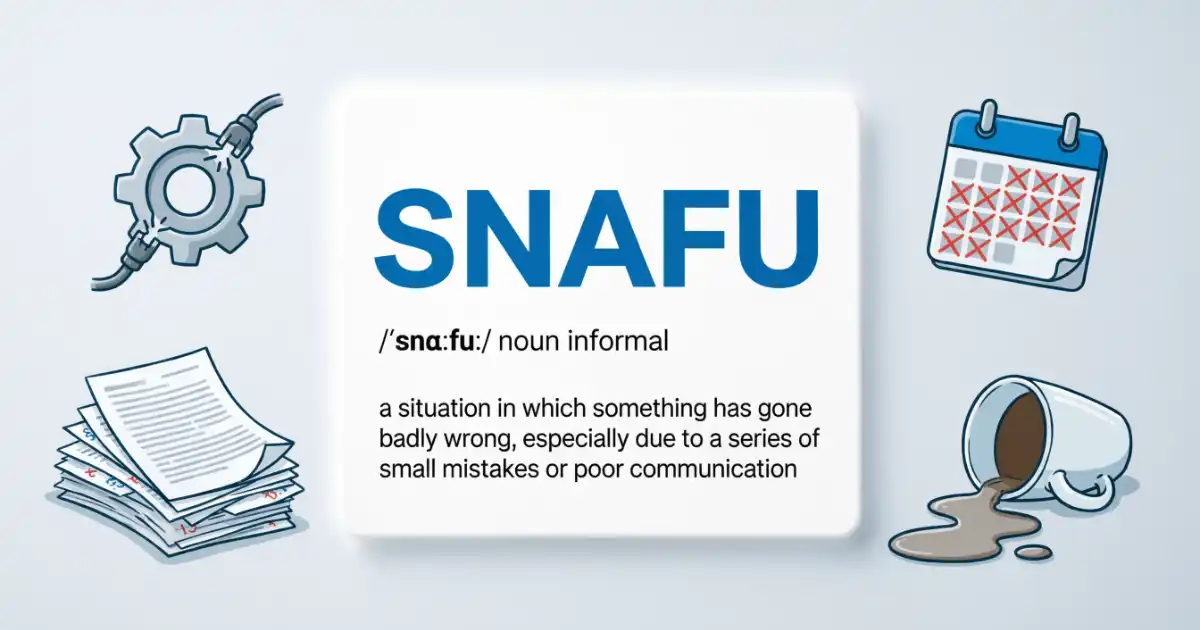
SNAFU is an informal term meaning that a situation has gone badly wrong or that things are not happening as planned. It comes from a World War II military acronym traditionally expanded as Situation Normal, All F*ed Up**, although a sanitized version, Situation Normal, All Fouled Up, is also widely used. Today, people usually use snafu as a noun to describe a mistake, mix up, technical problem, or generally chaotic situation.
Introduction
If you have seen someone describe a scheduling problem, computer error, travel delay, or workplace mistake as a snafu, the word may seem unusual at first. It sounds like an acronym, but modern English speakers often use it like an ordinary noun. For example, someone might say, “There was a snafu with my flight,” meaning that something went wrong with the travel arrangements.
The term has an interesting history because it began as military slang during World War II. Its original expansion used profanity, while later versions softened the final word to fouled for more acceptable public use. Over time, the word moved beyond military language and became a general way to describe an unexpected problem or situation where things have gone wrong.
In this guide, you will learn what SNAFU means, where it came from, how people use snafu in everyday English, how to pronounce it, and how it differs from related words such as mess, mix up, glitch, and fiasco.
What Does SNAFU Mean?
SNAFU means a situation in which things have gone wrong or are not happening as planned.
Today, snafu is usually used as an informal noun. It can describe anything from a small administrative mistake to a much bigger series of problems.
For example:
The hotel had a booking snafu, so our room was not ready.
Here, snafu means a problem or mistake involving the reservation.
Another example is:
There was a snafu with the online payment system.
This means the payment process experienced a problem that disrupted what was supposed to happen.
The word is particularly useful when you want to describe a messy situation without explaining every individual mistake. Cambridge Dictionary defines snafu as a situation in which nothing has happened as planned.
What does SNAFU stand for?
The original military expansion is commonly given as:
Situation Normal, All F*ed Up**
A sanitized version is:
Situation Normal, All Fouled Up
The second version avoids profanity and is sometimes used when explaining the acronym in a more formal or family friendly context. Historical accounts of the term also connect it with World War II military slang.
| Form | Meaning | Context | Example |
|---|---|---|---|
| SNAFU | Situation Normal, All F***ed Up | Original military slang | The operation became a SNAFU |
| SNAFU | Situation Normal, All Fouled Up | Sanitized version | The project is a complete SNAFU |
| snafu | A situation that went wrong | Modern informal English | We had a booking snafu |
Where Did the Word SNAFU Come From?
SNAFU originated as U.S. military slang during World War II. The expression captured a sarcastic idea: even when confusion and mistakes were happening, that could be treated as the normal state of affairs.
The acronym became especially associated with wartime military culture. Its popularity also helped the word move into broader American English.
The term became even more recognizable through Private Snafu, a fictional U.S. Army cartoon character created during World War II. The U.S. War Department commissioned a series of animated shorts beginning in 1943 to entertain and educate military personnel.
The character repeatedly made mistakes and got himself into trouble, making his name a fitting reference to the acronym.
The Private Snafu films covered practical military topics, including security, health, discipline, and the consequences of careless behavior. The series eventually included 27 short films made between 1943 and 1945.
Over the decades, snafu lost much of its specifically military association. People began using it in workplaces, technology, travel, business, sports, and everyday conversation.
How Is SNAFU Used Today?
Today, snafu usually means an unexpected problem, mistake, or breakdown in plans. It can refer to something minor or something that creates significant disruption.
The word often has a slightly humorous or understated tone. Someone might call a major scheduling problem a snafu rather than simply saying everything went wrong.
For example:
We had a small snafu with the meeting schedule.
The website experienced a payment snafu this morning.
A shipping snafu delayed the order by two days.
There was a snafu at the airport, and several passengers had to rebook their flights.
The word can be used in professional settings, but it is still informal. It works better in an everyday conversation or casual workplace message than in highly formal writing.
SNAFU Examples in Everyday Conversation
Understanding the word becomes easier when you see how naturally it fits into different situations.
Workplace example
We had a snafu with the spreadsheet, but the corrected version is ready.
This describes a mistake or problem without making the situation sound overly dramatic.
Travel example
There was a flight booking snafu, so I had to call the airline.
Here, snafu refers to a problem with the reservation.
Technology example
A software snafu caused the app to stop working.
This means a technical mistake or problem caused an unexpected failure.
School example
There was a scheduling snafu, and two classes were assigned to the same room.
The word describes an administrative mix up.
Online shopping example
The store had a shipping snafu and sent my package to the wrong address.
Here, the term refers to a fulfillment or delivery mistake.
Family or daily life example
We had a little snafu with the dinner reservation.
This sounds casual and slightly humorous.
Is SNAFU a Negative Word?
Yes, snafu generally refers to something negative because it describes a problem or situation that has gone wrong.
However, the tone is often lighter than words such as disaster or catastrophe. A person may use snafu to acknowledge a mistake without making it sound extremely serious.
For example:
There was a snafu with the reservation.
sounds relatively calm.
By comparison:
The reservation was a complete disaster.
sounds much stronger.
The exact tone depends on the situation and the speaker. A snafu can describe a minor inconvenience or a much more serious failure.
SNAFU vs. Similar Words
Several English words can describe problems, but they do not always have exactly the same tone or meaning.
| Term | Meaning | Best Use | Example |
|---|---|---|---|
| Snafu | A situation that has gone wrong | Informal problems and mix ups | There was a scheduling snafu |
| Glitch | A small technical or temporary problem | Technology and systems | The app had a glitch |
| Mix up | A mistake involving people, information, or arrangements | Everyday mistakes | There was a mix up with the orders |
| Fiasco | A complete or embarrassing failure | Serious or highly unsuccessful situations | The event became a fiasco |
| Mess | A disorganized or difficult situation | General conversation | The whole situation is a mess |
| Blunder | A significant mistake | Individual errors | It was a costly blunder |
SNAFU vs. glitch
A glitch usually refers to a small problem, especially with technology or a system.
A snafu is broader. It can involve technology, travel, scheduling, communication, administration, or almost any other situation.
SNAFU vs. fiasco
A fiasco usually suggests a major or embarrassing failure.
A snafu does not necessarily mean the outcome was disastrous. It can describe something as simple as a booking error or scheduling mistake.
SNAFU vs. mix up
A mix up often describes a specific mistake, such as confusing two orders or dates.
A snafu can describe the entire problematic situation surrounding that mistake.
Is SNAFU Still Considered Slang?
SNAFU began as military slang, but modern dictionaries treat snafu as an informal English noun.
The word is now much broader than its original military use. People can use it in conversations about technology, business, travel, sports, events, and everyday problems.
It is still not the best choice for every formal document. In a legal filing, academic paper, or official report, words such as error, failure, problem, or administrative issue may communicate the situation more precisely.
How Do You Pronounce SNAFU?
SNAFU is normally pronounced:
sna foo
The first part sounds like sna, followed by foo.
In ordinary modern use, people generally pronounce it as one word rather than saying each letter separately.
Common Mistakes When Using SNAFU
Assuming it only refers to military problems
The word has military origins, but modern usage is much broader. You can use snafu for ordinary problems involving travel, work, technology, scheduling, or services.
Treating it as completely formal language
Snafu is informal. It can appear in casual professional communication, but more formal writing may call for a clearer term such as error, problem, or administrative mistake.
Thinking every snafu is a disaster
A snafu simply means something went wrong. The problem can be minor or serious depending on context.
Forgetting its original profanity
The original expansion contains profanity. The sanitized version uses fouled instead. If you are writing for a formal or family friendly audience, you can explain the sanitized version instead.
Using SNAFU as though it always means one specific mistake
The word can refer to an individual problem or a broader situation where several things have gone wrong. Context determines the scope.
Conclusion
SNAFU means a situation in which things have gone wrong or failed to happen as planned. The term originated as World War II military slang and later became part of everyday informal English. Today, you may see snafu used for everything from a scheduling mistake and software problem to a travel or shipping issue.
The main thing to remember is that snafu usually describes a problem or mix up, often with a slightly humorous or understated tone. If you need a more formal expression, terms such as problem, error, failure, or administrative issue may be more appropriate.Frequently Asked Questions About SNAFU
What does SNAFU mean in slang?
In slang and informal English, SNAFU describes a situation where things have gone wrong or failed to happen as planned. It originated as military slang and is now used more broadly.
What does SNAFU stand for?
SNAFU is commonly expanded as Situation Normal, All F*ed Up**. A sanitized version is Situation Normal, All Fouled Up.
Is SNAFU a bad word?
The modern word snafu is not normally treated as profanity. However, its original acronym contains profanity, which is why the sanitized expansion using fouled is often given in public explanations.
Is SNAFU still used today?
Yes. People still use snafu to describe mistakes, technical problems, scheduling issues, travel disruptions, and other situations that do not go according to plan.
Is SNAFU military slang?
Yes. The expression originated in U.S. military slang during World War II before becoming part of broader informal English.
What is an example of SNAFU?
A simple example is: There was a snafu with the hotel reservation, so we had to find another room. The word refers to the booking problem.
Is SNAFU an acronym or a word?
It began as an acronym, but snafu is now commonly used as a regular noun in English. It can also be written in lowercase when used as an ordinary word.
What is the difference between SNAFU and FUBAR?
Both terms originated in military slang and contain profanity in their original expansions. SNAFU describes a situation that has gone wrong, while FUBAR generally describes something as seriously broken or beyond repair. The two terms overlap, but their tone and severity can differ.